Ukraine’s ‘Future Force’ Interview Series: Unmanned Ground Vehicles for Ukraine’s Defense (part 2)

Clock Icon 3 min read
May 11, 2026

Contents

On May 11, 2026, Maksym Chebotarov, U.S.–Ukraine Partnership Program Coordinator at the Transatlantic Dialogue Center, held an interview with Igor Shmyrov, Head of the UGV Division of the Brave1

Brave1 is a Government of Ukraine–backed defence technology platform designed to speed up the development, testing, and deployment of innovations that strengthen Ukraine’s battlefield capabilities. It serves as a single coordination point that helps connect defence tech developers with the needs of the security and defence sector and supports solutions from early-stage ideas to real-world use.

Context

Ukraine’s high-intensity war has expanded the "strike environment" far beyond the immediate frontline. Drones enable persistent surveillance and rapid precision strikes, creating a de facto "kill zone" where routine movement – rotations, resupply runs, and evacuations – can be as dangerous as direct combat.

Contents

In this environment, unmanned ground vehicles (UGVs) are shifting from a niche capability to an increasingly routine tool. Rather than serving as futuristic add-on, they are being used for practical battlefield tasks: sustaining positions, reducing exposure on the most dangerous routes, and evacuating wounded personnel when sending people is no longer feasible.
Key takeaways

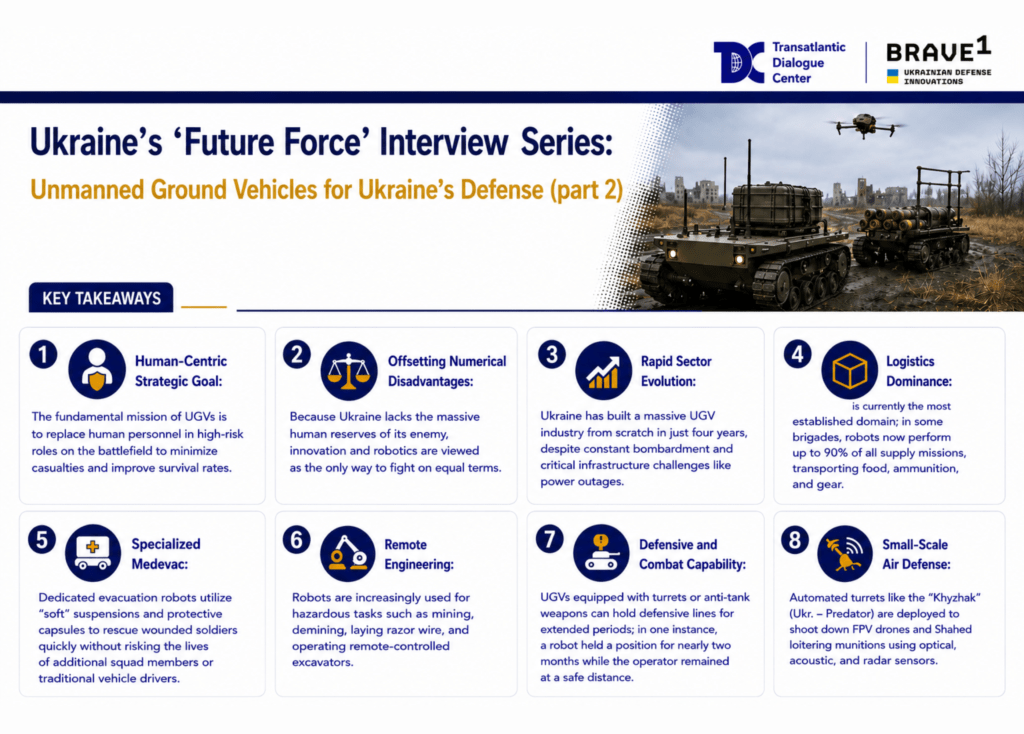
  • Human-Centric Strategic Goal: The fundamental mission of UGVs is to replace human personnel in high-risk roles on the battlefield to minimize casualties and improve survival rates.
  • Offsetting Numerical Disadvantages: Because Ukraine lacks the massive human reserves of its enemy, innovation and robotics are viewed as the only way to fight on equal terms.
  • Rapid Sector Evolution: Ukraine has built a massive UGV industry from scratch in just four years, despite constant bombardment and critical infrastructure challenges like power outages.
  • Logistics Dominance: Logistics is currently the most established domain; in some brigades, robots now perform up to 90% of all supply missions, transporting food, ammunition, and gear.
  • Specialized Medevac: Dedicated evacuation robots utilize "soft" suspensions and protective capsules to rescue wounded soldiers quickly without risking the lives of additional squad members or traditional vehicle drivers.
  • Remote Engineering: Robots are increasingly used for hazardous tasks such as mining, demining, laying razor wire, and operating remote-controlled excavators.
  • Defensive and Combat Capability: UGVs equipped with turrets or anti-tank weapons can hold defensive lines for extended periods; in one instance, a robot held a position for nearly two months while the operator remained at a safe distance.
  • Small-Scale Air Defense: Automated turrets like the "Khyzhak" (Ukr. – Predator) are deployed to shoot down FPV drones and Shahed loitering munitions using optical, acoustic, and radar sensors.
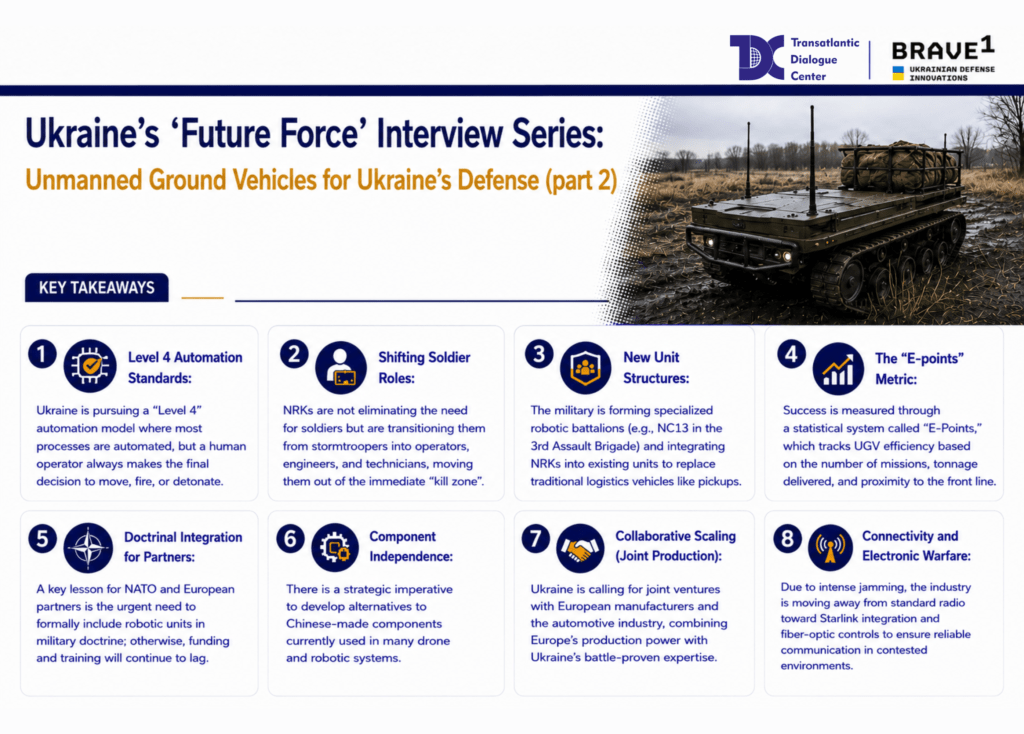
  • Level 4 Automation Standards: Ukraine is pursuing a "Level 4" automation model where most processes are automated, but a human operator always makes the final decision to move, fire, or detonate.
  • Shifting Soldier Roles: NRKs are not eliminating the need for soldiers but are transitioning them from stormtroopers into operators, engineers, and technicians, moving them out of the immediate "kill zone".
  • New Unit Structures: The military is forming specialized robotic battalions (e.g., NC13 in the 3rd Assault Brigade) and integrating NRKs into existing units to replace traditional logistics vehicles like pickups.
  • The "E-points" Metric: Success is measured through a statistical system called "E-Points," which tracks UGV efficiency based on the number of missions, tonnage delivered, and proximity to the front line.
  • Doctrinal Integration for Partners: A key lesson for NATO and European partners is the urgent need to formally include robotic units in military doctrine; otherwise, funding and training will continue to lag.
  • Component Independence: There is a strategic imperative to develop alternatives to Chinese-made components currently used in many drone and robotic systems.
  • Collaborative Scaling (Joint Production): Ukraine is calling for joint ventures with European manufacturers and the automotive industry, combining Europe’s production power with Ukraine’s battle-proven expertise.
  • Connectivity and Electronic Warfare: Due to intense jamming, the industry is moving away from standard radio toward Starlink integration and fiber-optic controls to ensure reliable communication in contested environments.

The views, thoughts, and opinions expressed in the interview and published on this site belong solely to the speakers and do not necessarily reflect the views of the Transatlantic Dialogue Center, its committees, or affiliated organizations. The key takeaways are provided to inform discussion and do not represent official policy positions.