
 11 min read
The report is produced by Transatlantic Dialogue Center with the support of the Askold and Dir Fund as a part of the Strong Civil Society of Ukraine – a Driver towards Reforms and Democracy project, implemented by ISAR Ednannia, funded by Norway and Sweden. The contents of this publication are the sole responsibility of Transatlantic Dialogue Center and can in no way be taken to reflect the views of the Government of Norway, the Government of Sweden and ISAR Ednannia.
Peer reviewers
Dmytro Lebedyev, Senior Expert, IT & Telecom Sector at Better Regulation Delivery Office (BRDO)
Veronika Movchan, Academic Director, Head of the Center for Economic Studies at the Institute for Economic Research and Policy Consulting
Anton Antonenko, Vice President of the DiXi Group
Vitalii Dankevych, Doctor of Economics, Professor, Dean of the Faculty of Law, Public Administration and National Security at Polissia National University; Senior Associate at CSIS and fellow at CEPA.
Ivan Golturenko, Geologist, Specialist at GPR Investigation
Yuliia Shaipova, Affiliated Expert with the Foreign Policy Council “Ukrainian Prism”
Hennadiy Maksak, Executive Director of the Foreign Policy Council “Ukrainian Prism”
Oleksandra Azarkhina, Chief Specialist in the Department for the Implementation of Innovation Management and Development, Command of Close Air Defence Forces at the Air Force Command of the Ukrainian Armed Forces
The authors are also grateful to Valentyn Badrak, Pavel Bilek, Mihai Sebastian Chihaia, Kaspars Germanis, Gustav Gressel, Iryna Kosse, Juraj Majcin, Iana Okhrimenko, Garry Poluschkin, and Maria Repko for their valuable comments and suggestions.
Despite its reputation for digital innovation, Ukraine’s progress remains heavily dependent on government digital services, with weak AI adoption and limited digital transformation among businesses.
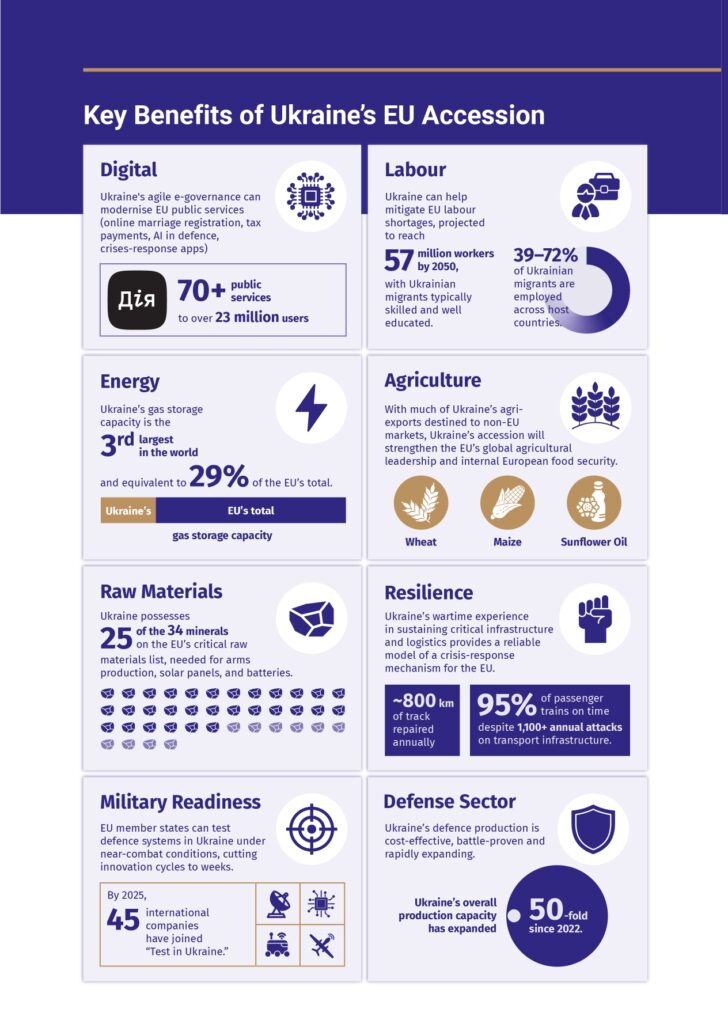
The EU already bears fiscal costs supporting Ukrainians living in the EU, while Ukraine’s accession could lead to larger labour migration flows and increased competition for certain jobs.
Ukraine’s ability to contribute to EU energy security is constrained by war-related damage to its energy infrastructure and limited renewable energy capacity.
Ukraine’s accession would offer limited benefits while placing significant pressure on the EU’s agricultural budget, particularly through high expected CAP payments (€7–10 billion per year), as well as on market stability.
Ukraine’s accession will not translate into concrete EU gains in critical raw materials and supply‑chain security, while the U.S. gets most of the benefits from Ukraine’s critical raw materials.
Ukraine’s resilience model, largely shaped by wartime conditions, may not align with established EU practices, as it is perceived as a crisis-driven response rather than a long-term institutional capacity suited to the Union’s context.
Military cooperation with Ukraine remains largely ad hoc and transactional, without a structured pathway to embed Ukraine’s combat-tested expertise into EU interoperability, capability development, and training standards.
Ukraine’s strength lies mainly in rapid assembly and tactical adaptation, rather than in “breakthrough” platform innovation; it is not compatible with NATO/EU standards, which limits its suitability for long-term, large-scale procurement.