The EU’s Next Chapter: Economic, Political and Security Gains from Ukraine’s Accession

Clock Icon 11 min de lectura
By Marianna Fakhurdinova, Viktoriia Valinkevych, Yehor Tkachuk, Stepan Rusyn, Diana Maslianchuk, Bohdan Veselovskyi, Kateryna Khimich, Sofiia Demchuk, Yana Balanchuk
junio 19, 2026

Contenido

23 MB


The report is produced by Transatlantic Dialogue Center with the support of the Askold and Dir Fund as a part of the Strong Civil Society of Ukraine – a Driver towards Reforms and Democracy project, implemented by ISAR Ednannia, funded by Norway and Sweden. The contents of this publication are the sole responsibility of Transatlantic Dialogue Center and can in no way be taken to reflect the views of the Government of Norway, the Government of Sweden and ISAR Ednannia.


Peer reviewers

Dmytro Lebedyev, Senior Expert, IT & Telecom Sector at Better Regulation Delivery Office (BRDO)

Veronika Movchan, Academic Director, Head of the Center for Economic Studies at the Institute for Economic Research and Policy Consulting

Anton Antonenko, Vice President of the DiXi Group

Vitalii Dankevych, Doctor of Economics, Professor, Dean of the Faculty of Law, Public Administration and National Security at Polissia National University; Senior Associate at CSIS and fellow at CEPA.

Ivan Golturenko, Geologist, Specialist at GPR Investigation

Yuliia Shaipova, Affiliated Expert with the Foreign Policy Council “Ukrainian Prism”

Hennadiy Maksak, Executive Director of the Foreign Policy Council “Ukrainian Prism” 

Oleksandra Azarkhina, Chief Specialist in the Department for the Implementation of Innovation Management and Development, Command of Close Air Defence Forces at the Air Force Command of the Ukrainian Armed Forces


The authors are also grateful to Valentyn Badrak, Pavel Bilek, Mihai Sebastian Chihaia, Kaspars Germanis, Gustav Gressel, Iryna Kosse, Juraj Majcin, Iana Okhrimenko, Garry Poluschkin, and Maria Repko for their valuable comments and suggestions.


Key Takeaways

Chapter 1: Economic Assets

1.1. Digital Ukraine: A Strategic Contribution to EU Innovation

Common EU Misperception about Ukraine’s Accession:

Despite its reputation for digital innovation, Ukraine’s progress remains heavily dependent on government digital services, with weak AI adoption and limited digital transformation among businesses.

Contenido

Key Benefits of Ukraine’s EU Accession:
  • Boosting the EU’s Global Digital Competitiveness. Ukraine’s thriving IT sector, with expertise in AI, cybersecurity, and digital governance, has become one of the drivers of the wartime economy, accounting for 41,6% of service exports and 12,3% of the total state’s export in 2025. accounting for 41.6% of service exports and 12.3% of total national exports in 2025. With a dynamic startup ecosystem, Ukraine ranks among Europe’s leading hubs for tech innovation. Deeper integration of Ukraine’s digital ecosystem would strengthen the EU’s competitiveness vis-à-vis the U.S. and China, reinforcing European leadership in critical technologies.
  • Addressing the EU’s digital skills gap. Europe currently faces a shortfall of around 2 million STEM professionals, and nearly 60% of EU firms cite skills shortages as a major constraint on investment. Ukraine’s accession—bringing over 300,000 IT professionals and 290 institutions providing IT education—would help ease these shortages and expand the EU’s talent base.
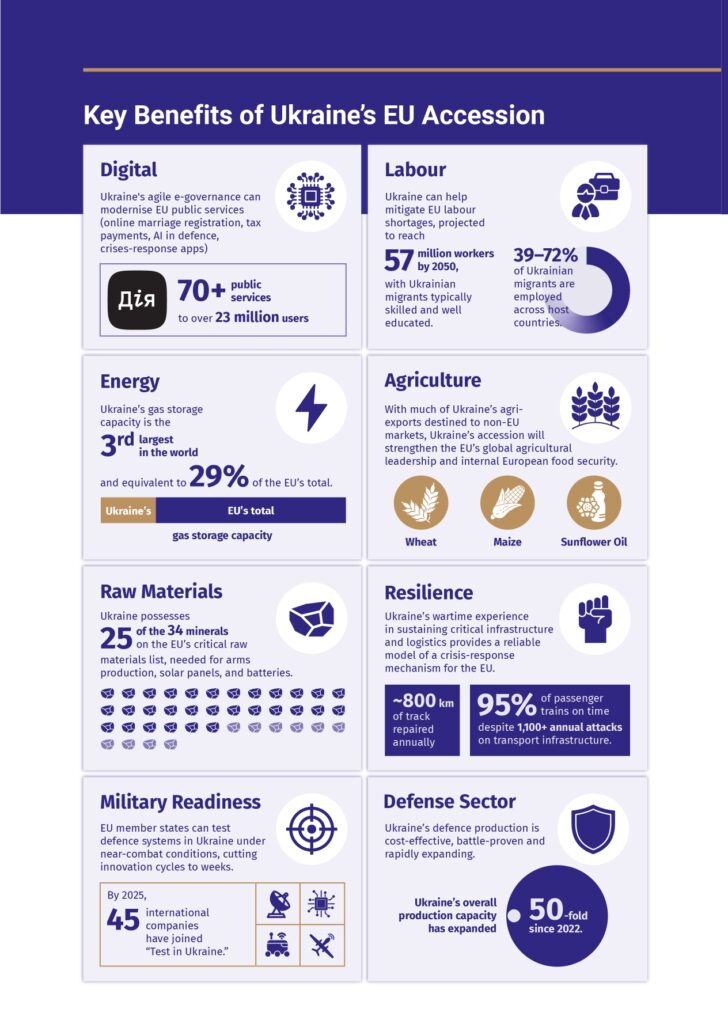
  • Advancing E-Governance and Public Digital Services. Ukraine’s Diia platform is a global leader in e-governance, offering 70+ public services to over 23 million users. It has propelled Ukraine to 1st place globally in the E-Participation Index, ahead of EU countries. Adopting Ukraine’s agile digital governance models can modernise EU public services (such as online marriage registration, tax payments, etc.) and improve citizen engagement across member states.
  • Driving the EU’s AI and Emerging Technologies Leadership. Ukraine’s AI sector is expanding rapidly, with Kyiv emerging as a leading European AI hub. Companies such as Grammarly and People.ai showcase Ukraine’s capabilities in building globally competitive AI products. After the accession, Ukraine’s digital ecosystem can position the EU as a global leader in AI and foster sovereign development of this domain within Europe.
  • Integrating AI in the Miltech Sector. While the EU has limited experience adapting to rapidly evolving warfare, Ukraine already applies AI in defence for intelligence, precision strikes and rear-area administration (Odd Systems, The Fourth Law, and Swarms). Drawing on Ukrainian public services such as Army+, Reserve+, and Brave1, EU member states could develop crisis-response digital platforms to deliver emergency alerts during natural disasters, airspace disruptions, air-quality incidents, and other emergencies.

1.2. Strengthening the EU's Labour Force: The Value of Including Ukrainians in the Free Movement of Labour

Common EU Misperception about Ukraine’s Accession:

The EU already bears fiscal costs supporting Ukrainians living in the EU, while Ukraine’s accession could lead to larger labour migration flows and increased competition for certain jobs.

Common EU Misperception about Ukraine’s Accession:

The EU already bears fiscal costs supporting Ukrainians living in the EU, while Ukraine’s accession could lead to larger labour migration flows and increased competition for certain jobs.

Key Benefits of Ukraine’s EU Accession:
  • Added value for the member states' economies. Ukrainians already contribute more in taxes and social contributions than they receive in welfare support in several EU member states, including Slovakia (€231 million in revenues vs €33 million in support) and Poland, where they accounted for 2.7% of GDP in 2024. Ukraine’s accession is unlikely to trigger a new large-scale migration wave, but instead deepen the integration of Ukrainians already living in the EU. Combined with better skills matching and higher wages, this is likely to further increase their fiscal contribution.
  • Cost-free skilled labour force. Ukraine has been investing significantly in educating and training skilled professionals who contribute to the EU labour market – 58% of its population aged 30-34 has achieved a tertiary education, surpassing the EU average of 40%. The EU benefits from a highly skilled workforce without bearing the full cost of education and professional development.
  • Gaining access to unique skills and competencies from Ukrainians. Today, around 25% of EU businesses report major difficulties in hiring suitably skilled employees, and nearly 63% of SMEs report challenges in finding adequately skilled workers. Ukrainian migrants, who account for 5.2 million people in Europe, bring essential skills in short supply within the EU, notably in sectors such as construction, healthcare, and IT. Moreover, the diverse skill sets of Ukrainian migrants can drive innovation and creativity within the EU. 
  • Alleviating pressing labour shortages in the EU. By integrating Ukrainian workers, the EU can help alleviate pressing labour shortages driven by an ageing population and declining birth rates: by 2050, the EU’s working-age population (20–64) is projected to decrease by 57 million. A large share of Ukrainians temporarily residing in Europe is already employed, with rates ranging from 39% to 72% across host countries.

1.3. Ukraine’s Energy and Green Potential: A Catalyst for a Sustainable Europe

Common EU Misperception about Ukraine’s Accession:

Ukraine’s ability to contribute to EU energy security is constrained by war-related damage to its energy infrastructure and limited renewable energy capacity.

Key Benefits of Ukraine’s EU Accession:
  • Enhancing the EU’s Renewable Energy Capacity. Ukraine has significant renewable energy potential, with an estimated capacity of 83 GW in solar and 688 GW in wind. Renewables accounted for 20.4% of installed electricity generation capacity in 2025, with 3 GW of renewable energy added since 2022, even though war constraints make these figures volatile. Ukraine’s accession could help the EU reach its 45% renewables target by 2030 and reduce the EU’s energy import dependency (57% in 2024).
  • Strengthening Europe’s Energy Security. Ukraine’s synchronisation with ENTSO-E has expanded two-way electricity trade, increasing transfers by 77% between 2021 and 2023. Integrating Ukraine into the EU’s internal energy market as a member state rather than an external supplier would provide access to diversified and reliable energy supplies, strengthen grid resilience, and help lower energy costs. 
  • Utilizing Ukraine’s Blackout-Mitigation Solutions. Blackouts in Portugal, Spain, and Germany highlight growing grid disruption risks across the EU. Drawing on experience gained while operating under sustained attacks since 2022, Ukraine has developed rapid restoration, backup generation, and crisis-response capabilities that can help strengthen Europe’s energy resilience.
  • Leveraging Ukraine’s Gas Infrastructure to Strengthen EU Energy Resilience. Ukraine’s 30 bcm underground gas storage capacity — the third largest in the world and equivalent to 29% of the EU’s total — could expand EU storage by 10% and help stabilize prices. As of end‑2025, about 200 foreign non‑resident entities had stored gas in Ukraine, and some European states (e.g., the Czech Republic) already recognise the system’s wartime reliability.
  • Accelerating the EU’s Green Hydrogen and Biomethane Transition. Subject to the full development of its estimated renewable energy potential, Ukraine could potentially supply up to 1.7 million tonnes of green hydrogen annually by 2050 and 21.8 bcm of biomethane per year, around four times current EU production, supporting the EU’s net-zero aims and strengthening Europe’s clean-energy competitiveness.

1.4. Not a Threat, but a Partner: The Value of Ukrainian Agriculture for Europe

Common EU Misperception about Ukraine’s Accession:

Ukraine’s accession would offer limited benefits while placing significant pressure on the EU’s agricultural budget, particularly through high expected CAP payments (€7–10 billion per year), as well as on market stability.

Key Benefits of Ukraine’s EU Accession:
  • Prompting Long-overdue CAP Reform. Ukraine’s accession aligns with and may accelerate long-discussed CAP reform toward stronger support for small- and medium-sized farms. The Commission’s 2028–2034 MFF proposal reflects this shift and reduces the CAP envelope by 15% (to €295 billion), making assessments based on the current CAP increasingly irrelevant. Even under existing rules, concerns that Ukraine would divert CAP funds are overstated: only around 20% of its farmland (≈5 million hectares) is eligible for subsidies, while its agricultural sector is dominated by large agribusinesses (10,000–100,000 hectares) with limited need for support.
  • Strengthening the EU’s Strategic Autonomy in Food Systems. Ukraine can help reduce the EU’s reliance on external suppliers of plant proteins and key agricultural commodities. With the EU producing just 3 million tonnes of soybeans against a demand of 35 million tonnes, Ukraine’s annual soybean output of over 6 million tonnes makes it a strategic partner in addressing this deficit. This would strengthen food security, support the EU’s Protein Strategy, and diversify agri-food supply chains.
  • Developing Integrated European Value Chains. Ukraine’s production of cereals, oilseeds, and feed inputs complements the EU’s higher-value agri-food sectors. Together, Ukraine’s large-scale production and the EU’s advanced processing and logistics would create integrated continental value chains, strengthen food security and supply chain resilience with limited risk of market disruption.
  • Building the EU’s Global Agricultural Leadership. With a large share of Ukrainian agri-exports, particularly grain, oriented toward global markets, Ukraine’s accession would strengthen the EU’s position in global agri-food competition vis-à-vis major exporters such as Russia. Combining Ukrainian and EU export capacities would increase resilience to geopolitical risks and expand market presence through stronger trade links with partners such as China, Turkey, and Egypt.
  • Advancing Sustainable and Innovative Agriculture. Ukraine’s integration offers an opportunity to accelerate the European Green Deal across a broader regional scale, particularly in climate-smart agriculture, soil restoration, and sustainable land use. At the same time, Ukraine’s use of drone technologies in precision farming, crop monitoring, and input optimisation, as well as satellite-based soil analysis, could strengthen the EU’s position as an agri-tech leader.

1.5. Critical Raw Materials: Towards Diversified Supply through EU–Ukraine Partnership

Common EU Misperception about Ukraine’s Accession:

Ukraine’s accession will not translate into concrete EU gains in critical raw materials and supply‑chain security, while the U.S. gets most of the benefits from Ukraine’s critical raw materials.

Key Benefits of Ukraine’s EU accession:
  • Ukraine’s critical raw materials could help meet the EU’s urgent needs. According to the European Commission, the EU’s overall raw materials needs are projected to increase six-fold by 2030. Ukraine has significant potential in materials relevant for defence and aerospace (titanium), batteries (lithium, graphite), and advanced manufacturing. Ukraine possesses deposits of 25 of the 34 minerals on the European Union’s critical raw materials list. It is already a key supplier of raw materials and its further integration into the EU supply chains would help to increase these numbers. 
  • Ukraine’s critical raw materials can help derisk EU supply chains. The EU is vulnerable due to concentrated dependence on third-country suppliers, limited control over key value chain segments dominated by China, and exposure to disruptions in global logistics routes, as illustrated by the 2026 U.S.–Iran escalation. Ukraine can reduce these risks by providing a proximate and reliable source of critical raw materials, strengthening EU supply chain resilience, reducing transport costs and strengthening European economic security.
  • Multiplying EU assets through favourable conditions for businesses. Ukraine’s cooperation with the United States under the Critical Minerals Agreement is explicitly designed not to hinder EU integration and can be adjusted to meet future EU accession obligations. Moreover, Ukraine’s favourable investment environment, including 20-year mining concessions and 50-year Production Sharing Agreements (PSAs), provides a stable legal framework for long-term foreign investment in mining and refining projects. 

Chapter 2: Political and Security Assets

2.1. Ukraine’s Resilience: An Opportunity for Europe’s Multi-Sectoral Fortitude

Common EU Misperception about Ukraine’s Accession:

Ukraine’s resilience model, largely shaped by wartime conditions, may not align with established EU practices, as it is perceived as a crisis-driven response rather than a long-term institutional capacity suited to the Union’s context.

Key Benefits of Ukraine’s EU Accession:
  • Adopting a tested and modernised Ukrainian resilience model inspired by the Nordic “total defence” concept. Confronting sustained full-scale aggression, Ukraine has stress-tested and recalibrated European resilience mechanisms in real time, turning theoretical preparedness into daily practice. Drawing on this experience, the EU could help bridge the gap between its long-standing Nordic-inspired resilience doctrine and limited operational readiness.
  • Optimising resilience of state bodies. Ukraine’s system of governance has proven functional even under martial law, with the Parliament, Government, President, and local authorities continuing to operate. Amid frequent cyber threats and outdated procedures, European governments could learn from Ukraine’s digitalisation of public services, optimisation of offline services for emergencies, and digital emergency notification systems, such as Diia, air alert apps, and electricity scheduling tools.
  • Improving the EU’s emergency management while fostering more adaptive crisis responses. The 2025–2026 blackouts in Spain, Portugal, and Germany, along with cyberattacks in Norway, Denmark, and Estonia, highlight the need for stronger EU adaptation mechanisms. Ukraine provides both practical experience in rapidly restoring damaged infrastructure and transport systems, as well as innovative approaches. Despite over 1,100 attacks on railway infrastructure in 2025, it maintained rapid repairs and ensured 95% of passenger trains ran on time. At the same time, decentralised energy solutions, backup generators, and flexible electricity redistribution helped it endure the severe winter of 2026, while ad hoc “Invincibility Points” offered quick, effective support during energy shortages.
  • Enhancing EU business processes and corporate philanthropy. Ukraine’s digital public services offer lessons in optimising bureaucracy and improving service delivery. Its experience could also strengthen corporate philanthropy and values-driven business in the EU: in 2025, 79% of Ukrainian companies donated regularly to support the Armed Forces, and these contributions influenced purchasing decisions for 55% of consumers.
  • Strengthening EU civil society. With an estimated 25–30% of Ukrainians regularly engaged in civic activity (compared to about 12.3% in the EU) and around 86% participating in charitable efforts, Ukraine’s accession could inspire European societies to assume shared responsibility for state resilience through grassroots initiatives, crowd funding and crisis response.

2.2. Battlefield Lessons: Ukraine as a Catalyst for EU Security and Military Readiness

Common EU Misperception about Ukraine’s Accession:

Military cooperation with Ukraine remains largely ad hoc and transactional, without a structured pathway to embed Ukraine’s combat-tested expertise into EU interoperability, capability development, and training standards.

Key Benefits of Ukraine’s EU Accession:
  • Enhancing EU Military Readiness. With Europe’s largest, combat-experienced army, Ukraine could accelerate the EU Rapid Deployment Capacity (5,000 troops) and strengthen PESCO initiatives. Ukrainian personnel could also help train EU forces through EUMAM and NATO initiatives such as NSATU and JATEC, while bolstering Europe’s defence-industrial workforce via the roughly 300,000 people employed in Ukraine’s defence industrial base. 
  • Battle-Tested Innovation for Europe. Ukraine can help the EU adapt to rapidly evolving warfare by exporting hard-tested doctrine. With innovation cycles compressed to weeks, Ukraine also offers a model for shortening the path from battlefield feedback to capability upgrades. Its high-intensity experience operating Western systems, reinforced by Kyiv’s “Test in Ukraine” initiative, helps identify real-world performance limits and practical fixes.
  • Strengthening EU Air Defence. Ukraine’s frontline experience in short‑range air defence (SHORAD) concepts is already being exported through Ukrainian advisory and support deployments in the Middle East. If adapted and scaled within the EU, this expertise could significantly strengthen such frameworks as the European Drone Wall and the European Sky Shield Initiative (ESSI), helping build a more effective, interoperable, multi‑layer European air and drone defence architecture.
  • Fostering EU Cyber Resilience. The EU faces an escalating cyber threat landscape: ENISA reported 11,000 serious cyber incidents in 2024 alone. Ukraine’s accession would significantly strengthen EU cybersecurity frameworks. After more than a decade of sustained Russian cyber operations, Ukraine developed a proven model for multi-layered cyber defence and repelled roughly 14,000 cyberattacks in 2022–2025.
  • Expanding EU Peacekeeping Capacity. Ukraine’s accession could strengthen EU peacebuilding missions by helping address persistent constraints, including shortages of trainers and the disruptive influence of Russian-linked mercenaries. Ukraine could also contribute combat-tested counter-drone tactics and operational lessons from maritime drones such as Magura, relevant to EU maritime operations.

2.3. Ukraine’s Military-Industrial Base: A Strategic Opportunity for Europe’s Defense Sector

Common EU Misperception about Ukraine’s Accession:

Ukraine’s strength lies mainly in rapid assembly and tactical adaptation, rather than in “breakthrough” platform innovation; it is not compatible with NATO/EU standards, which limits its suitability for long-term, large-scale procurement.

Key Benefits of Ukraine’s EU Accession:
  • Expanding EU defence production capacity via Ukraine’s industrial base. Since 2022, Ukraine’s arms output has grown 12-fold, while overall production capacity has expanded 50-fold. Ukraine is already joining EU joint procurement frameworks, including SAFE, and has launched joint ventures and industrial partnerships with Rheinmetall, KNDS, Thales, and Saab. Deeper integration into Europe’s defence industrial ecosystem would unlock economies of scale and accelerate production in high-demand areas such as drones and air-defence systems.
  • Bolstering EU Strategic Autonomy. The EU remains heavily dependent on imported defence equipment, with roughly 80% of procurement sourced from outside the Union. Deeper integration of Ukraine’s defence industry would strengthen Europe’s own capabilities (including deep-strike assets) and reduce reliance on non-European suppliers, particularly U.S. systems.
  • Improving Cost-Effectiveness in Procurement. Ukraine’s defence production is comparatively cost-effective. For example, the Sapsan ballistic missile is roughly three times cheaper than its Western counterpart, PrSM ($825 million vs $3 billion), while Stugna-P anti-tank guided missiles are far cheaper per unit than Javelins ($20,000 vs $175,000–$200,000 per missile). If integrated into the EU market under common standards, Ukraine’s cost-effective output could support the rearmament of EU member states while easing pressure on public finances, without sacrificing operational relevance.
  • Accelerating innovation through a combat-proven, end-to-end Ukrainian ecosystem. Ukraine offers the EU not just individual systems or additional manufacturing capacity, but a unique end-to-end innovation ecosystem. It connects frontline needs and battlefield testing with rapid redesign, continuous upgrades, and scalable production. This integrated cycle enables innovation at a pace that is difficult to replicate within traditional peacetime procurement systems.