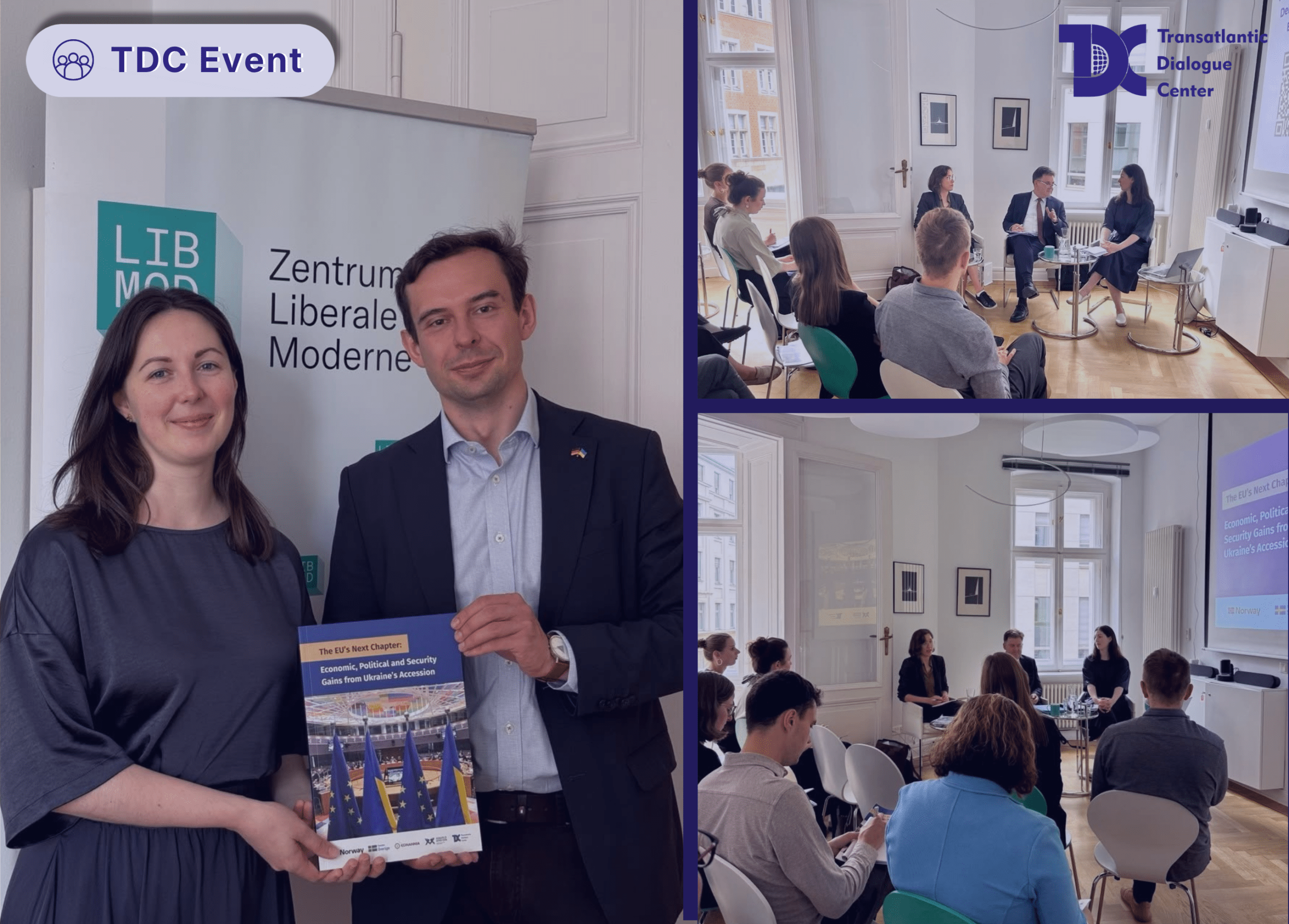
Following the Brussels launch, the Transatlantic Dialogue Center (TDC) presented its latest research, “The EU’s Next Chapter: Economic, Political and Security Gains from Ukraine’s Accession,” at a joint event with Zentrum Liberale Moderne (LibMod) in Berlin. The presentation was delivered by Marianna Fakhurdinova, Coordinator of the EU–Ukraine Partnership Program at TDC, and organized by Stepan Rusyn, Coordinator of the Germany–Ukraine Partnership Program at TDC.
The central argument of the presentation was that Ukraine’s accession is not only a political decision. Drawing on the report’s data, Fakhurdinova demonstrated that Ukraine’s membership could fill documented structural gaps in the EU’s defense production, energy security, technological competitiveness, and critical supply chains.
The presentation was structured around five data-driven cases:
- Critical raw materials. The EU will need six times more critical raw materials by 2030 to sustain its green and digital transitions. Ukraine holds 25 of the EU’s 34 critical minerals, including those essential for weapons production, solar panels, and batteries.
- Defense production. Approximately 80% of EU defense procurement is currently sourced from outside the Union. Ukraine’s defense manufacturing capacity has increased fivefold since 2022, with a significant share of output proving more cost-competitive than alternatives available to European partners.
- Food security. The EU produces roughly 3 million tons of soy annually but consumes over 35 million tons. Ukraine grows approximately 6 million tons and is positioned to diversify and stabilize EU supply chains.
- Cybersecurity. The EU recorded over 11,000 cyber incidents in 2024. Ukraine has repelled approximately 14,000 cyberattacks during the full-scale war, accumulating field-tested expertise that no peacetime exercise can replicate.
- Labour market. The EU could face a shortage of 57 million workers by 2050. Most Ukrainians currently residing in EU member states are already integrated into the labour market and hold high levels of education, representing an immediate, rather than hypothetical, contribution to Europe’s demographic resilience.
The research covers eight sectors in total — from defense industry and digital technologies to energy security, critical raw materials, food security, and labour mobility — offering a comprehensive framework for understanding Ukraine’s accession as a source of long-term gains for the European Union.
TDC extends its gratitude to Daria Malling (LibMod) and Wilfried Jilge (DGAP) for their expert contributions to the discussion.
The full report is available 此处.
本报告由跨大西洋对话中心在 Askold and Dir Fund 的支持下制作,是由 ISAR Ednannia 实施、挪威和瑞典资助的“强大的乌克兰公民社会——改革与民主的推动力”项目的一部分。本出版物的内容由跨大西洋对话中心独自负责,绝不代表挪威政府、瑞典政府和 ISAR Ednannia 的观点。