

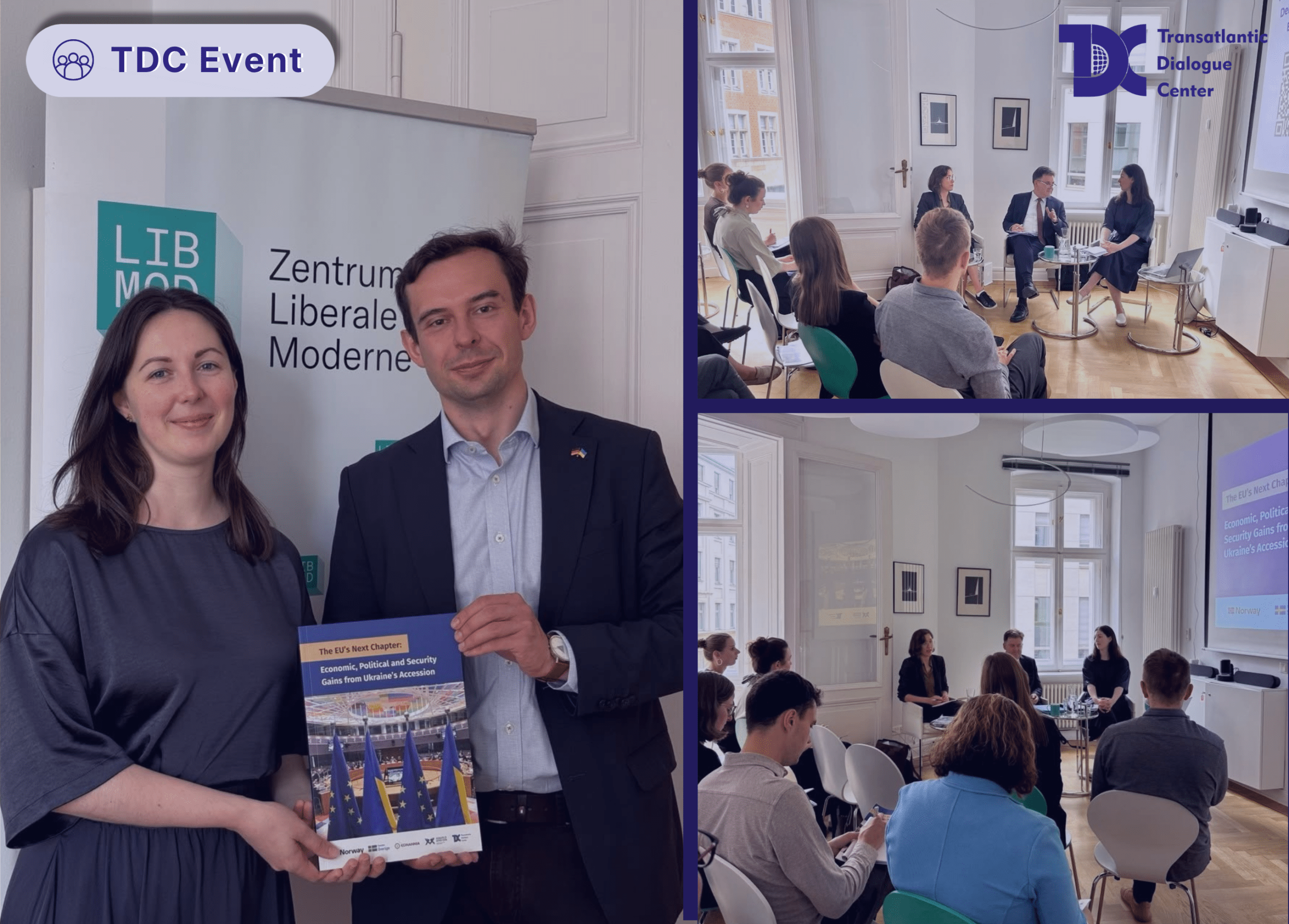
Après son lancement à Bruxelles, le Transatlantic Dialogue Center (TDC) a présenté sa dernière étude, « Le prochain chapitre de l’UE : les gains économiques, politiques et sécuritaires de l’adhésion de l’Ukraine », lors d’un événement organisé conjointement avec Zentrum Liberale Moderne (LibMod) à Berlin. La présentation a été assurée par Marianna Fakhurdinova, coordinatrice du programme de partenariat UE–Ukraine de TDC, et organisée par Stepan Rusyn, coordinateur du programme de partenariat Allemagne–Ukraine de TDC.
L’argument central de la présentation était que l’adhésion de l’Ukraine ne relevait pas seulement d’une décision politique. S’appuyant sur les données du rapport, Fakhurdinova a démontré que l’adhésion de l’Ukraine pourrait combler des lacunes structurelles documentées de l’UE en matière de production de défense, de sécurité énergétique, de compétitivité technologique et de chaînes d’approvisionnement critiques.
La présentation s’articulait autour de cinq cas étayés par des données :
- Matières premières critiques. D’ici 2030, l’UE aura besoin de six fois plus de matières premières critiques pour mener à bien ses transitions écologique et numérique. L’Ukraine possède 25 des 34 minéraux critiques de l’UE, dont certains sont essentiels à la production d’armes, de panneaux solaires et de batteries.
- Production de défense. Environ 80 % des équipements de défense achetés par l’UE proviennent actuellement de pays extérieurs à l’Union. La capacité de production de défense de l’Ukraine a quintuplé depuis 2022, une part importante de cette production s’avérant plus compétitive en termes de coûts que les solutions à la disposition des partenaires européens.
- Sécurité alimentaire. L’UE produit environ 3 millions de tonnes de soja par an, mais en consomme plus de 35 millions. L’Ukraine en cultive environ 6 millions de tonnes et se trouve en mesure de diversifier et de stabiliser les chaînes d’approvisionnement de l’UE.
- Cybersécurité. L’UE a recensé plus de 11,000 cyberincidents en 2024. L’Ukraine a repoussé environ 14,000 cyberattaques depuis le début de la guerre à grande échelle, acquérant ainsi sur le terrain une expertise qu’aucun exercice en temps de paix ne saurait reproduire.
- Marché du travail. L’UE pourrait connaître une pénurie de 57 millions de travailleurs d’ici 2050. La plupart des Ukrainiens qui résident actuellement dans les États membres de l’UE sont déjà intégrés au marché du travail et possèdent un niveau d’éducation élevé : ils apportent donc une contribution immédiate, et non hypothétique, à la résilience démographique de l’Europe.
Au total, l’étude porte sur huit secteurs — de l’industrie de la défense et des technologies numériques à la sécurité énergétique, aux matières premières critiques, à la sécurité alimentaire et à la mobilité de la main-d’œuvre — et offre un cadre complet permettant de comprendre l’adhésion de l’Ukraine comme une source de gains à long terme pour l’Union européenne.
TDC remercie Daria Malling (LibMod) et Wilfried Jilge (DGAP) pour l’expertise qu’ils ont apportée à la discussion.
Le rapport complet est disponible ici.
<em>Le rapport est produit par le Transatlantic Dialogue Center avec le soutien de l’Askold and Dir Fund, dans le cadre du projet Strong Civil Society of Ukraine – a Driver towards Reforms and Democracy, mis en œuvre par ISAR Ednannia et financé par la Norvège et la Suède. Le contenu de cette publication relève de la seule responsabilité du Transatlantic Dialogue Center et ne peut en aucun cas être considéré comme reflétant les opinions du gouvernement norvégien, du gouvernement suédois et d’ISAR Ednannia.</em>
Ce texte a été traduit automatiquement à partir de l’original anglais, qui reste accessible en passant le site en anglais.