Ukraine’s ‘Future Force’ Interview Series: Unmanned Ground Vehicles for Ukraine’s Defense (part 3)

Clock Icon 2 min read
April 28, 2026

Inhalt

On April 28, 2026, Maksym Chebotarov, U.S.–Ukraine Partnership Program Coordinator at the Transatlantic Dialogue Center, held an interview with Vasyl Arbuzov, Communication Strategist, PR and GR Consultant at Defense Robotics UA.

Defence Robotics UA is a Ukrainian non-profit organization and charity fund that accelerates the integration of robotic systems – especially UGVs – into the Armed Forces of Ukraine by linking developers and manufacturers with combat units and supporting the fast testing, adaptation, training, and deployment of life-saving technologies, while also helping build a wider ecosystem and advocating for regulatory changes that speed up adoption on the frontline.

Inhalt

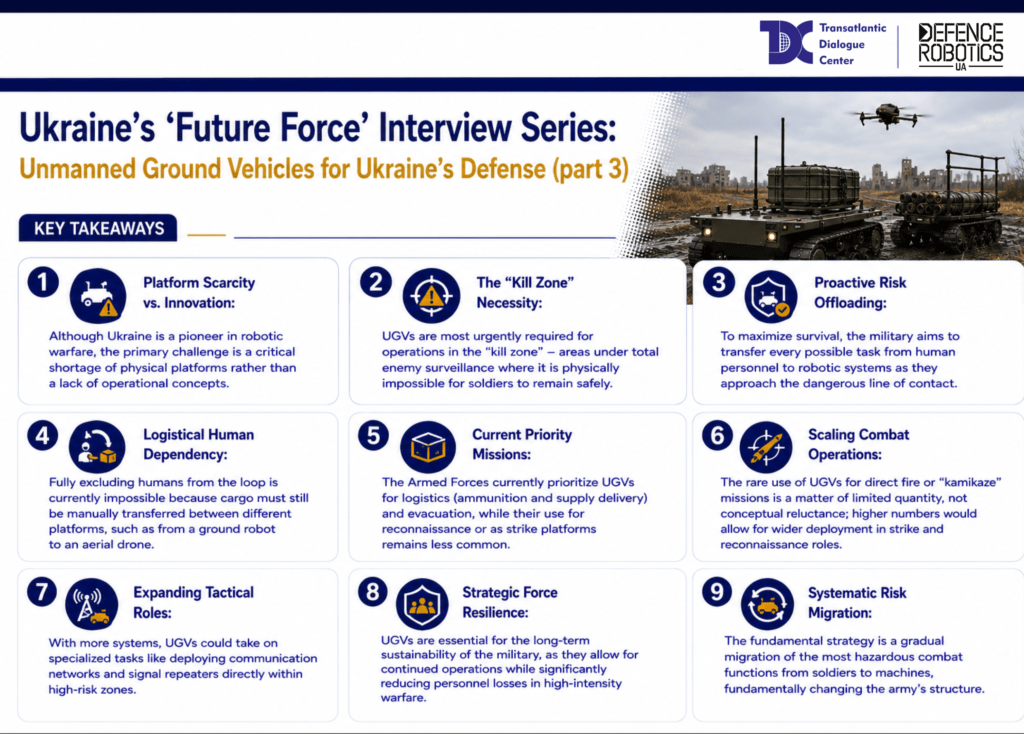
  • Platform Scarcity vs. Innovation: Although Ukraine is a pioneer in robotic warfare, the primary challenge is a critical shortage of physical platforms rather than a lack of operational concepts.
  • The “Kill Zone” Necessity: UGVs are most urgently required for operations in the “kill zone” – areas under total enemy surveillance where it is physically impossible for soldiers to remain safely.
  • Proactive Risk Offloading: To maximize survival, the military aims to transfer every possible task from human personnel to robotic systems as they approach the dangerous line of contact.
  • Logistical Human Dependency: Fully excluding humans from the loop is currently impossible because cargo must still be manually transferred between different platforms, such as from a ground robot to an aerial drone.
  • Current Priority Missions: The Armed Forces currently prioritize UGVs for logistics (ammunition and supply delivery) and evacuation, while their use for reconnaissance or as strike platforms remains less common.
  • Scaling Combat Operations: The rare use of UGVs for direct fire or “kamikaze” missions is a matter of limited quantity, not conceptual reluctance; higher numbers would allow for wider deployment in strike and reconnaissance roles.
  • Expanding Tactical Roles: With more systems, UGVs could take on specialized tasks like deploying communication networks and signal repeaters directly within high-risk zones.
  • Strategic Force Resilience: UGVs are essential for the long-term sustainability of the military, as they allow for continued operations while significantly reducing personnel losses in high-intensity warfare.
  • Systematic Risk Migration: The fundamental strategy is a gradual migration of the most hazardous combat functions from soldiers to machines, fundamentally changing the army’s structure.

If you wish to support Defence Robotics UA, please use the official donation page.


The views, thoughts, and opinions expressed in the interview and published on this site belong solely to the speakers and do not necessarily reflect the views of the Transatlantic Dialogue Center, its committees, or affiliated organizations. The key takeaways are provided to inform discussion and do not represent official policy positions.