

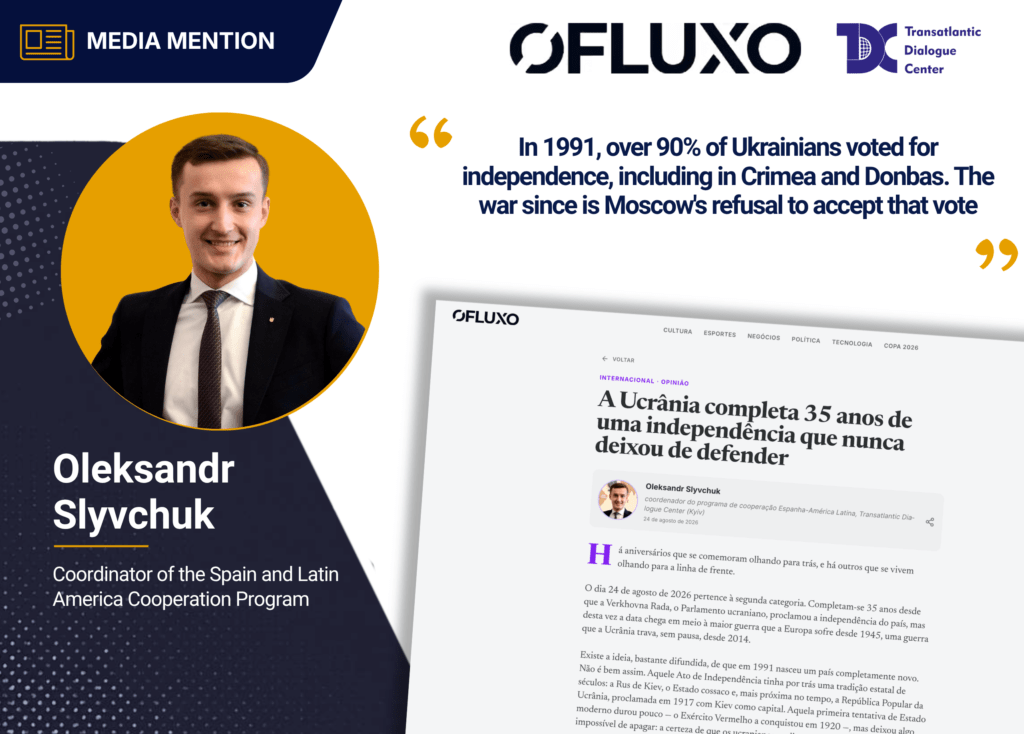
Oleksandr Slyvchuk, Coordinator of the Spain and Latin America Cooperation Program at the Transatlantic Dialogue Center, published an op-ed marking 35 years of Ukrainian independence and tracing the historical continuity Moscow has spent more than a century trying to erase.
In the article, Slyvchuk argues that Ukraine’s independence in 1991 was not a new beginning, but a continuation of centuries of statehood — from Kyivan Rus and the Cossack state to the Ukrainian People’s Republic proclaimed in 1917. He also highlights the role of the Ukrainian government-in-exile, which survived more than seventy years of Soviet rule and formally handed over the symbols of authority in Kyiv in 1992.
Slyvchuk explains that Moscow repeatedly tried to destroy this continuity through the Holodomor, Stalinist purges, and sustained Russification of language, education, and culture. Yet these efforts failed: in the 1991 referendum, over 90% of Ukrainians voted for independence, including in Crimea, Donetsk, and Luhansk — the very regions Russia has occupied since 2014.
The op-ed also draws a key contrast between Ukraine’s struggle for independence in 1918–1921 and the country’s response after 2014. Following Russia’s annexation of Crimea, Ukraine did not collapse. Instead, it rebuilt its army almost from scratch, reformed its institutions, and spent the next eight years preparing for the full-scale invasion on February 24, 2022.
Slyvchuk underlines that Russia’s invasion is not fundamentally about territory, but about the Kremlin’s refusal to accept that the Soviet Union dissolved permanently. He points to Vladimir Putin’s July 2021 article, “On the Historical Unity of Russians and Ukrainians,” as a clear example of Moscow’s denial of Ukraine’s right to exist as a separate state.
Finally, Slyvchuk warns that ceding territory would not be a pragmatic compromise, but a direct threat to the continuity of Ukrainian statehood. Every concession to an aggressor only buys time until the next attack, while Moscow’s ultimate goal remains unchanged: total control over Ukraine. As the article concludes, independence is never won once and for all — it must be sustained every day.
Read the full article via the link.