

From August to December 2025, the Transatlantic Dialogue Center hosted a remote internship for eight students from Argentina, Chile, and Peru through the Spain and Latin America Cooperation Program. Participants represented a diverse group of institutions, including Universidad Argentina de la Empresa, Universidad Católica de Santiago del Estero, Universidad del CEMA, and Universidad del Salvador in Argentina; Universidad de Concepción and Universidad Diego Portales in Chile; and Universidad Nacional Pedro Ruiz Gallo in Peru. The program’s goal was to give young researchers practical experience in analytical work, media studies and strategic communication in the field of international affairs.
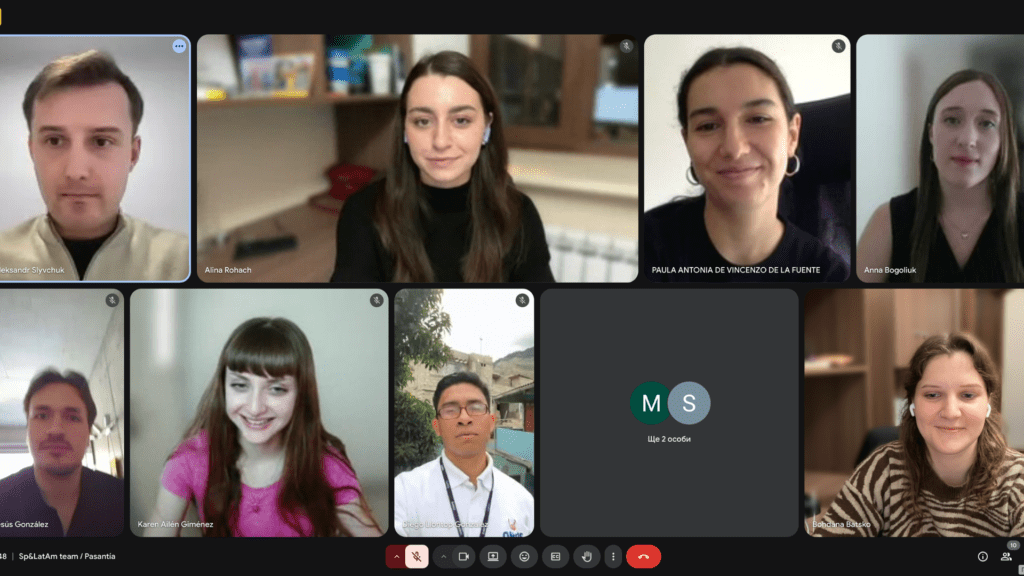
The core project of the internship was a joint study titled “Competing Narratives: How Ukraine Is Informed and Misinformed About in Latin America”. The interns carried out several stages of research, beginning with data collection and the monitoring of Russian, Ukrainian, and Latin American media in Spanish. They analysed dominant themes, tone, emotional framing, and narrative patterns. In the next stages, they produced a preliminary assessment and a comparative matrix that examined differences and similarities across sources, including visual presentation, emotional load, and manipulation techniques. The final phase involved surveys and field-level verification to understand how audiences in Argentina, Chile, and Peru perceive and internalise these narratives. The study is available at the link provided.


Alongside the analytical work, interns contributed to TDC communication activities by documenting the internship process and producing short videos for social media. They also supported the editing of the Spanish-language versions of two major TDC analytical papers, “Can SAFE make Ukraine safer? Insights into the new European financial instrument” and “Russia’s role in the post-war world order. How will Russia’s position in the Global South and within international institutions evolve?”. This gave participants hands-on experience with policy-oriented writing, methodological standards and the adaptation of complex research for Spanish-speaking audiences.


The internship proved to be an important and formative experience for the participants. For many, it was their first structured engagement with comparative media analysis and international communication. As Ana Karla Bogoliuk, student of Government and International Relations at Universidad Argentina de la Empresa, noted:
“This internship has given all of us the opportunity to deepen our understanding of international communication in the twenty-first century, the proliferation of fake news and propaganda, the composition of the Latin American media environment, the information habits and opinions of the population, the identification of narratives, as well as the case under study, the war between Russia and Ukraine, its background and the battle that is also being fought in the information space”.
Similarly, Jesús González Parada, a graduate in Political and Administrative Sciences from Universidad de Concepción, emphasised the personal dimension of the program:
“Beyond the academic findings, this experience was profoundly enriching on a personal level. It allowed me to generate new knowledge, to develop critical thinking about international communication, but above all, to connect with a team that, in Chilean slang, can be described as ‘bacán’, a team where geographical distance disappeared in the face of collaboration, giving way to a sense of fraternity that transcends borders”.
The program showed how Latin American perspectives enrich the understanding of global information dynamics. Participants applied regional experience with media fragmentation, transitional narratives, and civic resilience to interpret how competing messages about Ukraine are constructed and contested in the Spanish-speaking world. Their work resulted in a structured analytical framework that will support researchers, journalists, and diplomats across both regions.
This project was supported by the International Renaissance Foundation.