
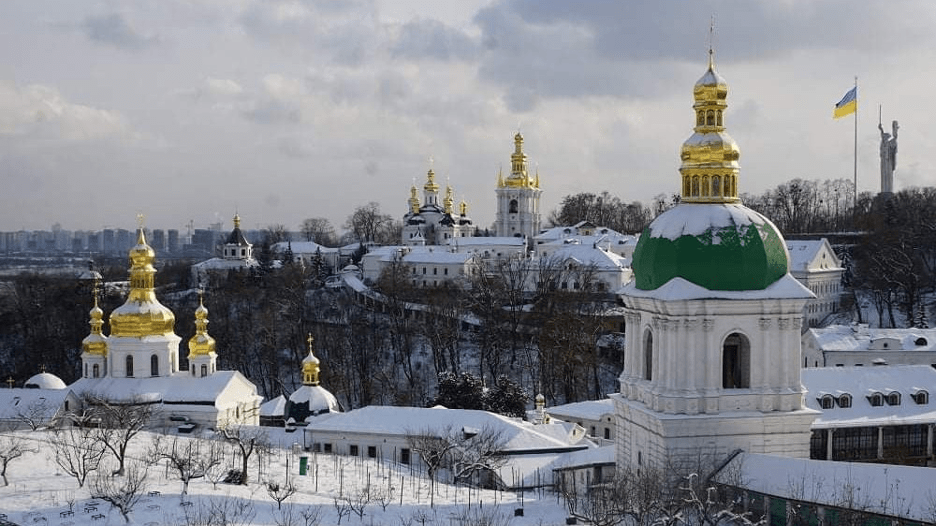
After 2019, probably every resident of Ukraine became familiar with a phrase coined by former president Petro Poroshenko: Army. Language. Faith, evoking the famous slogan of the French Revolution, Liberté, Égalité, Fraternité (“Liberty, Equality, Fraternity”). It brings together three elements representing different dimensions of national resilience: security, cultural identity, and spirituality. Poroshenko actively used this phrase, including during the 2019 presidential campaign and the parliamentary elections, when his European Solidarity party competed with the Servant of the People party, which currently holds a majority in the Ukrainian Parliament and identifies itself as representing the “populist center.” At that time, Russia’s hybrid war against Ukraine was already underway, and part of Ukraine’s territory was under occupation — so for certain social groups, the slogan was perceived as populist and as introducing an unnecessary divide. This happened because religious and language issues, which in theory were meant to unite the Ukrainian nation, produced the opposite effect. Not without Russia’s involvement, these topics provoked misunderstandings and mutual accusations.
In the context of Russia’s full-scale invasion of Ukraine in 2022, the slogan gained renewed force, responding to the real needs of Ukrainian society. If the army symbolizes the defense of the state in the physical dimension, and language its cultural sovereignty, then faith refers to a deeper level — consolidation around values and public morality. In this sense, the Church appears not only as a religious community but also as a social institution shaping identity, solidarity, and public legitimacy.
Ukrainian society remains, traditionally, deeply religious, with Christianity predominating. According to Snake Island Institute data, 63% of citizens consider themselves believers [1]. Religiosity, however, has a clear regional dimension and a complex confessional structure. In Ukraine’s western oblasts, religion more strongly influences the social worldview (which is linked to the weaker impact of the Soviet atheistic legacy), and Greek Catholicism is particularly popular there, whereas Orthodoxy dominates in the east and south. 53.8% of Ukrainians identify with the Ukrainian Orthodox Church (taking into account all patriarchates), 5.8% with the Ukrainian Greek Catholic Church (UGCC), while fewer than 1% identify with the Roman Catholic Church [2]. Thus, the majority of society retains a religious self-identification, but the confessional structure remains pluralistic.
Although for many Ukrainians religion is a source of moral guidance, attitudes toward its role in politics remain ambivalent. A significant share of citizens believes that religion is an extension of Ukrainian culture and influences political processes. At the same time, there is social demand to limit the political influence of the clergy. This stems largely from the influence — and a kind of lobbying — of the values of the “Russian world” (russkiy mir) by the Ukrainian Orthodox Church of the Moscow Patriarchate (UOC-MP), which is linked to the aggressor state.
The Church in Ukraine, therefore, operates at the intersection of several planes: spiritual, sociocultural, and political. In wartime, it is simultaneously a space of moral support — actively helping the Ukrainian army and raising funds — a marker of identity, and an object of state security policy. In this article, we examine changes in the Church’s role and its influence since the beginning of the full-scale Russian-Ukrainian war, and assess its significance for the future of the state and the prospects for its further development in the new socio-political landscape.
Transforming the Church’s social role in wartime
Until 2014, for a significant part of Ukrainians, the Church primarily played a ritual and normative role, reduced to active participation in services, celebrating religious holidays, and maintaining cultural traditions. Religious practices often remained isolated from the public sphere and were mainly ritual in nature. However, with the start of Russian aggression, the Church’s engagement expanded significantly. It began to serve as a social mediator and a crisis institution, responding to wartime challenges not only through preaching but also through concrete practical action [3].
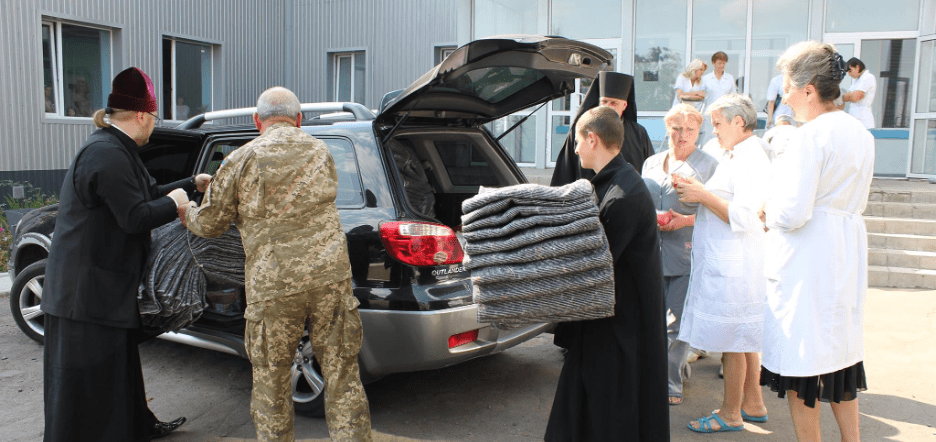
As an institution, in the realities of both the ongoing hybrid war since 2014 and the current full-scale Russian invasion, the Church has in fact grown beyond its core purpose. Beyond providing spiritual assistance, it has put into practice the teaching of Jesus Christ: “Be merciful, just as your Father is merciful” [4]. In this sense, one can observe the transformation of the Church from a symbolic carrier of spiritual values into a real actor in the public sphere, participating in sustaining the vitality of society.
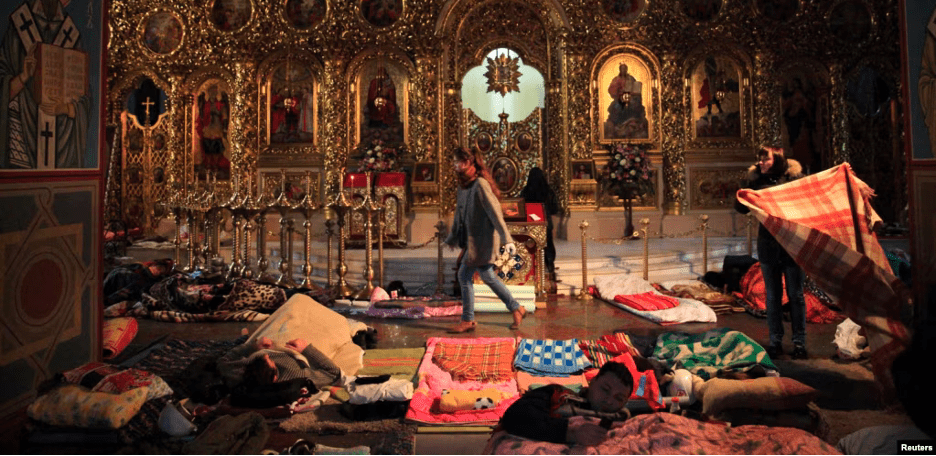
After 24 February 2022, most institutions, especially the Ukrainian Greek Catholic Church, the Orthodox Church of Ukraine, and the Roman Catholic Church in Ukraine, publicly announced that they would open sacred buildings as shelters and temporary accommodation for internally displaced persons. Humanitarian aid warehouses were organized at parishes; centralized fundraising campaigns were conducted for the needs of the Armed Forces of Ukraine (AFU); and food, medicine, and clothing were regularly sent to the front. Importantly, a significant part of this assistance was provided regardless of confessional affiliation: to a greater or lesser extent, almost all major religious communities became involved in volunteer activity [5]. This allows us to speak of the emergence of the Church as a supra-confessional humanitarian actor, for whom dogmatic differences ceased to be the priority, and the response to the existential crisis of Ukrainian society became paramount.
In the face of mass tension, uncertainty, and loss, the Church also becomes a space for mourning and receiving support — through funeral rites, commemorative practices, and collective prayer for the fallen. These activities serve a socio-therapeutic function, helping families cope with traumatic experiences. In this case, rites become not only religious practice, but a mechanism of collective processing of loss.
In wartime, the Church has transformed into a center of volunteer mobilization, a moral arbiter, and a therapeutic space. It has become an element of national consolidation, providing not only a spiritual dimension of solidarity but also material support for those directly affected by the consequences of war. Representatives of the Church are present at the front, in hospitals, in frontline communities, and among internally displaced refugees. It is precisely this empirical engagement that shapes a new type of legitimation for the Church as an institution in Ukraine’s wartime society.
“Army” and “Faith” as a coherent whole: the phenomenon of military chaplaincy
The war has reshaped not only the army, but also the very understanding of what it means to accompany a person in extreme situations. It is here that “army” and “faith”, two elements of Poroshenko’s slogan, ceased to function as separate concepts and fused into the unified institution of military chaplaincy.
Chaplaincy in Ukraine is not a new phenomenon: the first clergy went to the front as early as 2014, with the beginning of Russia’s hybrid aggression in the east of the country. At the time, they served voluntarily — without formal status, uniforms, or a legal basis [6]. The full-scale invasion in 2022, however, encountered a different institutional reality: on 30 November 2021, the Verkhovna Rada adopted the Law “On the Service of Military Chaplaincy,” which entered into force on 1 July 2022. This law institutionalized chaplaincy as an official component of the armed forces — with officer ranks, contracts, and a clear chain of command [7]. Currently, more than 738 chaplains serve in the Armed Forces of Ukraine (AFU), of whom 78 hold the rank of full-time military officer [8].
Notably, military chaplaincy in Ukraine is interdenominational in nature. Most chaplains represent the Orthodox Church of Ukraine, but alongside them serve clergy of the Ukrainian Greek Catholic Church, Protestant pastors, and imams and rabbis. In the conditions of total war, the Ukrainian army consciously builds a space in which religion does not divide, but unites. A chaplain does not ask about confessional affiliation — simply stays close [9].
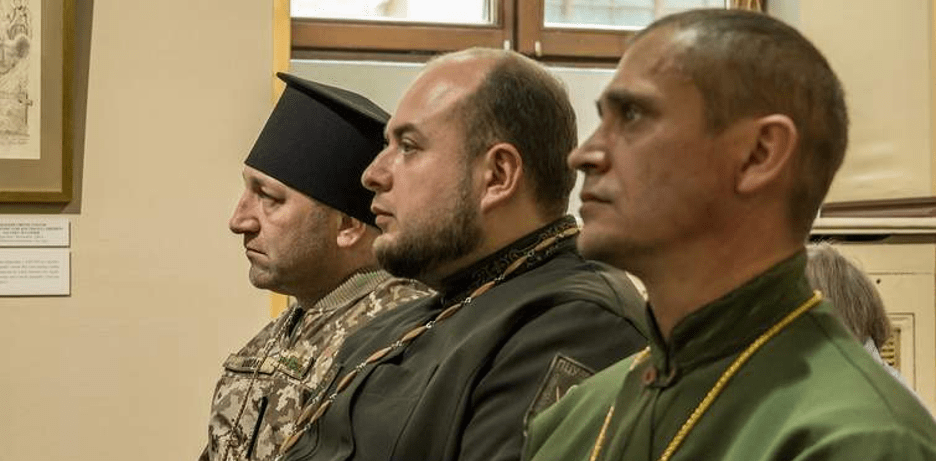
This presence is the essence of the entire phenomenon. A chaplain is not only a clergyperson conducting a service before battle. They accompany soldiers during the evacuation of the wounded, discuss family difficulties, and listen to fears that cannot be documented in a report. Muhammad Ali, an imam-chaplain serving in the AFU, put it with striking precision: The army is a big metal machine that can be cruel. A chaplain is a piece of soul in this mechanism, an element of humanity and a bond with God that is palpably missing in the military [10]. These words describe the reality of a person who chooses, every day, to remain with those who fight. This is confirmed by the main motto of the chaplaincy service: “To be there.”
It is also worth emphasizing that Ukrainian military chaplaincy is actively adapting to NATO standards. Chaplains undergo training in partner countries and absorb doctrines that have been shaped in Western armies over decades [11]. At the same time, the Ukrainian side brings something that cannot be found in any handbook — ten years of real combat experience in spiritual accompaniment. This exchange is mutual and equal.
Thus, military chaplaincy has become an institutional expression of an idea that is difficult to formulate rationally, but easy to feel: that an army is not only weapons and logistics, but also a soul in need of support. In Ukraine, that support today has a specific name, a military rank, and a uniform.
Choosing a Church as a geopolitical choice
It should be understood that religious identity in wartime is not only a matter of confessional affiliation. It directly reflects a worldview system: how a person understands their place in reality, which community they belong to, and what values they remain faithful to under pressure [12]. The changing religious landscape of Ukraine shows that choosing a Church ceased to be a purely spiritual decision and became, simultaneously, an act of identification and a matter of national security.
Roots of the problem: the Church as Moscow’s instrument
To fully understand the scale of today’s transformations, one must refer to history. Christianity reached Ukrainian lands in 988, and for centuries the Kyivan Metropolis maintained an orientation toward Constantinople. Subordination to Moscow occurred only in 1686. Since then, the Moscow Patriarchate has consistently used church structures to exert political influence [13].
In the Soviet period, this tradition took on a new form: clergy widely cooperated with the KGB, and the confessional effectively became a source of information for the state. The most high-profile documented case is Patriarch Kirill himself, the current head of the Russian Orthodox Church, whose activities under the pseudonym “Mikhailov” as a representative of the Moscow Patriarchate in Geneva in the 1970s were recorded in Swiss federal archives [14].
After the collapse of the USSR, Moscow granted the Ukrainian Orthodox Church formal autonomy, but only to the extent that allowed it to keep the Church within its sphere of influence. Repeated attempts to obtain autocephaly [15] — for example, in 1991–1992 under Metropolitan Filaret — were systematically blocked. Only in 2019 did the Ecumenical Patriarchate of Constantinople grant the Tomos [16] of autocephaly to the newly created Orthodox Church of Ukraine (OCU), institutionally independent from Moscow [17].
Mass transitions: numbers that speak for themselves
The full-scale invasion in 2022 turned this slow process into an avalanche. Whereas before the outbreak of the major war, in 2021, around 13% of Ukrainians identified with the UOC-MP (Moscow Patriarchate) and 24% with the independent OCU, by the end of 2024, these figures had changed radically. Support for the UOC-MP fell to 5.5%, while the OCU expanded to 35% of the population [18]. In just three years, the influence of the Moscow Church in Ukrainian society more than halved.
This process is also taking place at the institutional level. As of May 2025, more than 1,900 communities have transferred under the jurisdiction of the OCU since the Tomos was granted [19]. At the same time, around eight thousand UOC-MP parishes continue to operate in Ukrainian-controlled territory, increasing the scale and complexity of the problem.
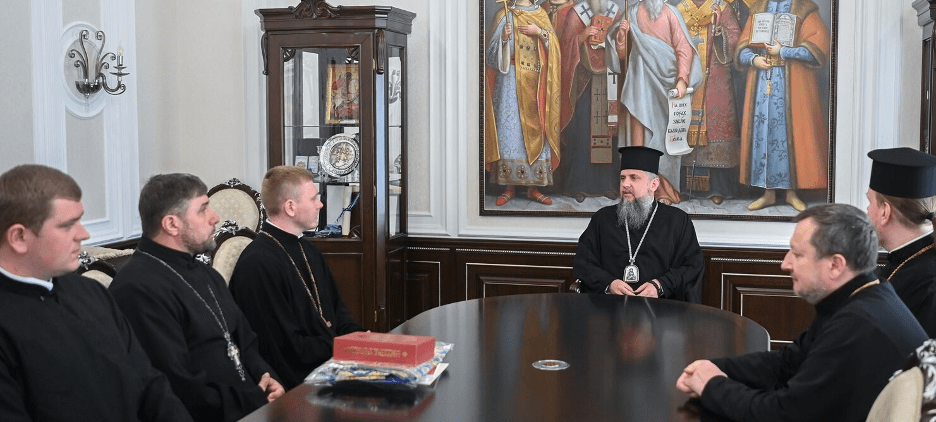
A symbolic and practical element of this transformation has become language: the OCU conducts liturgy in Ukrainian, while the UOC-MP traditionally uses Church Slavonic, which, in the context of war, a significant part of society perceives as a marker of an alien cultural orbit. The language of liturgy thus ceased to be a purely theological matter and acquired a clear identity dimension.
The Church in the face of a security threat
Alongside mass shifts of believers, the security dimension of the crisis has been developing. Since 2022, the Security Service of Ukraine (SBU) has initiated more than 208 criminal proceedings against representatives of the UOC-MP, including cases against 27 high-ranking hierarchs — metropolitans and archbishops [20]. They are accused of espionage, treason, and aiding the aggressor. For example, in April 2025, a hierarch from Donetsk oblast was detained for passing information on the location of command posts to Russia’s FSB in exchange for evacuating his family to Russia [21]. In Kharkiv and Sumy, there were cases in which clergy were convicted for providing coordinates for missile strikes on Ukrainian positions [22].
These facts significantly affected public sentiment: around 74% of Ukrainians support a complete ban on the activities of structures of the Russian Orthodox Church [23]. The state’s response was to adopt a relevant law in August 2024. Viktor Yelenskyi, head of the State Service of Ukraine for Ethnopolitics and Freedom of Conscience, explained the logic of this decision as follows: The Verkhovna Rada took this step only because the Russian church became a participant in the war and set itself the goal of destroying Ukrainian statehood, culture, and identity [24].
The dilemma between security and European integration
Implementing the law, however, proved far more difficult than adopting it. The UOC-MP does not exist as a single legal entity — instead, thousands of separate entities operate: the Kyivan Metropolis, eparchies, and individual parishes. Altogether, there are around ten thousand structures, and each requires a separate court procedure. The statutory mechanism is deliberately gradual: first, a state body establishes the fact of ties to the ROC, issues an order to eliminate violations, and only if it is ignored (as happened in the case of the Kyivan Metropolis under Metropolitan Onufriy) does it file a lawsuit in court. These proceedings may take years. This slow but legally impeccable path was chosen consciously: it minimizes grounds for accusations of violating religious freedom by Western partners, in line with the European tradition according to which only a court has the right to ban the activities of religious organizations [25].
This approach does not eliminate international tensions. Human Rights Watch and the Office of the UN High Commissioner for Human Rights expressed concern about potential violations of freedom of religion, referring to the European Convention on Human Rights [26, 27]. Hungary, which systematically blocks Ukraine’s integration course, also adds this issue to its list of objections [28].
The situation is complicated by a domestic factor: around 44% of remaining UOC-MP supporters declare that pressure has strengthened their faith. This is a higher “spiritual hardening” indicator than in other denominations, signaling the risk of forming a “persecuted minority” syndrome within the country [29].
Ukraine is in a complex situation: any attempt to resolve an issue that is simultaneously a matter of security, identity, and international reputation with a single legal act inevitably creates new problems. Choosing a Church in Ukraine today is a geopolitical decision, yet the state is forced to treat it not only as a matter of sovereignty but also as a challenge requiring delicacy, consistency, and respect for international standards.
Where is the country heading? Ukraine’s new ideological profile
One of the most interesting paradoxes of contemporary Ukrainian politics is that the incumbent president Volodymyr Zelenskyi — a person who in 2019 came to power as a kind of antithesis to Poroshenko’s “patriotic triad” — has in fact become the main implementer of the slogan “Army. Language. Faith.” Centrist populism appeals to the “ordinary person” beyond any ideological markers, and skepticism toward language and religious issues as “factors dividing society” — all this gave way to a consistent state strategy. Within its framework, strengthening the army, consolidating the Ukrainian language, and breaking with Moscow’s church structures ceased to be elements of rhetoric and became state policy in practice. This paradox is perhaps the best proof that the triad “Army. Language. Faith” is an integral part of Ukraine’s state-building process under existential threat.
This kind of algorithm has a deeper dimension that can be described as a “decolonization of the spirit.” The departure from the structures of the Moscow Patriarchate, the shift to Ukrainian in liturgy, and the formation of Ukraine’s own independent church tradition are not merely religious or cultural phenomena occurring in isolation from the broader context of the war. It is an act of geopolitical self-determination taking place at the deepest axiological level of social consciousness. Importantly, this process is stimulated not only by state policy but, above all, by bottom-up social demand. People who, in wartime, have lost loved ones or experienced evacuation or occupation, choose a Church consciously — as a space free of ties to the country that is destroying them. That is why this choice is irreversible, regardless of the legal fate of the UOC-MP.
It is also significant that consolidation is not happening through religious homogenization. Greek Catholics, Catholics, Protestants, Jews, and Muslims — all are active participants in Ukrainian civil society and support Ukraine in its struggle. For these communities, defending the state is not merely a patriotic duty, but the defense of the very idea of a multiethnic and multiconfessional society against authoritarian unification [30]. In this sense, interfaith solidarity is not an accidental wartime phenomenon, but a structural feature of the country’s new religious landscape.
Despite the clear strengthening of the Church’s role, Ukraine is not heading toward a religious state. Rather, what is taking shape is a “mosaic model”: a society in which conservative values and liberal freedoms do not exclude one another but balance each other. As the Ukrainian dissident and philosopher Myroslav Marynovych notes, post-war conservatism should not be “ossified and prohibitive” — its mission is to restore to the center of social attention respect for law, property, and moral responsibility [31]. In this context, the values cultivated by the Church should be seen not as dogma, but as a lighthouse; not as a ban, but as a value-based foundation [32].
In this model, the Church ceases to be merely a place of prayer and becomes part of what civil society researchers call “civil religion” — a space where shared meanings are formed, veterans and people with war trauma undergo rehabilitation, and collective memory is cultivated. At the same time, Ukraine will have to develop a balance between the growing importance of the Church in the public sphere and the standards of secularism required by the country’s European integration course.
Finally, there is a dimension still underestimated in public discourse: the Church as an instrument of cultural diplomacy. The OCU and the UGCC are already active players on the international stage — through relations with Constantinople, the Vatican, and diaspora communities in Europe and America. In a context where Russia actively uses the Moscow Patriarchate as a tool of “soft power,” independent Ukrainian Churches constitute a natural counterweight to this strategy. Their potential as channels of international solidarity and of Ukrainian cultural presence in the world remains largely untapped — and this is one of the strategic tasks of post-war reconstruction.
“Faith” in 2026 is a story about what kind of country Ukraine is building: open, yet rooted; secular, yet imbued with values; pluralistic, yet capable of self-defense. The Church in this architecture is not an authority over society, but one of the foundations on which it rests.
This text was produced in cooperation with the “Alliance of Ukrainian Youth ‘24 August’” Foundation (Alliance 24/08), which operates as a space for dialogue between conscious Polish and Ukrainian youth.
The views, thoughts, and opinions expressed in the papers published on this site belong solely to the authors and not necessarily to the Transatlantic Dialogue Center, its committees, or its affiliated organizations. The papers are intended to stimulate dialogue and discussion and do not represent official policy positions of the Transatlantic Dialogue Center or any other organizations with which the authors may be associated.
Bibliography
[1] Snake Island Institute, Values Index UA, s. 8-11, https://snakeisland-bucket.s3.eu-north-1.amazonaws.com/reports/SII+Values+Index+UA.pdf
[2] Snake Island Institute, Values Index UA…
[3] Kościół pomaga: wsparcie dla uchodźców, chorych, żołnierzy oraz osób potrzebujących [The Church helps: support for refugees, the sick, soldiers and those in need], Media Centr. https://mediacentr.com.ua/tserkva-dopomagaye-pidtrimka-dlya-bizhentsiv-hvorih-vijskovih-ta-tih-hto-potrebuye/.
[4] Holy Scripture, New International Version, Luke 6:36.
[5] E. Opanasiuk, I. Panchuk, “Динаміка релігійної ідентичності в Україні за останнє десятиліття” [“The Dynamics of Religious Identity in Ukraine in the Last Decade”]: “Notatki naukowe Narodowego Uniwersytetu “Akademia Ostrogska”. Seria “Filozofia””. Czasopismo naukowe. “Ostróg”. Wydawnictwo NaUOA. 10.06.2024. https://journals.oa.edu.ua/Philosophy/article/view/4122/3769.
[6] ”У страшних умовах ми зберігаємо людяність і саме капелан у цьому допомагає” – начальник Служби військового капеланства ЗСУ [“In terrible conditions, we maintain our humanity and it is the chaplain who helps us in this” – Head of the Military Chaplaincy Service of the Armed Forces of Ukraine]: Католицький Оглядач [Obserwator Katolicki]. https://catholicnews.org.ua/u-strashnih-umovah-mi-zberigaiemo-lyudyanist-i-same-kapelan-u-comu-dopomagaie-nachalnik-sluzhbi/ .
[7] “Капелан розповів, як поєднується війна та віра” [The chaplain explained how war and faith are connected], Ukrinform. https://www.ukrinform.ua/rubric-society/3638476-kapelan-rozpoviv-ak-poednuetsa-vijna-ta-vira.html
[8] K. Vovk, ““Капелан — це частинка душі у великому механізмі армії”. Цінність і роль капеланів на фронті” [“A chaplain is a part of the soul in the great mechanism of the army.” The value and role of chaplains on the front lines], Svidomi, https://svidomi.in.ua/page/kapelan-tse-chastynka-dushi-u-velykomu-mekhanizmi-armii-tsinnist-i-rol-kapelaniv-na-fronti.
[9] [“In terrible conditions we maintain…”] [Obserwator Katolicki].
[10] K. Vovk, Svidomi….
[11] [“In terrible conditions we maintain…”] [Obserwator Katolicki].
[12] E. Opanasiuk, I. Panchuk The Dynamics of Religious Identity…
[13] O. Chuprynska, Beyond Faith: Unpacking Ukraine’s Ban on the Ukrainian Orthodox Church (Moscow Patriarchate), Transatlantic Dialogue Center, 26.09.2024 https://tdcenter.org/2024/09/26/beyond-faith-unpacking-ukraines-ban-on-the-ukrainian-orthodox-church-moscow-patriarchate/
[14] O. Chuprynska, Beyond Faith…
[15] Full autonomy and independence of the local Orthodox Church from foreign spiritual authorities (e.g. the patriarch) in administrative and organizational matters.
[16] A church document by which various jurisdictional or theological matters of greater importance are regulated in the Orthodox Church. Jurisdictional tomoses are most often issued to grant or recognize the autocephalous or autonomous status of a given local Church.
[17] Вселенський патріархат вручає томос про автокефалію української церкви – трансляція [The Ecumenical Patriarchate hands over the tomos on the autocephaly of the Ukrainian Church – broadcast], Radio Svoboda, https://www.radiosvoboda.org/a/news-tomos-vruchennia/29691838.html.
[18] Українське суспільство, держава і церква під час війни. Церковно-релігійна ситуація в Україні-2024 (інформаційні матеріали) [Ukrainian Society, State, und Church in Wartime: Das Church und Religious Situation in Ukraine 2024 (information materials)], Razumkov Centre, https://razumkov.org.ua/images/2025/01/28/2024-Religiya-religion-FIN.pdf
[19] Перевірка УПЦ (МП): переслідування віруючих чи боротьба із російським впливом? [Control of the UOC (Moscow Patriarchate): persecution of believers or fight against Russian influence?], Radio Svoboda, https://www.radiosvoboda.org/a/perevirka-upc-mp-tserkva/33420524.html.
[20] СБУ: з лютого 2022 року відкрили понад 200 проваджень щодо кліриків УПЦ (МП), 40 з них засуджені до ув’язнення [SBU: since February 2022, over 200 cases have been initiated against clergy of the UOC (Moscow Patriarchate), 40 of them were sentenced to prison], Radio Svoboda https://www.radiosvoboda.org/a/news-sbu-rozsliduvannya-svyashchennyky-upts-mp/33586113.html
[21] V. Romanenko, Protopriest from Moscow-affiliated church detained by Ukraine’s Security Service over espionage for Russia, Ukrainska Pravda, https://www.pravda.com.ua/eng/news/2025/04/10/7506886/
[22] A. Strashkulych, The devil in disguise: the Ukrainian Orthodox priests who work with Russian secret services and justify the war, Ukrainska Pravda, https://www.pravda.com.ua/eng/articles/2025/09/11/7530266/ [dostęp: 05.03.2026].
[23] Майже 75% українців підтримують заборону діяльності РПЦ в Україні [Almost 75% of Ukrainians support the ban on the Russian Orthodox Church in Ukraine], Ukrinform, https://www.ukrinform.ua/rubric-society/3953799-majze-75-ukrainciv-pidtrimuut-zaboronu-dialnosti-rpc-v-ukraini.html
[24] Заборона УПЦ МП – це безпрецедентний випадок за всю історію існування України – Держетнополітики [The ban of the UOC (Moscow Patriarchate) is an unprecedented case in the entire history of Ukraine – State Service for Ethnopolitics], Media Centr Ukraina,https://mediacenter.org.ua/uk/zaborona-upts-mp-tse-bezpretsedentnij-vipadok-za-vsyu-istoriyu-isnuvannya-ukrayini-derzhetnopolitiki/
[25] Чому Верховна Рада не може заборонити УПЦ МП і як це мало працювати [Why the Supreme Council cannot ban the UOC (Moscow Patriarchate) and how it was supposed to work], BBC News, https://www.bbc.com/ukrainian/news-65477459.
[26] Human Rights Watch, Ukraine: New Law Raises Religious Freedom Concerns, https://www.hrw.org/news/2024/10/30/ukraine-new-law-raises-religious-freedom-concerns.
[27] Human Rights Without Frontiers (HRWF), UKRAINE: The legal fate of the UOC MP against the backdrop of the war in Ukraine, https://hrwf.eu/ukraine-the-legal-fate-of-the-uoc-mp-against-the-backdrop-o-the-war-in-ukraine/
[28] L. Zemplényi, EU Commission Pushes for Ukraine’s Accession by 2028 despite Hungary’s Objection, Hungarian Conservative, https://www.hungarianconservative.com/articles/current/eu-commission-ukraine-accession-2028/.
[29] Razumkov Centre, [Ukrainian society, state and Church…].
[30] Віра та нація: роль релігії в українській ідентичності та опорі [Faith and Nation: The Role of Religion in Ukrainian Identity and Resistance,], Lviv Herald, https://tinyurl.com/y8ee63h8.
[31] «Україна потребує великого впливу консервативної ідеї, бо інакше вона може згубити свою ідентичність», ― Мирослав Маринович [“Ukraine needs a strong influence of conservative ideas, otherwise it may lose its identity” – Myroslav Marynovych], RISU, https://risu.ua/ukrayina-potrebuye-velikogo-vplivu-konservativnoyi-ideyi-bo-inakshe-vona-mozhe-zgubiti-svoyu-identichnist–miroslav-marinovich_n136539
[32] [“Ukraine needs a strong influence of conservative ideas…”], RISU.