

The authors are grateful to John Drennan, Maksym Chebotarov and Maksym Skrypchenko for their valuable comments and suggestions.
The report is produced by Transatlantic Dialogue Center with the support of the Askold and Dir Fund as a part of the Strong Civil Society of Ukraine – a Driver towards Reforms and Democracy project, implemented by ISAR Ednannia, funded by Norway and Sweden. The contents of this publication are the sole responsibility of Transatlantic Dialogue Center and can in no way be taken to reflect the views of the Government of Norway, the Government of Sweden and ISAR Ednannia.
Introduction
Transatlantic relations are undergoing their most severe test in decades, driven not only by political change in Washington, but by a deeper strategic reorientation of the United States. Long-running debates over burden-sharing, strategic priorities, and economic nationalism have translated into concrete policy shifts during the first year of Donald Trump’s second presidency, bringing transatlantic allies to the brink of trade wars and unprecedented military tensions over Greenland.
The redirection of U.S. resources toward homeland security and strategic competition with China, the scaling back of support for Ukraine, sustained criticism of EU institutions and European domestic policies, protectionist trade measures, and the deprioritization of global climate leadership collectively signal a fundamental transformation of the transatlantic partnership. As a result, the shared values that once underpinned the alliance have weakened, making pragmatic engagement increasingly necessary.
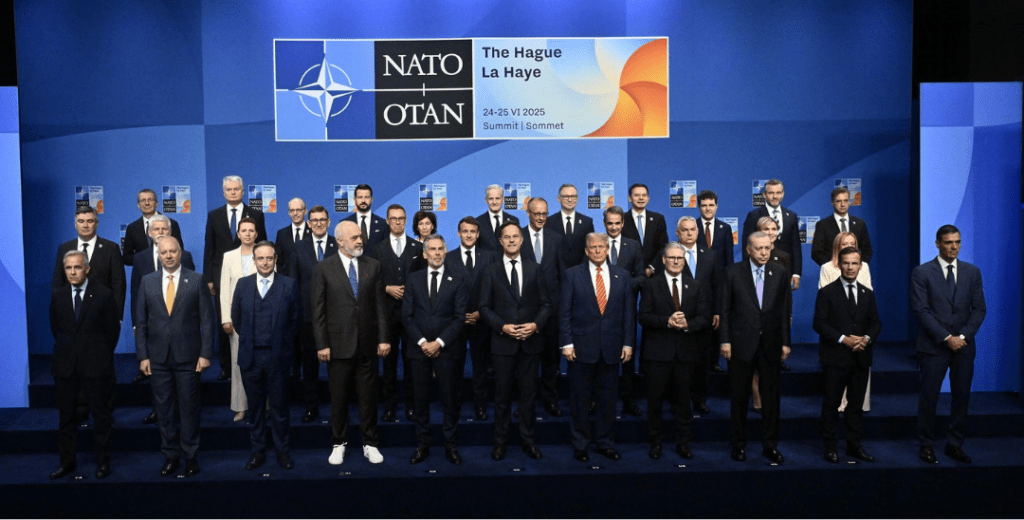
This erosion of U.S. commitment has prompted a strategic response from the EU. Facing greater uncertainty about Washington’s reliability, the EU has moved toward enhanced strategic autonomy, accelerated rearmament, and a more prominent role in supporting Ukraine. Decisions taken at the 2025 NATO summit in The Hague, alongside initiatives such as the ReArm Europe Plan/Readiness 2030 and the Prioritized Ukraine Requirements List (PURL), reflect EU’s efforts to adapt to a changing security environment in light of diminished U.S. leadership, with an increasing emphasis on European burden-sharing.
However, much of the research on transatlantic relations still frames it primarily as a bilateral U.S.–EU partnership, overlooking Ukraine’s central role in European security and the future of U.S.–EU cooperation. The Russo-Ukrainian war has become a defining stress test of this evolving relationship: U.S. efforts to end the war swiftly have bottlenecked, EU member states remain excluded from the ongoing peace negotiations, while Russia continues to hinder the process and pursue a protracted confrontation with the West.
Against this backdrop, while the United States is strategically disengaging from Europe, it remains in the vital interest of both Ukraine and the EU to identify opportunities for tactical engagement with Washington amid the ongoing war with Russia. This reflects a dual dynamic: in the short term, both Ukraine and the EU remain politically and materially reliant on Washington, even as they seek to develop longer-term strategies for greater autonomy. More broadly, in an increasingly complex and volatile international environment, the United States, the EU, and Ukraine face a shared need to pragmatically identify points where their efforts can be coordinated or, at a minimum, their positions aligned. This research seeks to identify such areas and to advance policy recommendations for pragmatic alignment, if not full allied cooperation. By examining both points of divergence and underexplored areas of convergence, including countering autocratic powers, engaging globally, and developing defense cooperation, the paper highlights opportunities for trilateral engagement. In doing so, it also offers recommendations for the EU and Ukraine on managing relations with the United States under the Trump administration.
Chapter 1. Transatlantic Relations Challenges and Diverging U.S.–EU–Ukraine Positions
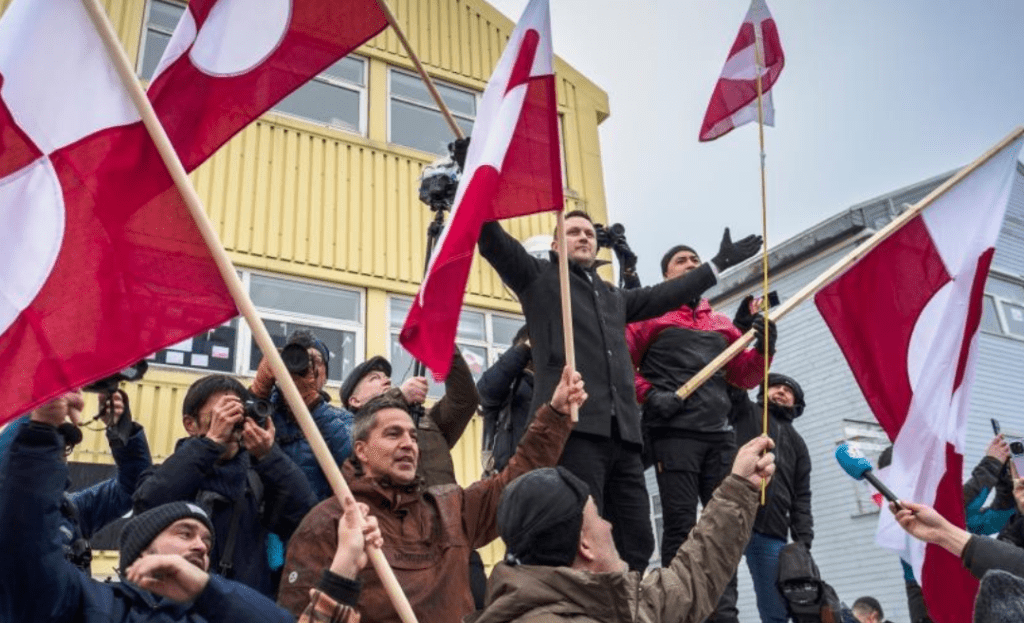
Donald Trump’s return to the White House has intensified the crisis of trust in transatlantic relations, marking a shift away from strategic alignment and values-driven multilateralism of previous administrations toward transactional, bilateral pragmatism under renewed “America First” doctrine[1] [2]. This shift is reflected in increasingly confrontational U.S. rhetoric, the use of coercive diplomacy, and widening policy divergences on issues that had previously been areas of close coordination, most notably through direct engagement with Russia and mounting pressure on partners over defence spending, Greenland, and the terms of ending the Russo-Ukrainian war.
As alliances increasingly take the form of conditional bargains, trust and the spirit of solidarity have eroded. This chapter examines the key areas in which these diverging US–EU–Ukraine positions have emerged and reshaped contemporary transatlantic relations.
- Dissolving Common Ground: International Law
U.S. President Donald Trump has publicly stated that his exercise of global power is constrained primarily by his own moral judgment rather than by international law[3]. His foreign policy reflects a highly transactional logic in which international institutions and legal norms are subordinated to short-term U.S. gains, filtered through the president’s own preferences. Such unilateral actions as military operations in Venezuela and Iran, territorial claims over Greenland, and the decision to withdraw from 66 international organisations illustrate this shift[4]. Washington’s distancing from international justice mechanisms, and President Trump’s engagement with Vladimir Putin despite an ICC arrest warrant, underscore a broader erosion of normative constraints on great-power behaviour.
In response to U.S. military operations in Venezuela and Iran, EU leaders have stressed restraint and reaffirmed UN Charter principles, including the prohibition on the use of force and respect for territorial integrity[5]. Policymakers also warned that the Venezuela intervention risked legitimising great-power spheres of influence, potentially encouraging similar assertiveness by China and Russia. Public opinion mirrors these concerns: in early 2026,
only 16 percent of EU citizens considered the United States an ally,
reflecting a significant erosion of trust in Washington and growing anxiety over the durability of transatlantic security ties[6].
Paradoxically, as a country that has suffered most from violations of international law, Ukraine adheres strictly to international humanitarian law and the rules of armed conflict, actively engaging in global institutions such as the UN and ICC to pursue accountability for Russian aggression. President Zelenskyy has stressed resistance to authoritarian threats, notably in his Davos address[7], calling for stronger collective action by Western democracies. Within this framework, Ukraine has framed its response to U.S. actions cautiously: endorsing strikes on Iranian nuclear sites as a signal against proliferation and Russian support[8], while refusing to recognise Nicolás Maduro’s legitimacy[9], aligning these positions with its broader commitment to international norms.
- European Security in Peril
- Strategic Geopolitical Shift.
For the United States, Europe is no longer the top strategic priority; homeland defence and deterring China have taken its place. This shift is often seen in Washington as justified: America’s provision of security for Europe, at a significant share of the associated costs, allowed European states to develop robust welfare systems. Faced with the risk of overstretching by fighting two major wars simultaneously, the U.S. has pragmatically prioritised the theatre it considers most critical – the Indo-Pacific. In this context,
Europe is increasingly viewed by the U.S. as a weak actor, burdened by internal problems and insufficiently capable of defending itself.
For the EU, this change has come as a major shock. Many Europeans perceive it as a betrayal of the transatlantic unity that had existed for decades. As a result, new formats for European security are now under discussion, including a European Security Council[10], a stronger European pillar within NATO, and the pursuit of European strategic autonomy[11]. At the same time, some in Europe still hope for a renewed U.S. commitment and continue to believe that a future American administration might reverse the current course[12]. For Ukraine, the US shift creates acute strategic uncertainty, as its survival depends on transatlantic cohesion.
- Differing Threat Perceptions.
With changing strategic priorities comes different assessments of threats, complicating the possibility of a coherent transatlantic vision.
While China is viewed by different U.S. institutions either as a pacing threat or main economic competitor, the challenge posed by Russia is increasingly downplayed[13]. Whereas the Biden administration framed Russia and China as part of a broader contest with authoritarian powers, the Trump administration argues that the two can be decoupled, seeking to draw Moscow closer to Washington[14]. The U.S. National Security Strategy adopts comparatively restrained rhetoric toward Moscow and encourages European states to pursue the re-establishment of strategic stability to Russia[15].
This increasingly emphasizes points of divergence with European allies. Chief EU representatives Ursula von der Leyen[16] and Kaja Kallas refer to Russia as an existential threat[17]. However, positions of member states differ in this regard: for CEE countries, Russia is the central security challenge[18], while others are more reluctant to view the Kremlin as a direct threat[19]. In comparison, though the EU takes relations with China more cautiously than 7-10 years ago, it is still critically dependent on China in raw materials and clean energy technologies[20].
It treats China simultaneously as a partner, an economic competitor and a systemic rival[21] [22], at the same time trying to hedge risks in relations with the U.S. through selective cooperation with Beijing[23].
Ukraine sees Russia as the primary threat to European security, arguing that the Kremlin has no intention of ending the war and is preparing for a potential direct confrontation with NATO in 2029-2030[24]. China’s backing of Russia through sanctions evasion and dual-use goods further reinforces this threat perception, contributing to highly negative views among two thirds of Ukrainians[25] and making Ukraine one of only two countries worldwide where most people (55 %) see China as an adversary or rival[26].
- The Speed Mismatch in Transatlantic Deterrence.
A growing mismatch between the pace of U.S. strategic reorientation and Europe’s ability to assume greater responsibility for its own security is another transatlantic challenge. The U.S. effort to reallocate responsibility for the majority of NATO’s conventional defense capabilities toward European allies by 2027[27] contrasts with Europe’s slow capacity to rearm, creating a transition gap: Europe will be expected to deter, but is not yet equipped to do so. The absence of a synchronised timeline for transferring deterrence responsibilities threatens credibility of the European security architecture.
The current U.S. administration views EU member states as the “free riders club”[28], having relied for decades on American security guarantees while contributing too little in return[29]. Washington has long pressed for greater European responsibility for its own conventional defense[30] and higher defence spending, while simultaneously signalling a rapid reduction of its military presence and security commitments on the continent. A drawdown of U.S. forces in EU countries is partially already underway: in October 2025, the U.S. announced a reduction of its troop presence in Romania from roughly 2,000 to 1,000.[31]
The EU, albeit slowly and painfully, has accepted this reality and taken meaningful steps toward rearmament, but its timelines do not align with U.S. expectations. It has launched major defence and industrial initiatives: adopting new strategic frameworks (EDIS, EDIP)[32], introducing institutional reforms (Commissioner for Defence and Space)[33], and deploying financial instruments (ReArm Europe Plan / Readiness 2030)[34]. Yet these efforts require time, and some high-end capabilities cannot be substituted, such as long-range strike platforms, advanced multiple rocket launcher systems like the M142 HIMARS, ballistic missile defence assets, and key munitions.
The U.S. remains the primary provider of these systems, while raising concerns that new EU defence initiatives restrict market access for U.S. companies[35]. This creates a paradox in which
Europe is urged to become more autonomous while remaining critically dependent on American capabilities and defence exports.
In practice, many European capitals face a short-term versus long-term dilemma: acquiring American systems to close urgent gaps while simultaneously developing European capabilities to reduce long-term reliance. Within this context, some EU member states continue to favor U.S. suppliers, viewing these purchases as a way to strengthen security ties with Washington[36].
Ukraine’s reliance on US-supplied air defence illustrates the risks of this imbalance. Kyiv’s ability to protect critical infrastructure depends heavily on American air defence (particularly, Patriot systems), underscoring Europe’s limited capacity to offer comparable protection in sufficient industrial production levels. A too fast U.S. drawdown, whether in troop presence or security assistance, could leave European allies exposed during a prolonged adjustment period, weakening deterrence, eroding allied trust, and sending destabilising signals to Russia.
- Strategic Vulnerabilities in Defence Industry Cooperation.
Defence industry cooperation among the US, the EU, and Ukraine faces persistent obstacles, including U.S. export controls, regulatory barriers, concerns over the security of production sites in Ukraine, and restrictions on technology transfer. Political developments in 2025 have further strained relations, eroding trust and accelerating Europe’s push toward greater defence-industrial self-sufficiency.
Although many U.S. companies present themselves as responsible suppliers,on the government side,transatlantic industrial cooperation is constrained by the International Traffic in Arms Regulations (ITAR), which restrict the transfer of defence-related technology to non-U.S. persons without authorization and impose strict licensing, data-control, and registration requirements. These rules complicate joint projects such as the F-35 and limit co-production. In cooperation with Ukraine, security risks and technology-transfer concerns remain the main barriers to establishing production facilities or joint ventures.
To avoid ITAR constraints, EU defence producers increasingly seek to develop systems without U.S.-origin components, even as EU remains heavily dependent on them[37].
Beyond hardware, Europe’s reliance on U.S. software, requiring constant updates and potentially subject to kill switches, creates vulnerabilities in EU deterrence[38]. Internally, defence industry fragmentation, national protectionism and limited trust among producers continue to impede deeper European defence-industrial cooperation. While SAFE, the €150 billion Security Action for Europe, aims to expand capacity and allow Ukrainian participation,[39] joint ventures with Ukraine remain constrained by concerns over security insurances, intellectual property, and technology transfer.
Ukraine has rapidly expanded its defence industry under wartime pressure and seeks integration into European supply chains. However, Ukraine’s reliability as an industrial partner is limited by security risks, partial export restrictions, and financial constraints:
Ukraine is expected to fund only about 60% of its production capacity in 2026[40].
Despite few successful examples, efforts to establish cooperation remain limited so far. While Ukraine could become an important contributor to Europe’s rearmament, its rapidly growing defence industry is also increasingly viewed by EU producers as a potential competitor.
- Peaceful Settlement in Ukraine: Divergent Views
- Peace, But Not “Just”.
There is no unified transatlantic vision for the peaceful settlement, end-goal of the war or Ukraine’s long-term future. The positions of the European Union and the United States differ markedly in both their principles and visions for ending the Russo-Ukrainian war.
The new U.S. administration prioritizes a rapid ceasefire and appears willing to use tools such as direct talks between Presidents Trump and Putin to achieve it[41]. However, it shows little interest in a just peace or in holding Russia accountable, as several proposed plans suggest a return to normal relations without consequences for Russian aggression[42].
President Trump avoids assigning responsibility for the war to Russia and exerts more pressure on Kyiv than on Moscow, at least verbally. U.S. policymakers portray Europeans as overly confrontational, criticizing them for lacking coherent peace initiatives and for insufficient support of Ukraine[43]. Multiple rounds of negotiations have so far yielded little progress, marked by a lack of shared vision for peaceful resolution of the war.
By contrast, for the prominent EU actors, Ukraine’s territorial integrity is non-negotiable[44]; they uphold the principle of “nothing about Ukraine without Ukraine”[45] and support the legal prosecution of senior Russian officials, including Vladimir Putin[46]. At the same time, European states remain largely excluded from the peace negotiation process and consequently exercise only limited influence over its direction, expressing concerns over unilateral diplomatic engagements by the United States with Russian officials.
Ukraine advocates for a just and durable peace, while simultaneously engaging in negotiations and coordinating closely with its American and European partners. Whereas early in the war most Ukrainians rejected any territorial concessions, recent polling shows a conditional openness to compromise[47], alongside strong sensitivity to the terms of potential agreement.
Notably, 86 % of Ukrainians expect another invasion in some time even if a ceasefire is reached[48].
Despite ongoing trilateral U.S.-Ukraine-Russia negotiation process[49], it is not publicly known whether a consensus exists on issues such as Ukraine’s NATO membership, the nature of security guarantees[50] and territorial concessions[51].
- Military Support: U.S. Withdrawal and Europe’s Slow Engagement.
While military support to Ukraine remains substantial in aggregate, though politicized and not enough for Ukraine to win the war, disruptions in U.S. assistance and uneven European engagement have reduced predictability and coherence at a critical stage of the war.
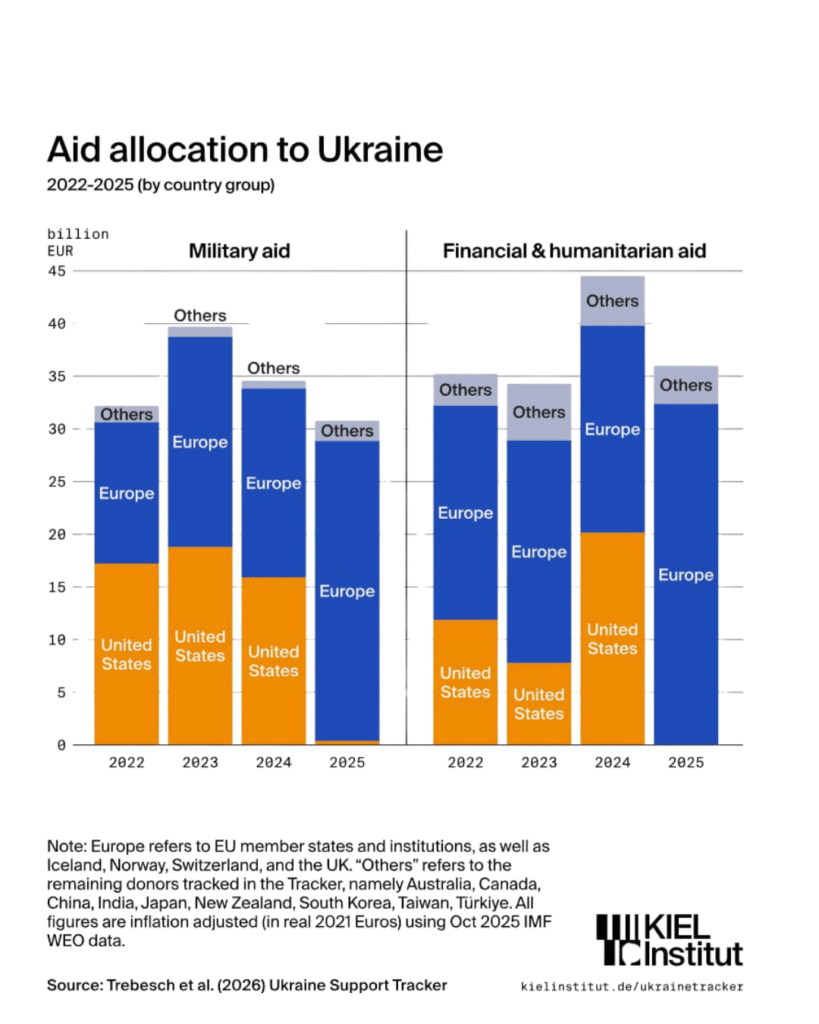
The U.S.view: Washington has repeatedly accused EU countries of insufficient support for Ukraine, even under the Biden administration. President Trump significantly overstated U.S. contribution, claiming total U.S. support exceeded $300 billion, although actual figures — including direct assistance, investments in the U.S. own military, and related expenditures — amounted to approximately $175 billion[52]. Under his administration, scepticism toward aid intensified[53]: several programmes approved under the previous administration, including the Ukraine Security Assistance Initiative (USAI), were repeatedly suspended[54], and additional funding dropped sharply: from $60 billion in 2024 to around $800 million in 2026[55].
Following the Oval Office confrontation between Trump, U.S. Vice President JD Vance, and Zelenskyy in February 2025[56], the U.S. temporarily halted intelligence sharing and military aid to Kyiv, demonstrating that support for Ukraine can be used as a tool of political leverage. Disruptions in both American weapons and intelligence support contributed to the loss of some Ukrainian territories and to widespread bombing of cities[57]. Although intelligence sharing was later restored and deliveries were resumed, the episode exposed the fragility of U.S. commitments. Despite periodic expressions of frustration with Putin’s unwillingness to negotiate[58] [59], a return to large-scale direct U.S. assistance remains unlikely amid the administration’s Indo-Pacific reorientation and concerns over depleted stockpiles[60].
The EU view: In early 2025, EU military assistance to Ukraine lagged behind that of the United States – $52 billion against $65 billion, although Europe provided more humanitarian and economic aid[61].
By the end of the year, however, the EU significantly increased its military support, surpassing total U.S. contributions ($70 billion)[62].
While Member States failed to reach consensus on the use of frozen Russian assets, the EU has agreed to indefinitely freeze the assets[63] and continue support through 90€ bn EU borrowing backed by budget headroom[64]. Though lacking strong symbolic impact, the decision demonstrated the EU’s ability to advance through compromise, despite initial Hungarian and Slovak positons[65].
Many in the EU hesitated that the United States would be willing even to sell weapons for Ukraine. Yet, the ad hoc PURL initiative emerged to finance U.S. arms for Ukraine with European funds, aiming to prevent further setbacks on the frontline and meet Ukraine’s most pressing military needs[66], though without full EU participation. EU member states nevertheless remain unable to replace certain critical US-provided capabilities, particularly in communications and intelligence, due to limited satellite infrastructure[67]. Uncertainty also persists over the sustainability of U.S. arms supplies amid stockpile concerns, and over Europe’s willingness and ability to continue purchasing American weapons at the same levels in the context of growing political and economic tensions with Washington.
- Security Guarantees: Europe’s Indecision and U.S. Constraints.
Credible security guarantees are one of the vital elements for Ukraine to engage in any peace talks. Yet, there are no accurate details on the level of the U.S. commitments, while Europe, though more willing in principle, faces unresolved questions about its decisiveness and long-term capacity. The mismatch between Ukrainian expectations, U.S. restraint, and European uncertainty defines the current trilateral dilemma.
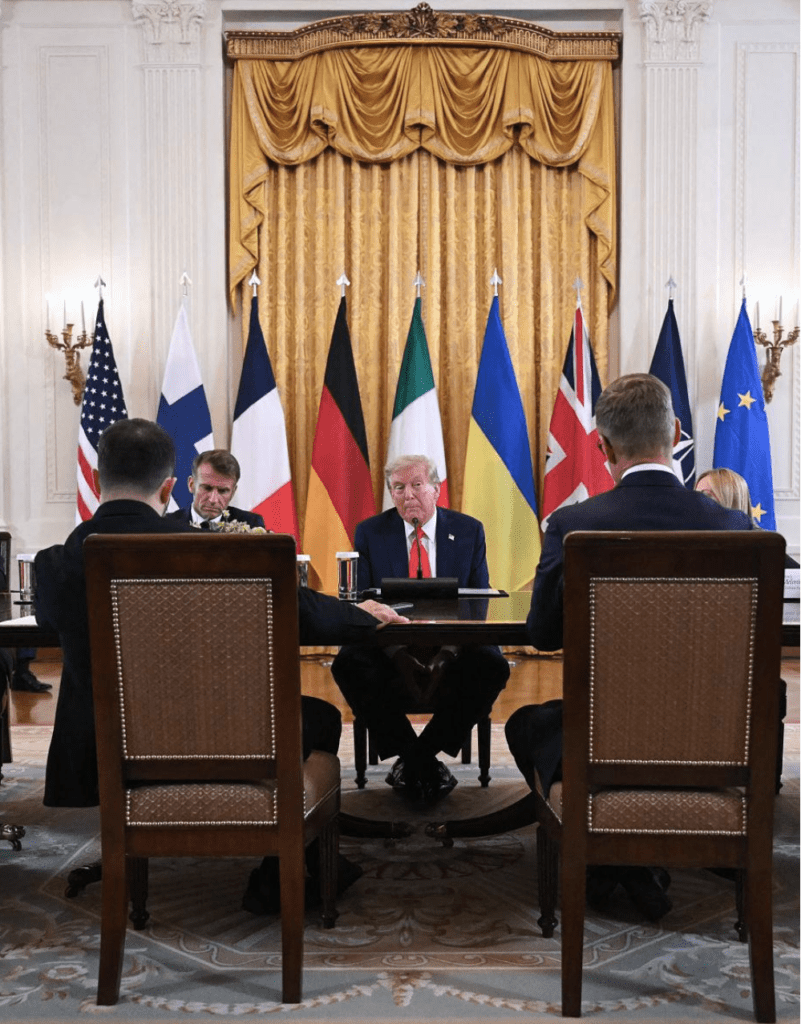
The U.S. made clear it will not offer direct security guarantees with boots on the ground or lead a peace-enforcement mission[68]. While the White House has welcomed the idea of the European-led “coalition of the willing”, U.S. support remains largely undefined[69] [70].
Any American involvement is likely to be indirect (strategic enablers, ISR, monitoring), leaving operational responsibility primarily with European partners.
At the same time, uncertainty remains regarding whether the current administration would reliably uphold any security guarantees it offers.
For many in Europe, the primary goal of the coalition of the willing is to demonstrate resolve and signal to the U.S. that Europeans are prepared to take responsibility for its own security[71]. However, participation is highly conditional, shaped by three key prerequisites: a ceasefire, deployment away from active combat zones, and sufficient U.S. political and logistical backing[72]. Any deployment would also require balancing national defence priorities, NATO’s strategic reserves, and troop presence on the Eastern Flank[73]. Although French, British and Ukrainian militaries are reported to have determined force contributions, mandates and command structures, these details remain unknown to the general public[74].
For Ukraine, uncertainty over security guarantees remains a significant challenge. President Zelenskyy consistently emphasises that security guarantees are essential to deter renewed Russian aggression and to enable Ukraine to support European partners if they are attacked[75]. The society also supports deployment of partner troops within the coalition of the willing in Ukraine (72,7%)[76] and sees such foreign involvement as important for deterrence. At the same time, questions remain about the credibility and durability of European engagement in the absence of firm U.S. commitments.
- Economy: Strategic Costs of U.S. Tariffs
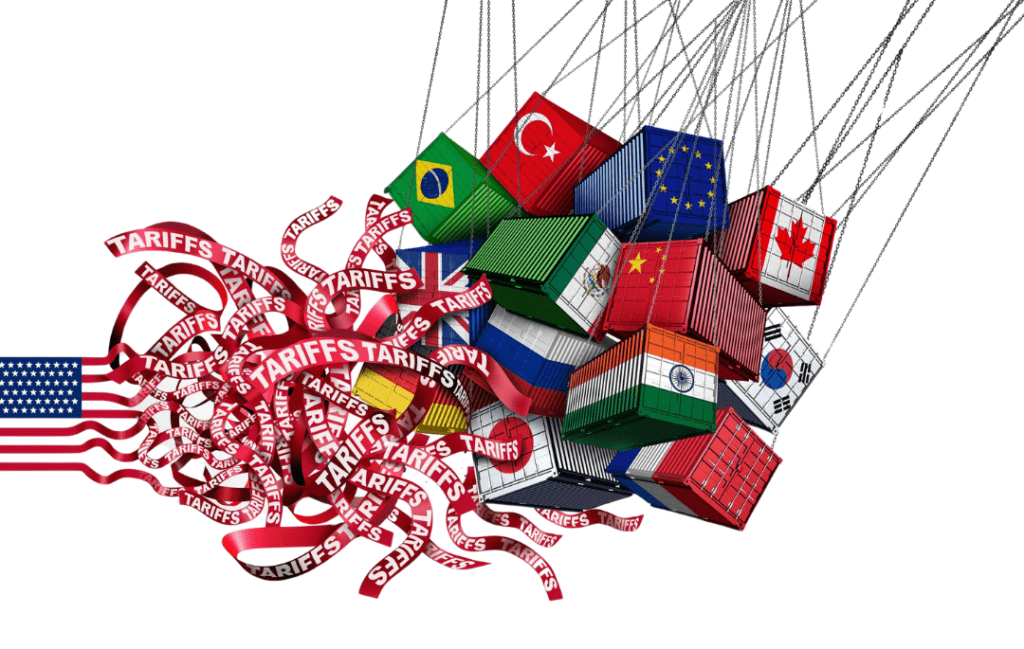
As in 2025 the United States imposed 20% tariffs on EU goods and threatened to raise them to 30%, the White House framed the measures as necessary to strengthen domestic manufacturing, reduce trade deficits, and secure critical supply chains[77]. Some sectoral tariffs and threats seemed politically motivated: domestically, to support import-competing industries in key swing states such as Michigan, Wisconsin, Pennsylvania[78]; and internationally, to influence European partners over Greenland[79].
In practice, the 2025 tariffs fell short of their objectives: they produced mixed economic outcomes[80], generated high domestic opposition, with roughly 60% of Americans considering the tariffs illegal[81], and strained trust and cohesion in transatlantic relations[82].
European policymakers viewed the tariffs as disproportionate and destabilising to the economic ties across the Atlantic. Nevertheless, to maintain stable relations with Washington, Brussels accepted trade terms that would otherwise have been difficult to justify: most tariffs were capped at 15%, while 50% duties remained on steel, aluminium, and copper[83] [84]. Although the agreement reduced immediate uncertainty, it highlighted the politicisation of U.S. economic policy and revealed the EU’s vulnerability to economic coercion as long as it remains dependent on the United States for security. In this context, the Supreme Court ruling that most 2025 tariffs were illegal gives the EU a legal and political basis to reassess or suspend the agreement’s implementation[85].
- The EU and NATO Future
- Backing European Power, Limiting EU Influence.
President Trump’s persistent criticism, efforts to undermine the EU’s political legitimacy, and challenges to its democratic norms are eroding the long-standing, trust-based relationship between Washington and Brussels.
The U.S. administration frames the EU as responsible for Europe’s alleged wrong turn[86], “civilisational erasure,” and the “erosion of national identities”[87]. These narratives, echoed in official speeches and the U.S. National Security Strategy, reflect a confrontational stance toward Brussels. Tensions are reinforced by the EU’s position as a powerful regulatory actor that resists external pressure. Disputes over digital regulation illustrate this dynamic: U.S. Secretary of State Marco Rubio framed EU penalties on Elon Musk for violating European rules as an attack on American technology companies and, by extension, American people[88].
For the EU, this approach exposes a growing asymmetry in the transatlantic relationship. While individual European states may be vulnerable to bilateral pressure, the Union’s regulatory and economic power makes it a frequent target of political attacks. Such rhetoric risks eroding trust, complicating cooperation across policy domains, and emboldening Eurosceptic far left and far right parties to weaken the EU from within.
For Ukraine, the pursuit of EU membership remains the cornerstone of its foreign policy. The united EU also serves as one of Kyiv’s strongest advocates for financial and security assistance within Europe. Therefore, efforts that undermine the EU’s political authority are not acceptable for Ukraine.
- Vetoed Enlargement and Fast-Track Accession.
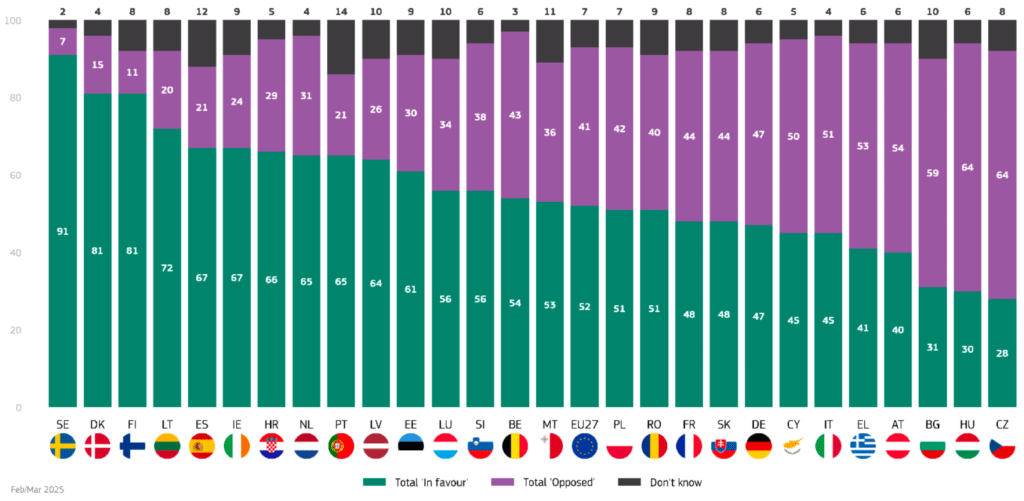
Despite Ukraine’s progress on EU integration reforms and positive European Commission’s assessments[89], political obstacles continue to block accession. Hungary’s veto has prevented the opening of negotiations clusters[90], stalling enlargement and exposing a structural weakness in EU decision-making. At the same time, there is no consensus on Ukraine’s fast-track accession, backed by the U.S.
From the American perspective, Hungary’s veto reinforces perceptions of EU weakness and fragility.
The U.S. supports Ukraine’s EU integration and views fast-track accession — with ambitious and arguably realistic deadlines like 2027 — as one of the top priorities for ending the war and shifting responsibility to the EU[91].
However, this support is often framed through a politicised lens, reflecting a limited American understanding of EU enlargement: not as a reform-driven process, but as negotiation that can be accelerated through bargaining or pressure on the EU. This disconnect undermines U.S. confidence in the EU’s ability to act as an autonomous geopolitical actor willing to share risks.
Frustration within the EU over Hungary’s use of veto is mounting, yet no decisive steps have been taken to break the deadlock, such as shifting from unanimity to qualified majority voting.
This inaction reflects some member states’ reluctance to pursue a long-term structural solution, instead managing the problem through frontloading and procedural workarounds. Prolonged reliance on such tactics risks normalising veto weaponisation and weakening enlargement process[92]. At the same time, while the European Commission has proposed ideas like “reverse enlargement” or gradual integration for Ukraine[93], member states, including France and Germany, remain sceptical of fast-track accession[94].
For Ukraine, the continued blockage of cluster openings is deeply destabilising. Kyiv seeks formal negotiations as recognition of reform progress and a signal of EU commitment. Prolonged delays risk eroding domestic support for reforms, fuelling euroscepticism, and undermining momentum for enlargement at a critical moment in Ukraine’s EU trajectory.
Kyiv views EU membership as an important “soft” security guarantee.
To this end, President Volodymyr Zelenskyy argues that accession is feasible under a fast-track scenario and should be tied to a clear date in any agreement, ending the war[95].
- Eroding NATO.
Growing transatlantic tensions are disrupting NATO, the central institutional embodiment of decades-long transatlantic cooperation. While Europeans remain heavily dependent on the United States, particularly on the nuclear umbrella, manpower, and military bases, political frictions directly undermine alliance cohesion.
The U.S. administration has emphasised America’s central role in NATO to justify reshaping the Alliance around the president’s priorities rather than collective consensus[96], framing pressure on allies over defence spending as having “saved NATO.” This approach extends beyond burden-sharing: rhetoric regarding U.S. incorporation of Greenland[97] undermines respect for state sovereignty and threats of tariffs signal willingness to exert pressure on allies[98]. Simultaneously, Washington is pursuing “NATO 3.0,” shifting primary responsibility for conventional defence to Europe while concentrating U.S. resources on other theatres[99]. Thus, in early 2026 the U.S. transferred three Joint Force Commands to European control[100], while simultaneously taking over the command of maritime forces (MARCOM) [101].
In response to U.S. pressure, most European NATO members met the 2% GDP defence spending target by the 2025 Hague NATO summit and accepted a new benchmark of 5% by 2035[102]. However, implementation of the latter would be challenging. While the EU has adjusted rhetorically and financially, U.S. pressure over Greenland has become a political shock, triggering deeper concern about alliance reliability. At the same time, a
“European NATO” remains structurally difficult absent major changes to the alliance’s structure: the Supreme Allied Commander Europe (SACEUR) is always American, and the United States permanently chairs NATO’s Nuclear Planning Group.
This highlights Europe’s dependence on U.S. leadership even as trust in that leadership erodes.
Ukraine’s future NATO membership remains a point of divergence within the Alliance. The 2023 NATO Summit in Vilnius consolidated Ukraine’s prospective accession[103], yet the strategic landscape shifted under Donald Trump. While Alliance’s earlier collective commitments were not formally revoked, Washington signalled that Ukraine’s membership is off the table[104], with reported proposals requiring Kyiv to renounce its accession ambitions[105]. Kyiv continues to view NATO membership as its preferred long-term security guarantee, acknowledging that accession cannot occur during active hostilities, but hoping the window may reopen as political circumstances evolve[106]. Against this backdrop, most European Allies uphold the open-door principle and support Ukraine’s eventual accession, though some vocal and silent exceptions remain[107].
Chapter 2. Areas of Strategic Alignment in the EU–U.S.–Ukraine Security Framework
Business competitiveness, China, and the Arctic seem to be among the central priorities of current U.S. foreign and economic policy. For Europe, pragmatic cooperation with Washington in these and similar areas offers a viable pathway to stabilizing increasingly fragile transatlantic relations at a time when values-based alignment has lost much of its mobilizing force. This chapter examines concrete various policy domains in which the interests of the U.S., EU and Ukraine continue to converge. It also assesses how cooperation in these areas can reinforce transatlantic coordination despite ongoing geopolitical turbulence.
- A Just Resolution of the Russo-Ukrainian war
The United States, the EU, and Ukraine possess a solid foundation for reaching consensus and ending the Russo-Ukrainian war on fair and sustainable terms, with Ukraine capable of defending itself and retaining the capacity to seize tactical initiative on the battlefield.
While the current U.S. administration appears to prioritise a rapid peace settlement before midterm elections, a just and durable peace in fact aligns with both U.S. and EU strategic interests
and position President Donald Trump as a credible peacemaker, who ended the largest European war since the Second World War. Moreover, the growing recognition in parts of the U.S. policy community that business deals with Russia would be largely hollow[108] [109] suggests that peace should be framed as a strategic imperative rather than a transactional bargain.
In practical terms, limited space for European participation in trilateral U.S.–Ukraine–Russia peace negotiations still exists, although it remains constrained. Ukraine’s coordination with European partners, such as joint communication with President Trump following the Oval Office incident in March 2025, demonstrates the potential for indirect trilateral engagement. The EU’s newly developed position paper on concessions Russia should make in ongoing diplomatic talks with Ukraine is ambitious[110]. Yet, it is reasonable that the EU and Ukraine should jointly articulate their positions on Ukraine’s future EU integration, particularly in light of the U.S.–Russia “20-point peace plan.”
Despite differences regarding the exact details of the involvement of parties, both the U.S. and EU countries recognise the need to provide Ukraine with robust security guarantees or protocols to prevent a repeat of Russian aggression[111] [112]. Even if the United States refrains from deploying troops, it might support a “coalition of the willing” through strategic enablers such as intelligence sharing, MRO services, airlift and broader logistics etc.Washington has also expressed its readiness to provide a limited force to monitor and verify a potential ceasefire and to deepen bilateral cooperation with Ukraine in the postwar period[113]. Such engagement serves both U.S. and EU interests by contributing to the consolidation of Ukraine as a state with credible and effective deterrent capabilities.
With U.S. military assistance to Ukraine largely curtailed, the PURL initiative remains a functional model for EU–U.S. cooperation. For the EU, procurement from the U.S. for Ukraine remains unavoidable,[22] since key capabilities are available only from U.S. producers, and Europe is unlikely to achieve defence-industrial self-sufficiency for at least 5–10 years.
At the same time, PURL advances U.S. interests by sustaining Europe as a key defence export market, reinforcing a tangible model of burden-sharing, and aligning with the America First Arms Transfer Strategy’s (AFATS) emphasis on supporting partners that invest in their own security and play a critical role in U.S. planning[114]. Domestic backing also remains significant:
public approval for supplying U.S. weapons to Ukraine reached 64% in 2025, up nine percentage points from 2024[115].
To strengthen the programme, participation could be broadened and shifted from emergency packages toward a long-term supply framework.
Frozen Russian assets represent another potential area for future cooperation, although political support remains limited. The initial proposal to allocate frozen assets has been partially substituted by a €90 billion EU loan to Ukraine. However, if approximately €180-200 billion in Euroclear-held assets are transferred from Belgian to EU jurisdiction, the issue may re-emerge on the EU agenda[116]. While the Trump administration has been against using the assets, the U.S. Congress has introduced the REPO Implementation Act of 2025, calling for the transfer of an estimated $5 billion in Russian frozen assets in the U.S. to Ukraine every 90 days[117].
Partners could also adopt a more assertive approach to disrupting Russia’s shadow fleet, which would both constrain revenues financing Moscow’s war effort and address broader security risks: the fleet has reportedly supported hybrid activities threatening critical maritime infrastructure, including undersea communication cables[118]. Previous measures have proven insufficient to significantly degrade the operational capacity of these fleets[119].
Closing this gap requires enhanced monitoring such as integrating flag-registry oversight into the FATF framework[120] or more robust enforcement on EU side, mirroring U.S. operations off Venezuela[121].
Any such campaign should be comprehensive rather than selective, targeting logistical networks as a whole to constrain long-term cooperation among sanctioned states.
The reconstruction of Ukraine constitutes a long-term investment opportunity for both the EU and the U.S. Ukraine’s recovery needs are projected from $587.7 billion[122] to $1 trillion[123] over the next decade. Rebuilding Ukraine’s ports, railways, and road would integrate Ukrainian logistics nets deeper into the EU and make Ukraine an Eastern European logistics center[124], creating new business opportunities for the U.S. by easing American firms’ entry into EU value chains[125]. A prosperous, resilient Ukraine would strengthen regional security and deepen transatlantic economic ties.
- Countering the Authoritarian Alignment
Both the EU and the U.S. recognise the growing socio-political and security risks associated with the emerging alignment among China, Russia, Iran, and North Korea, which is widely perceived as a destabilising axis in the contemporary international order[126]. The Russo-Ukrainian war provides the illustration of this dynamic: China, North Korea, and Iran are not only supporting Russia’s aggression, but are also using the war to test and upgrade their own military-industrial capabilities, including nuclear programs, and to secure related economic and technological gains. Against this backdrop, the transatlantic partners face a growing need to develop coordinated strategies to deter, constrain, and respond to the activities of China, Iran, and North Korea.
- Managing Strategic Competition with China
Despite differing threat perceptions, both the EU and the U.S. face a tangible challenge from China, at least through its deepening alignment with Russia. Cooperation between Moscow and Beijing is driven by a shared ideological objective to counter Western influence[127]. Through this partnership, China is absorbing new lessons in combat tactics[128], while serving as a decisive enabler of Russia’s war.
The PRC is reportedly responsible for roughly 80% of sanctions circumvention[129]
facilitating it through re-exports of Western technology, domestic substitutes, and alternative transport and payment infrastructures that attract other authoritarian states[130]. These aspects make a closer U.S.-EU-Ukraine coordination on China both urgent and necessary.
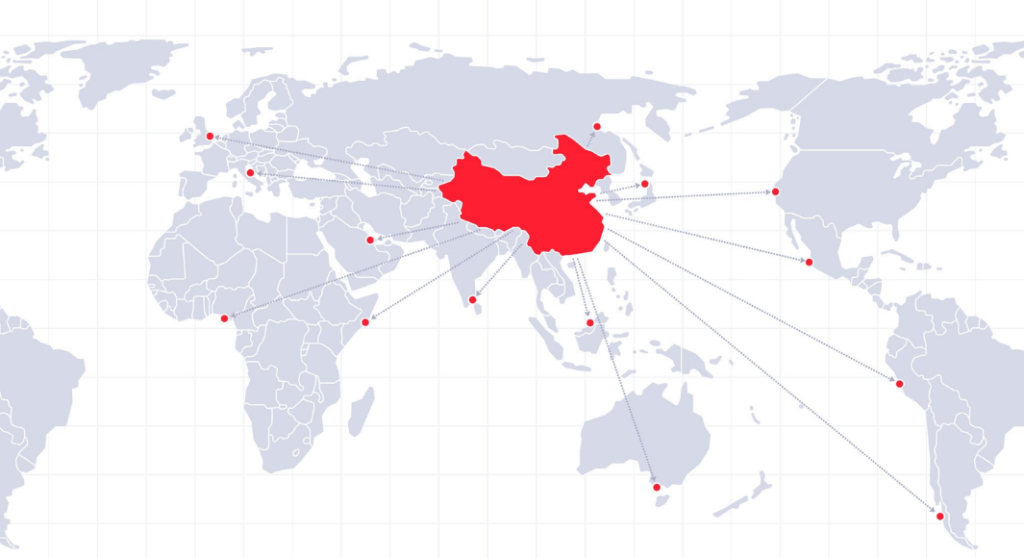
The EU and the U.S. pursue the objective of safeguarding critical and dual-use technologies, seeking to prevent their transfer, particularly where such technologies could support Russia’s war effort or a potential Chinese military campaign against Taiwan[131]. However, coordination gaps among allies allow Beijing and Moscow to exploit Western regulatory and enforcement weaknesses. Addressing these gaps requires policy convergence on both sides of the Atlantic. The United States should start treating Russia and China as increasingly integrated strategic actors, while the EU should adapt its approach by following U.S. practice in blacklisting China-linked defence and surveillance firms.
Such measures should not be limited to Russia sanctions packages but embedded in the EU’s broader de-risking strategy toward China[132]. It is also in the common interest to coordinate financial measures between U.S. and EU institutions to block China-based intermediaries from accessing dollar and euro channels used to help in sanctions evasion[133].
The U.S. and the EU should also continuously synchronise updates to dual-use control lists, in close coordination with Ukraine,
which plays a critical role in identifying Western components used in Russian weapons systems (e.g., drone parts, machine tools, technologies)[134]. On this basis, a harmonised transatlantic list of “no-export” entities, including subsidiaries and known intermediaries, should be developed to reduce grey zones where entities restricted in one jurisdiction remain accessible in another[135]. While a perfect blockade is unattainable, targeted disruption of key nodes and routes can meaningfully slow both China’s militarisation and Russia’s war effort[136].
- Addressing Iranian and North Korean Threats
Iran and North Korea’s military and nuclear ambitions threaten U.S. interests and Middle Eastern allies, while their support for Russia’s aggression poses a direct security risk to Europe. North Korea supplies Russia with ammunition and missiles and has deployed an estimated 15,000 military personnel[137].
Iran has transferred Shahed-107[138] and Shahed-136 drones[139] playing a crucial role in Russia’s strikes against Ukrainian cities and critical civilian infrastructure[140]. Danger posed by Iran and DPRK is acknowledged by both the U.S. National Defence Strategy[141] and the European Council Conclusions[142], but it is possible to pursue a more effective coordinated strategy to contain them.
One potential measure to mitigate this threat is enhanced intelligence-sharing among allies, particularly exchange of satellite-derived data to assess adversaries’ military capabilities and production capacities. This should be complemented by closer coordination of secondary sanctions targeting third-country intermediaries involved in the procurement and transfer of dual-use electronic components essential to the production of Russian drones and Iranian and DPRK missile systems. The U.S., the EU, and Ukraine should also prioritise disrupting illicit supply chains and shadow fleets that facilitate cooperation among revisionist actors.
- Engaging Globally
Cooperation between the United States and the European Union extends beyond U.S. responsibility for European deterrence. It is mutually dependent:
European goods are integral to U.S. supply chains, the EU is the United States’ largest trading partner[143] and holds roughly 24 percent of the U.S. Treasury market[144]. European states have long supported U.S. leadership in the international system, including through participation in the War on Terror, alignment with U.S.-led sanctions regimes, and cooperation on global crisis management.
Beyond diplomatic and economic alignment, EU member states have also historically supported U.S. strategic objectives in the Indo-Pacific, the Middle East, and Africa by hosting American military infrastructure. More than forty U.S. military bases are located across Europe, providing critical platforms for forward deployment, intelligence and power-projection operations[145] [146]. EU member states and Ukraine frequently act as core partners in advancing U.S. initiatives within international organizations and in support of the U.S. “Free and Open Indo-Pacific” vision[147]. Several European countries participate in US-led military exercises in the region, including Talisman Sabre and RIMPAC.
There are viable ways to enhance such cooperation and extend it to other regions. Under NATO leadership, operations such as Baltic Sentry launched in response to multiple incidents of undersea sabotage in Northern Europe, and Eastern Sentry, initiated following a major Russian drone incursion into Polish airspace, have demonstrated operational effectiveness. Scaling up and replicating these practices in other strategically sensitive regions would facilitate more equitable risk-sharing within the Alliance and strengthen collective deterrence.
- Turning Arctic into Strategic Advantage
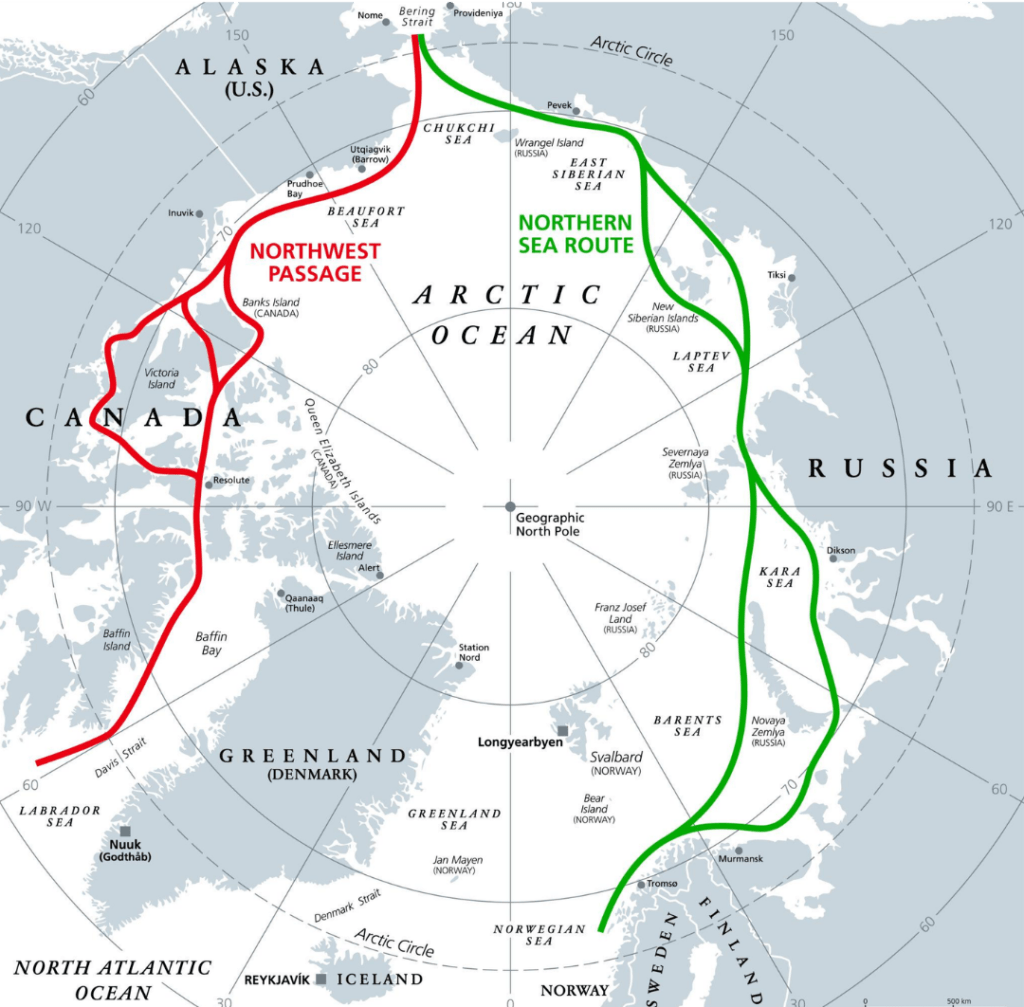
The Arctic is crucial to both the U.S. and the EU for its strategic military significance, access to natural resources, and emerging shipping routes such as the Northern Sea Route. Moreover, the region’s importance is heightened by activities from Russia and China that threaten U.S. and EU interests: Russia’s militarization and industrial exploitation still help to finance its war against Ukraine[148] and pose environmental risks[149]. In addition,
China’s investments in Arctic shipping routes, ports, and satellites, supported by the ‘Polar Silk Road’ and joint China–Russia military exercises, challenge transatlantic influence in the region[150].
Therefore, cooperation between the U.S., EU and Ukraine is essential to address these challenges and there are foundations on how it can be deepened.
First, cooperation should build on and expand existing achievements. NATO has already increased its activity in the region through the Arctic Sentry mission, bringing together NATO and Allied activities into one[151].
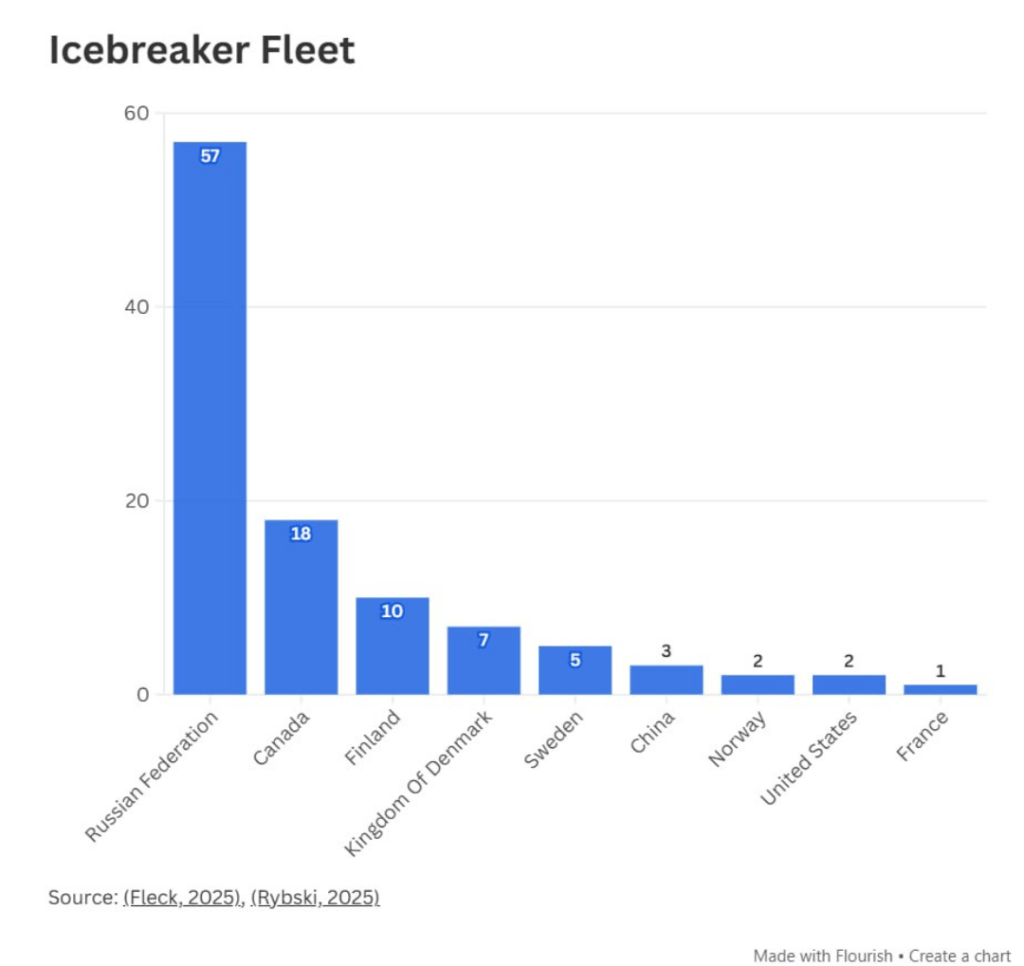
Furthermore, the U.S., Canada, and Finland signed the ICE Pact[152], intended to multiply manufacturing capacity for polar icebreakers and related capabilities. The next step is its operationalisation[153]. Although Russia currently maintains the world’s largest icebreaker fleet[154], the agreementcould narrow this gap and enable a more persistent NATO presence in the region[155].
This aligns with the EU’s partnership-based Arctic approach[156] and would allow Washington to strengthen its position in the High North by sharing risks and responsibilities with European allies. Ukraine could be a potential subcontractor for non-core parts of the icebreakers after the war, provided that funding is allocated for the restoration of Energomashspetsstal factory, damaged by the Russian missile strike in the Donetsk region[157].
Second, cooperation can be deepened amid the changing security environment: NATO’s extended frontline, rising strategic role of Greenland and the consequences of the Russo-Ukrainian war.
Sweden and Finland joining NATO enablesa subregional stronghold approach[158] in the European Arctic based on coordinated EU-U.S. deterrence. Cooperation could focus on building a combat-ready forward presence, strengthening regional command-and-control structures, improving military mobility and reinforcement routes, and integrating new European forces under a clear role-based division of labour aligned with NATO regional plans. This coordination, supported by high-readiness reinforcement from rear-area allies, will generate aggregated deterrence by forcing Russia to disperse resources across theatres, thereby strengthening overall Euro-Atlantic stability.
Additionally, Greenland has a strategic role for the American potential Golden Dome system as a possible vanguard for missile-warning sensors, observation systems, and interceptor capabilities. Strengthening deterrence therefore requires coordinated US–European action within the NATO framework[159], building on existing Arctic cooperation efforts established in the High North after the Second World War.
Trump`s “Golden Dome” initiative[160] could enhance transatlantic deterrence for both U.S. and EU, provided it is carried out in cooperation rather than competition with Europe.
At the same time, Ukraine’s strike on Russian strategic bombers at Olenya airbase during Operation “Spider Web”[161], cyber operations against the Russian Navy[162], and sustained Ukrainian resistance has further degraded Russia’s ability to project power in the Arctic, [33] undermining plans to respond to NATO’s northern enlargement through the expansion of its Arctic brigades[163]. This simultaneously gives the West the time and opportunity to adapt to future challenges and demonstrate the need for military cooperation with Ukraine, as it has strategic influence beyond the war.
- Reconfiguring Power in the Black Sea
The Black Sea is a shared EU–U.S.–Ukraine priority for security, trade, connectivity and energy resilience.
The region functions as a critical connectivity corridor linking Europe, the Middle East, Central Asia, and the Mediterranean.
It facilitates agricultural exports essential for global food security and serves as a transit route for oil and gas, with the potential to further integrate European and Central Asian energy markets. Moreover, the Black Sea contains substantial offshore gas reserves, making it central to EU and U.S. efforts to diversify energy supplies away from Russia.
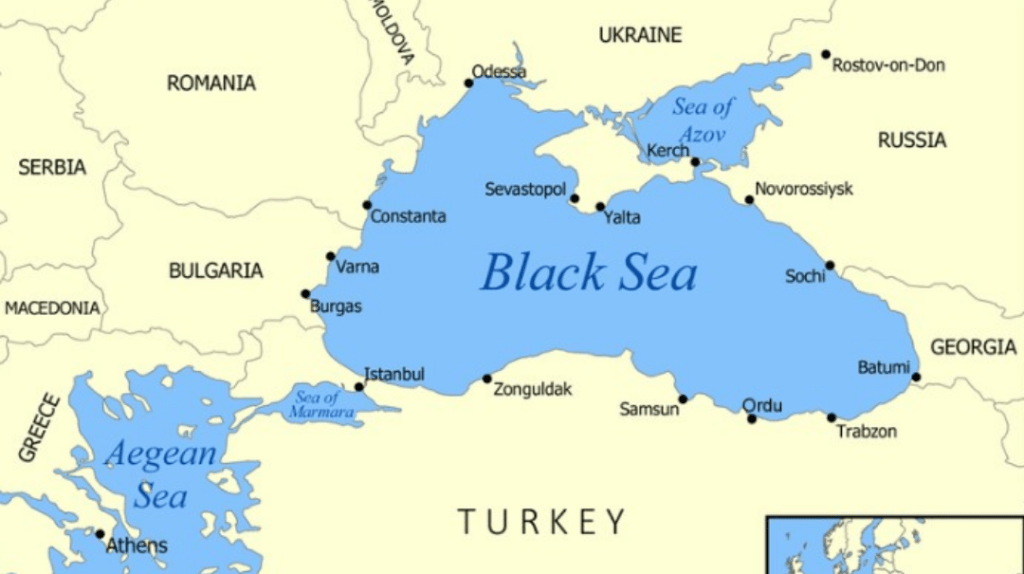
This strategic importance has translated into growing institutional attention from Western actors. In May 2025, the European Commission launched its first Black Sea strategy[164]. The United States has engaged through Congressional hearings on the future of the U.S. Black Sea strategy in September 2025 and the 2023 Black Sea Security Act[165]. NATO Allies affirmed the region’s centrality at the July 2023 Vilnius Summit[166].
However, significant threats to these shared European and American interests are posed by Russian military aggression, turning Ukraine’s occupied territory into a giant military base to control trade routes and further project power into Caucasus, Balkans and Middle East, as well as by China’s growing economic and infrastructural presence, including its development of Georgia’s Anaklia port as part of the Belt and Road Initiative[167]. Against this backdrop, the EU, the U.S., and Ukraine can deepen cooperation across several priority areas.
First, maritime security, particularly demining, represents an immediate priority. Since 2014, Russia has relied on a two-step blockade strategy: declaring extensive maritime areas “unsafe” and deterring neutral shipping through the use of sea mines, rising insurance costs, and recurrent strikes[168]. Joint efforts with NATO’s Shipping Centre, national hydrographic offices, and initiatives such as the Mine Countermeasures Black Sea Task Group led by Turkey, Romania, and Bulgaria have already demonstrated effectiveness in ensuring global food security. These initiatives could be expanded to include U.S. reconnaissance platforms, such as MQ-9 Reaper drones, and Ukraine’s participation in the trilateral framework. Such cooperation would help guarantee free and secure navigation in the post-war period[169].
Second, energy security presents another critical pillar for trilateral collaboration.
Coordinated efforts and foreign investment in Romanian, Bulgarian, and Turkish offshore reserves[170] could boost regional economies and displace Russian gas from EU markets[171] in line with U.S. strategic interests.
In this regional context, Ukraine has begun importing American liquefied natural gas (1 billion cubic meters in 2026[172]) and proposes developing an LNG terminal in Odesa[173], while offering energy assets to the U.S.-Ukraine reconstruction investment fund under the U.S. Resources Pact[174]. However, Ukraine’s own vast Black Sea gas reserves — potentially exceeding two trillion cubic meters[175] — remain largely inaccessible due to Russian occupation and militarization of seized offshore platforms[176].
Broader regional security cooperation is needed and could be deepened through an integrated EU-NATO framework. The European Commission’s recently proposed Black Sea Maritime Security Hub[177] aimed to improve intelligence sharing, bolster coastguard cooperation, and oversee critical infrastructure such as submarine cables, pipelines, and wind farms. Including Ukraine and Turkey in this initiative would allow the EU to incorporate Kyiv’s naval innovations and wartime intelligence experience, while reinforcing deterrence against Russian aggression and strengthening EU-NATO cooperation[178].
Complementing these efforts, NATO can enhance military mobility across the region by auditing key infrastructure in Romania and Bulgaria, ensuring rapid deployment of forces and equipment during contingencies. A continuous 365-day NATO naval presence in the Black Sea and more frequent joint naval exercises, would further strengthen deterrence and demonstrate Allied commitment to regional security.[179] In the post-war period Ukraine could be a key partner in training Western naval force due to the operational experience of the Ukrainian Navy and the legacy of the Sea Breeze exercises[180].
Finally, the Black Sea has emerged as a successful case study of the application of an asymmetric strategy. Ukraine’s naval campaign[181], including the elimination of 30% of Russia’s Black Sea fleet and sinking of its flagship “Moskva”, provide valuable lessons on power projection using affordable, scalable tech like sea drones and land-based missiles (e.g., Neptune), extending coastal defense ranges dramatically[182]. By sharing these insights, the U.S., NATO, and regional partners can accelerate the integration of unmanned technologies into broader naval planning[183].
In particular, collaboration with Ukraine would provide Washington with operational and technological advantages for potential Indo-Pacific conflicts, supporting a “hellscape strategy” in which low-cost drones form an autonomous, lethal shield against an amphibious threat to Taiwan.[184]
- Strengthening Cooperation in Critical Raw Materials
In 2023, China was the leading producer for 29 of the 50 critical minerals on the 2022 critical minerals list[185]. The European Union and the United States regard supply-chain resilience as a critical component of addressing the strategic challenges posed by China, as its coercive export controls on critical raw materials are a potential geo-economic weapon that exposes strategic dependencies and industrial vulnerability[186].
In February 2026 the U.S. launched the Forum on Resource Geostrategic Engagement (FORGE), bringing together 54 representatives, including Ukraine[187] and the European Commission[188].
This is the clearest example that despite instances of uncooperative U.S. policies, the critical minerals sector remains a shared strategic challenge[189] and to overcome it, it is necessary to move from competition to greater cooperation.
Some of the possible options for cooperation in this area are harmonizing standards[190] and coordinating industrial buildout in Europe to expand non-China processing capacity and lock in transatlantic offtake for key industries. To this end it is also vital to set up a co-financing mechanism between the U.S. International Development Finance Corporation and the European Investment Bank[191] to support projects that de-riskthird-country mining, processing, and recycling, and to attract private capital.
U.S.-EU cooperation in Ukraine can be a first step to align EU and U.S. policies on resource supply.
Ukraine possesses deposits of 22 of the 50 minerals designated as critical by the U.S. government and 25 of the 34 minerals on the European Union’s critical raw materials list[192].
The bilateral agreement signed in April 2025 grants the United Statesprivileged access[193] to Ukrainian critical minerals and forms the basis for cooperation with Ukraine under the Trump administration. Since 2021 Ukraine has also been an official EU partner on critical raw materials under a Memorandum of Understanding[194].
Ukrainian mineral resources are of strategic value for Europe, particularly given the EU’s limited domestic deposits. Moreover, Europe’s relatively constrained ability to diversify its export destinations makes Ukraine reserves even more significant[195]. The EU possesses such structural advantages as geographic proximity, established logistics and trade networks, and regulatory frameworks capable of integrating Ukraine into both European and U.S. markets.
A coordinated approach would enable both partners to share the risks and costs associated with developing Ukraine’s extractive sector, while simultaneously enhancing security and investment guarantees for Kyiv.
- Enhancing the EU–NATO Security Nexus
While the EU neither seeks nor can replace NATO,[196] given the lack of a unified military command, surveillance and nuclear deterrence, it can strengthen cooperation with the Alliance and Ukraine to make Europe a stronger security actor. Since Russia’s full-scale invasion of Ukraine, EU–NATO cooperation has deepened significantly.
This progress is reflected in the third Joint Declaration on EU–NATO cooperation, seven Structured Dialogues, and EU–NATO Staff Coordination on Ukraine[197]. In parallel, practical cooperation has expanded across cyber defence, military mobility, and critical infrastructure protection[198]. The EU also mobilised funding through the SAFE mechanism and the activation of the national escape clause to support delivery of key NATO capability targets[199].
Building on these advances, further steps could strengthen EU-NATO cooperation and improve interoperability. The EU could use its regulatory power and financial incentives to accelerate implementation of NATO standards for equipment, e.g. tanks, joint European testing and certification to improve interoperability.
This need has been underscored by the Russo-Ukrainian war, which exposed inconsistent interpretations of NATO ammunition standards[200].
Improved information exchange and intelligence sharing, by addressing longstanding Greece-Turkey constraints, would significantly strengthen situational awareness and policy coordination. At the operational level, relying on NATO command structures under the “Berlin Plus” agreement for future non-NATO crises, rather than creating a separate European chain of command, would help build trust and avoid unnecessary duplication[201].
Beyond bilateral EU-NATO cooperation, deeper trilateral engagement with Ukraine is also possible. Given the lack of Washington’s support for Ukraine’s near-term NATO membership, accelerating Ukraine’s EU integration and introducing trilateral structured EU-NATO-Ukraine dialogues could, in the interim, bring Ukraine closer to European defence structures and enhance interoperability[202]. In a post-war context, Ukraine’s war-proven military could also serve as instructors in EU and NATO military exercises. More broadly,
Ukrainian combat experience gathered through EUMAM, NSATU, and JATEC could be systematically integrated into European training programmes for soldiers and reservists.
The necessity of these measures is evidenced by the Hedgehog 2025 simulation, which revealed substantial deficiencies in NATO’s preparedness for modern electronic and unmanned aerial warfare in comparison to battle-hardened Ukrainian units[203].
- Deepening Defence Industries Cooperation
- Testing in Ukraine.
Ukraine has become a testing ground for a plethora of Western systems since 2022. In the summer of 2025, Kyiv institutionalised this process and launched the “Test in Ukraine” initiative, which, according to the Ukrainian government, offers foreign companies a unique opportunity to evaluate their systems under near-combat conditions alongside units with extensive battlefield experience[204].
This model provides direct operational feedback from the military, enabling rapid refinement of technologies and their adaptation to the practical demands of modern warfare. Forty-five international companies have already joined the initiative[205], and broader participation would further enhance the West’s ability to adjust to evolving modes of warfare, thereby contributing to Ukraine’s resilience as well as the deterrence capabilities of its partners.
- Co-producing with Ukraine.
According to Ukraine’s Council of Defence Industry, country’s potential production capacity will reach $50 billion in 2026[206]. However, Ukraine’s own state budget for 2026 allocates approximately $15–17 billion[207] for the procurement of weapons and equipment, leaving more than 50% of Ukraine’s total defense production capacity underfinanced[208]. Despite numerous concerns for Western companies to come and co-produce with Ukrainians, benefits from such cooperation are still manifold, and there are numerous mechanisms to carry this out.
For EU member states, joint weapons production with Ukraine offers a way to keep pace with Russia’s rapid technological adaptation while strengthening Ukraine’s resilience and Europe’s credibility as a burden-sharing partner. Over 25 Western companies already participate in weapons production or modernisation under the Build in Ukraine initiative[209], and Ukraine’s potential involvement in SAFE-funded projects could secure additional financing. By early 2026, Ukraine and Germany have launched joint drone production facilities[210], with respective agreements signed with Finland, Denmark and Latvia[211].
In the medium term, procurement from Ukraine could offer a cost-effective way for the EU countries to accelerate rearmament while sustaining domestic welfare spending[212].
Cooperation with the United States currently centers on expanding artillery ammunition production[213], but Ukraine could become a long-term partner in advanced defense technologies. President Trump and Secretary of the Army Driscoll have expressed interest in expanding cooperation in drone production, including a post-war agreement to exchange Ukrainian UAVs for U.S. systems[214]. This strategic intent is already reflected in U.S. procurement initiatives. Two Ukrainian companies were invited by the U.S. Department of War to join Drone Dominance, a $1 billion program to procure small lethal drones in 2026-2027, underscoring recognition of Ukraine’s technological capabilities and battlefield experience[215].
- Learning from Ukraine and Building European Air Defence.
Ukraine has demonstrated unprecedented growth in its defence industrial base – from production capacity of $1 bn in 2021 to $50 in 2026. Scaling up rapidly is the skill especially needed for European partners at a time when they need to move quickly from US-dependence to self-sufficiency. Collaboration is also possible in the field of military technology development, where Ukraine demonstrates innovative and cost-efficient solutions, as well as high adaptability to currently changing battlefield needs.
NATO is already learning from Ukraine within JATEC in terms of war planning, doctrines and training.
However, collaborating with Kyiv could also help the EU to define future capability plans and doctrines, given Ukraine's huge combat experience.
For example, Ukraine can contribute significantly to the development of Western defence capabilities by introducing new technologies and refining their operational use.
Violation of the Polish and Romanian airspace by Russian drones in 2025[216] and Iran’s 2026 attacks on Gulf countries[217] have demonstrated that, although contemporary air defence systems remain technologically advanced, they are not always cost-effective under real combat conditions[218]. Ukraine’s hybrid air-defence architecture, combining Soviet-era, Western, and indigenous systems, demonstrates how states can adapt to protect their airspace in high-intensity warfare. It offers lessons for NATO’s eastern flank and opportunities for defence diplomacy with third countries seeking cost-effective solutions[219].
Joint development of Ukrainian interceptor drones, already underway in the UK[220], could anchor a broader European drone-defence architecture, but countering Russia’s evolving threat will require expansion to more European states, scaled production, and frontline-tested doctrine. Integrating Ukraine into initiatives such as the European Drone Wall and the European Sky Shield Initiative (ESSI) would accelerate adaptation[221], reduce procurement costs, and speed deployment of counter-drone technologies.
Ukraine’s operational experience in short-range air defence (SHORAD), sensor fusion, electronic warfare, and counter-UAS would add critical technical expertise and institutional agility, helping turn fragmented national efforts into a resilient, interoperable, layered European air and drone defence system.
Recommendations
1. Communicating with the Trump Administration
- Ukraine and the EU should adopt a transactional approach engaging the Trump administration. The EU possesses financial resources, infrastructure and logistical strengths to ensure that agreements with the U.S. are mutually beneficial. Ukraine can leverage its battlefield-proven technologies, particularly drone production, to secure long-term cooperation and align its security needs with U.S. strategic interests.
- The EU should leverage member-state leadership as the main channel to engage the Trump administration, since national governments often communicate with Washington more effectively than EU institutions. Engagement should also target the highest level possible, as most decisions are driven by the President himself and the small circle of advisors.
- Ukraine should deepen coordination with the EU to strengthen its negotiating position, particularly regarding the peace deal’s provision on Ukraine’s EU integration. Closer alignment with European partners would prevent the U.S. administration from exploiting Ukraine’s sole position to accelerate unjust resolution of the war.
- EU and Ukrainian decision-makers should continue to balance restraint in responding to provocations and making concessions with bold, initiative-driven actions to shape relations with Washington, including using calibrated economic pressure through EU trade and economic tools.
2. Strengthening Ukraine
- The EU and U.S. should ensure that post-war security guarantees for Ukraine are robust enough both to deter renewed aggression and to reassure foreign investors. The U.S. could back a coalition of the willing with key enablers, monitor and verify a ceasefire to strengthen Ukraine’s long-term deterrence capacity in the shared U.S.-EU interest.
- The EU should prioritize providing Ukraine with military assistance over stockpiling, as rapid technological changes can make stored equipment obsolete, while continuing to procure American systems that Ukraine needs immediately and EU countries cannot yet replace. To this end, the PURL initiative should be strengthened, despite political tensions, by expanding European participation and shifting from short-term emergency packages to a long-term supply framework. To leverage Russian frozen assets, Euroclear-held assets could be transferred to EU jurisdiction, and the U.S. is recommended to adopt the REPO implementation Act.
- Closer defence cooperation between Ukrainian and European companies should be developed, particularly through testing in Ukraine and joint arms production both in European countries ensuring security and in Ukraine ensuring cost-effectiveness and operational relevance.
- The EU should ensure a fair and credible accession process for Ukraine. This includes preventing the weaponisation of the veto right either through institutional reform of the voting system or the suspension of the voting rights for Member States that persistently breach the EU principles.
- The EU should introduce trilateral structured EU-NATO-Ukraine dialogues to bring Ukraine closer to the Western defence structures and enhance interoperability.
3. Building European Security Independence
- The EU should build on the existing initiatives of joint armament development, such as SAFE, and expand joint procurement programs in the new EU budget. The creation of a genuinely integrated European market for defence procurement should be prioritised, alongside increased investment in deterrence capabilities, including long-range strike systems and missile technologies.
- The EU is recommended to use its regulatory power and financial incentives to accelerate implementation of NATO standards for equipment, joint European testing and certification to improve interoperability.
- To reduce excessive dependence on the United States, weapons supply chains should be decentralised through strengthening defence-industrial cooperation with technologically advanced partners like the United Kingdom, Canada and South Korea.
- To limit long-term industrial dependence on China, EU members should avoid cooperation with Chinese firms, particularly in semiconductors, advanced chips, and critical raw materials processing and defense-adjacent technologies.
- The EU should institutionalise Ukraine’s combat experience by engaging Ukrainian personnel as instructors in EU and NATO exercises and integrating lessons learned through EUMAM, NSATU and JATEC into European training for soldiers and reservists. Ukraine should also be formally included in programs like the European Drone Wall and European Sky Shield Initiative.
4. Addressing Global Threats Together
- The U.S. and the EU should develop a coordinated long-term strategy for countering shadow fleets to limit their role in financing Russia, North Korea, and Iran either through enhanced FATF monitoring or more systemic and forceful action against vessels and logistical networks.
- The growing strategic alignment between Russia, China, North Korea, and Iran reinforces the need for tighter EU-U.S. sanctions coordination, targeting third-country intermediaries involved in the procurement and transfer of dual-use components.
- The U.S. and the European Union should adopt a firmer, coordinated approach to restricting exports of dual-use goods to China by continuously synchronising the dual-use goods list in coordination with Ukraine, jointly blacklisting China-linked defense and surveillance firms and aligning financial sanctions to block China-based intermediaries from accessing U.S. dollar and euro financial channels.
- EU member states should take greater responsibility for deterring Russia in the Arctic by building a combat-ready NATO forward presence, strengthening regional command-and-control and military mobility, and integrating new European forces under a clear division of labour aligned with NATO regional plans.
- The EU and NATO could strengthen Black Sea security by integrating Ukraine and Turkey into the EU’s Black Sea Maritime Security Hub, while conducting NATO-led audits of critical infrastructure in Romania and Bulgaria to improve military mobility and rapid force deployment. Post-war navigation could be secured by NATO naval exercises and expanded demining efforts, including U.S. reconnaissance platforms and Ukraine’s participation in the Mine Countermeasures Black Sea Task Group.
5. Transatlantic Deal-Making
- European policymakers should ensure that Russian energy resources do not re-enter the European market after the end of the Russo-Ukrainian war, for instance, by investing in development of offshore gas reserves in Ukrainian, Romanian, Bulgarian, and Turkish waters and encouraging U.S. investments into post-war expansion of LNG infrastructure along Black Sea coast.
- The EU countries and the U.S. should cooperate on building up their Arctic capabilities through expanding polar icebreaker supply chains under ICE Pact, and integrating Ukraine as a possible subcontractor of non-core components by allocating targeted funding to restore the damaged Energomashspetsstal facility after the war.
- The EU and the U.S. should adopt a coordinated approach to integrate Ukrainian critical minerals into European and transatlantic supply chains. Leveraging the EU’s geographic proximity, transport corridors, and regulatory framework, both partners should co-finance and share risks in developing Ukraine’s mining and processing capacity to attract private capital.
- The EU and the U.S. should set common, binding standards for critical raw materials and jointly scale non-China processing capacity in Europe, while creating a shared co-financing tool to de-risk mining, processing, and recycling projects in third countries and attract private investment.
References
[1] Everts, S., Spatafora, G., & Ekman, A. (Eds.). (2025, October 15). Low trust: navigating transatlantic relations under Trump 2.0 (Chaillot Paper No. 182). European Union Institute for Security Studies. https://www.iss.europa.eu/publications/chaillot-papers/low-trust
[2] Chebotarov M., Mandzii A.-M. (2025, November 7). Ukraine’s Long War: Changing Strategies and Great Power Competition. Transatlantic Dialogue Center. https://tdcenter.org/2025/11/07/ukraines-long-war-changing-strategies-and-great-power-competition/#h-from-multilateralism-to-america-first-the-u-s-foreign-policy-shift
[3] Sanger, D. E., Pager, T., Rogers, K., & Kanno-Youngs, Z. (2026, January 10). Trump addresses Venezuela, Greenland and presidential power in New York Times interview. The New York Times. https://www.nytimes.com/2026/01/08/us/politics/trump-interview-power-morality.html
[4] The White House. (2026, January 7). Fact Sheet: President Donald J. Trump Withdraws the United States from International Organizations that Are Contrary to the Interests of the United States. https://www.whitehouse.gov/fact-sheets/2026/01/fact-sheet-president-donald-j-trump-withdraws-the-united-states-from-international-organizations-that-are-contrary-to-the-interests-of-the-united-states/
[5] Hayden, J. (2026, January 3). EU urges respect for international law after US capture of Maduro. POLITICO. https://www.politico.eu/article/eu-kallas-urges-respect-international-law-after-us-capture-maduro/
[6] Ash T. G., Krastev I., Leonard M. (2026, January 15). How Trump is making China great again—and what it means for Europe. ECFR. https://ecfr.eu/publication/how-trump-is-making-china-great-again-and-what-it-means-for-europe/
[7] World Economic Forum. (2026, January 22). Special address by Volodymyr Zelenskyy, President of Ukraine [Video]. https://www.weforum.org/meetings/world-economic-forum-annual-meeting-2026/sessions/special-address-by-volodymyr-zelenskyy-president-of-ukraine-3bf6955e08/
[8] Bondarieva, K., & Tyshchenko, K. (2025, June 22). Ukraine’s Foreign Ministry comments on US strikes on Iran: Iran’s nuclear programme must be terminated. Ukrainska Pravda. https://www.pravda.com.ua/eng/news/2025/06/22/7518239/
[9] Petrenko, R. (2026, January 3). Ukraine reiterates Maduro’s illegitimacy after US operation. Ukrainska Pravda. https://www.pravda.com.ua/eng/news/2026/01/03/8014485/
[10] European Commission. (2026, January 10). Speech by Commissioner Kubilius at the Folk och Försvar National Conference 2026: “Europe under pressure”. https://ec.europa.eu/commission/presscorner/detail/en/speech_26_69
[11] Anghel, S. E., & Damen, M. (2025, March 12). The future European security architecture: Dilemmas for EU strategic autonomy (PE 765.785). European Parliamentary Research Service. https://www.europarl.europa.eu/thinktank/en/document/EPRS_STU(2025)765785
[12] Ministry of National Defence. (2025, May 27). Polish-American alliance is the foundation of our security. Gov.pl. https://www.gov.pl/web/national-defence/polish-american-alliance-is-the-foundation-of-our-security
[13] Jcookson. (2025, May 6). Is China or Russia the bigger threat to the United States? There’s a clear answer. – Atlantic Council. Atlantic Council. https://www.atlanticcouncil.org/blogs/new-atlanticist/is-china-or-russia-the-bigger-threat-to-the-united-states-theres-a-clear-answer/
[14] Brattberg, E. (2025, November 6). The impact of evolving threat perceptions on the Transatlantic Alliance. Royal United Services Institute. https://www.rusi.org/explore-our-research/publications/insights-papers/impact-evolving-threat-perceptions-transatlantic-alliance
[15] The White House. (2025, November). 2025 National Security Strategy of the United States of America. https://www.whitehouse.gov/wp-content/uploads/2025/12/2025-National-Security-Strategy.pdf
[16] Rankin, J. (2025, March 19). ‘As real as it can get’: EU to loan €150bn for European defence from invasion. The Guardian. https://www.theguardian.com/world/2025/mar/19/eu-loans-scheme-europe-defence-invasion-russia-ukraine
[17] European External Action Service. (2025, January 22). Defence: Speech by High Representative/Vice-President Kaja Kallas at the annual conference European Defence Agency. European Union External Action. Retrieved February 26, 2026, from https://www.eeas.europa.eu/eeas/defence-speech-high-representativevice-president-kaja-kallas-annual-conference-european-defence_en
[18] Piotrowski, M. A. (2025, April 9). Baltic and Nordic states assess the Russian military threat (Bulletin No. 45 [2546]). The Polish Institute of International Affairs. https://www.pism.pl/publications/baltic-and-nordic-states-assess-the-russian-military-threat
[19] Dmytriieva, D. (2025, November 16). Orbán calls fears of Russian attack on EU or NATO ridiculous. RBC-Ukraine. https://newsukraine.rbc.ua/news/orb-n-calls-fears-of-russian-attack-on-eu-1763301674.html
[20] Carney, S. (2025, December 10). Europe’s strategic dependence on China – GIS Reports. GIS Reports. https://www.gisreportsonline.com/r/europe-dependence-on-china/
[21] European Commission. (2019, March 12). EU-China – A strategic outlook: Commission and HR/VP contribution to the European Council (21-22 March 2019) (JOIN/2019/5 final). https://commission.europa.eu/publications/eu-china-strategic-outlook-commission-and-hrvp-contribution-european-council-21-22-march-2019_en
[22] Liboreiro, J. (2025, June 21). Ursula von der Leyen’s return as China hawk shuts down talk of diplomatic reset. Euronews. https://www.euronews.com/my-europe/2025/06/21/ursula-von-der-leyens-return-as-china-hawk-shuts-down-talk-of-diplomatic-reset
[23] NBC News. (2025, May 21). German leader Friedrich Merz hails China ties, seeks ‘reset’ with Beijing. https://www.nbcnews.com/world/asia/german-leader-friedrich-merz-hails-china-ties-seeks-reset-beijing-rcna260759
[24] Litnarovych, V. (2025, November 13). Zelenskyy warns Russia preparing for “Big war” in Europe by 2030. UNITED24 Media. https://united24media.com/latest-news/zelenskyy-warns-russia-preparing-for-big-war-in-europe-by-2030-13384
[25] Razumkov Centre. (2024, October 31). Support among citizens for Ukraine’s accession to the EU and NATO. Attitude to foreign countries. Attitude to peace talks (September, 2024). https://razumkov.org.ua/en/research-areas/surveys/support-among-citizens-for-ukraine-s-accession-to-the-eu-and-nato-attitude-to-foreign-countries-attitude-to-peace-talks-september-2024
[26] Ash T. G., Krastev I., Leonard M. (2026, January 15). How Trump is making China great again—and what it means for Europe. ECFR. https://ecfr.eu/publication/how-trump-is-making-china-great-again-and-what-it-means-for-europe/
[27] Slattery, G., & Pamuk, H. (2025, December 6). Exclusive: US sets 2027 deadline for Europe-led NATO defense, officials say. Reuters. https://www.reuters.com/business/aerospace-defense/us-sets-2027-deadline-europe-led-nato-defense-officials-say-2025-12-05/
[28] Keate, N. (2025, July 18). Germany’s Merz admits Europe has been a ‘free-rider’ on US defense. POLITICO. https://www.politico.eu/article/europe-free-rider-us-defense-germany-friedrich-merz-donald-trump-nato/
[29] Huminski, J. C. (2025, June 9). Hague Summit Series: Trump and the rebalancing of NATO (Brief 1). International Centre for Defence and Security. https://icds.ee/en/hague-summit-series-trump-and-the-rebalancing-of-nato/
[30] U.S. Department of Defense. (2026, January 23). 2026 National defense strategy (Publication No. 2003864773) [PDF]. https://media.defense.gov/2026/Jan/23/2003864773/-1/-1/0/2026-NATIONAL-DEFENSE-STRATEGY.PDF
[31] Roth, A. (2025, October 29). US military to reduce number of troops in Romania as start of European drawdown. The Guardian. https://www.theguardian.com/us-news/2025/oct/29/military-troops-romania
[32] European Commission. (2024). EDIS: Our common European Defence Industrial Strategy. https://defence-industry-space.ec.europa.eu/eu-defence-industry/edis-our-common-defence-industrial-strategy_en
[33] European Commission. (n.d.). Andrius Kubilius: Commissioner for Defence and Space. https://commission.europa.eu/about/organisation/college-commissioners/andrius-kubilius_en
[34] European Commission. (2025, December 23). White Paper on European defence readiness 2030. https://defence-industry-space.ec.europa.eu/eu-defence-industry/white-paper-european-defence-readiness-2030_en
[35] Puzder, A., & Whitaker, M. (2026, February 23). Why US-EU defense industrial cooperation matters more than ever. POLITICO. https://www.politico.eu/article/why-us-eu-defense-industrial-cooperation-matters-more-than-ever/
[36] Ciolan, I. M., Moyer J. C. (2025, May 9). Navigating Uncertainty: Where Are EU–US Relations Headed? European View 24 (1): 42–51. https://journals.sagepub.com/doi/10.1177/17816858251339297
[37] Mejino-López, J., & Wolff, G. B. (2025, October 13). Europe’s dependence on US foreign military sales and what to do about it (Policy Brief 27/2025). Bruegel. https://www.bruegel.org/policy-brief/europes-dependence-us-foreign-military-sales-and-what-do-about-it
[38] Desmarais, A. (2025, March 13). Can the US turn off European weapons? Experts weigh in on “kill switch” fears. Euronews. https://www.euronews.com/next/2025/03/13/can-the-us-turn-off-european-weapons-experts-weigh-in-on-kill-switch-fears
[39] European Commission. (2025, May 27). SAFE: Security Action for Europe. https://defence-industry-space.ec.europa.eu/eu-defence-industry/safe-security-action-europe_en
[40] Spaliek, M. (2025, June 24). The potential of the Ukrainian defense industry exceeds $40 billion, but there is not enough funding – Zelensky. LIGA.net. https://news.liga.net/en/politics/news/the-potential-of-the-ukrainian-defense-industry-exceeds-40-billion-but-there-is-not-enough-funding-zelensky
[41] Doherty, E. (2025, August 16). Zelenskyy to meet with Trump after Putin talks end without a ceasefire. CNBC. https://www.cnbc.com/2025/08/16/trump-putin-russia-ukraine-zelensky-.html
[42] Nakashima, E. (2025, April 23). Trump administration unwinds efforts to investigate Russian war crimes. The Washington Post. https://www.washingtonpost.com/national-security/2025/04/22/trump-russia-war-crimes-intelligence-ukraine/
[43] Burns, A. (2025, September 12). Trump thrashes European leaders in wide-ranging interview: ‘I think they’re weak.’ POLITICO. https://www.politico.com/news/2025/12/09/trump-dasha-burns-interview-europe-immigration-ukraine-00682016?utm_content=topic/politics&utm_source=flipboard
[44] European Council. (2025, August 12). Statement by European Union leaders on Ukraine [Press release]. https://www.consilium.europa.eu/en/press/press-releases/2025/08/12/statement-by-european-union-leaders-on-ukraine/
[45] ERR News & ERR News, ERR. (2025, August 11). Baltics, Nordics pledge ‘unwavering support’ for Ukraine’s territorial integrity. ERR. https://news.err.ee/1609767831/baltics-nordics-pledge-unwavering-support-for-ukraine-s-territorial-integrity
[46] Perun, A., & Smilianets, V. (2025, May 9). Europe throws support behind Ukraine special tribunal to prosecute Russia. Reuters. https://www.reuters.com/world/europe/europe-throws-support-behind-ukraine-special-tribunal-prosecute-russia-2025-05-09/
[47] Fornusek, M. (2025, January 15). Number of Ukrainians open to territorial concessions rises to 38%, poll shows. The Kyiv Independent. https://kyivindependent.com/38-percent-ukrainians-territorial-concessions/
[48] New Europe Center (2025, December 15). Foreign policy and security. Opinions of Ukrainian Society–2025. https://neweurope.org.ua/en/analytics/zovnishnya-polityka-i-bezpeka-nastroyi-ukrayinskogo-suspilstva-2025/
[49] Hallam, M., Burke, K., & Connor, R. (2026, February 4). Ukraine’s top negotiator says trilateral talks “productive.” dw.com. https://www.dw.com/en/ukraines-top-negotiator-says-trilateral-talks-productive/live-75792446
[50] McLeary, P., & Detsch, J. (2025, November 26). Allies worry US demands Ukraine deal before security guarantees. POLITICO. https://www.politico.com/news/2025/11/26/us-demands-peace-deal-before-security-guarantees-for-ukraine-00670210
[51] The White House. (2025, November 25). President Trump Gaggles with Press on Air Force One, Nov. 25, 2025 [Video]. YouTube. https://www.youtube.com/watch?v=2K8V3xqC9Gc
[52] Dale, D. (2025, August 18). Fact check: Trump repeats false Ukraine aid figure while sitting with Zelensky. CNN. https://edition.cnn.com/2025/08/18/politics/ukraine-aid-trump-zelensky-fact-check
[53] Madhani, A., Miller, Z., & Mascaro, L. (2025, March 4). Trump hits “pause” on US aid to Ukraine after Oval Office blowout with Zelenskyy | AP News. AP News. https://apnews.com/article/trump-zelenskyy-russia-ukraine-a15a459c9a3a393d040478ebbe250a9e
[54]Cancian, M. F., & Park, C. H. (2025, July 22). Trump sends weapons to Ukraine: By the numbers. CSIS. https://www.csis.org/analysis/trump-sends-weapons-ukraine-numbers
[55] Allied Defense Act of 2025, S. 1071, 119th Cong. (2025). https://www.congress.gov/bill/119th-congress/senate-bill/1071/text
[56] Faguy, A. (2025, March 5). US pauses intelligence sharing with Ukraine. https://www.bbc.com/news/articles/cwygxvvrd8do
[57] Shuster, S. (2025, March 7). “Hundreds of dead”: Inside the fallout from Trump’s Ukraine intel pause. TIME. https://time.com/7265679/satellites-front-failing-hundreds-dead-fallout-trump-ukraine-aid-pause/
[58] Hodunova, K. (2025, September 18). “He let me down” — Trump again expresses frustration over Putin’s refusal to end war in Ukraine. The Kyiv Independent. https://kyivindependent.com/he-let-me-down-trump-again-expresses-frustration-over-putins-refusal-to-end-war-in-ukraine/
[59] Sabbagh, D. (2025, March 31). Donald Trump says he is ‘very angry’ with Vladimir Putin over Ukraine. The Guardian. https://www.theguardian.com/us-news/2025/mar/30/donald-trump-angry-vladimir-putin-ukraine-nbc
[60] Lowell, H. (2025, July 9). US only has 25% of all Patriot missile interceptors needed for Pentagon’s military plans. The Guardian. https://www.theguardian.com/us-news/2025/jul/08/us-pentagon-military-plans-patriot-missile-interceptor
[61] Fakhurdinova, M. (2026, January 15). Wartime assistance to Ukraine: the successes, failures, and future prospects of US and EU support models. CEPA. https://cepa.org/comprehensive-reports/wartime-assistance-to-ukraine-the-successes-failures-and-future-prospects-of-us-and-eu-support-models/
[62] The European External Action Service (EEAS). (2025, December). EU assistance to Ukraine. https://www.eeas.europa.eu/sites/default/files/2025/documents/EUDEL%20WAS%20Two-Pager%20on%20EU%20Assistance%20to%20Ukraine%20%28December%29.pdf
[63] Rankin, J. (2025, December 12). EU to freeze €210bn in Russian assets indefinitely. The Guardian. https://www.theguardian.com/world/2025/dec/12/eu-to-freeze-210bn-in-russian-assets-indefinitely
[64] European Council. (2025, December 19). European Council conclusions, 18 December 2025 [Press release]. https://www.consilium.europa.eu/en/press/press-releases/2025/12/19/european-council-conclusions-18-december-2025/
[65] European Policy Centre. (2025, December 19). EPC experts react: EU Council summit conclusions. https://www.epc.eu/publication/epc-experts-react-eu-council-summit-conclusions/
[66] Bereziuk, O. (2025, September 17). The first PURL aid packages will include missiles for Patriot and HIMARS systems. Babel. https://babel.ua/en/news/121498-the-first-purl-aid-packages-will-include-missiles-for-patriot-and-himars-systems
[67] Scazzieri, L. (2025, June 11). Plugging the gap: How Europe can keep Ukraine supplied with the means to defend itself (EUISS Brief No. 14). European Union Institute for Security Studies. https://www.iss.europa.eu/publications/briefs/plugging-gap-how-europe-can-keep-ukraine-supplied-means-defend-itself
[68] BBC News. (2025, August 19). Trump rules out sending US troops to Ukraine as part of security guarantees. https://www.bbc.com/news/live/cz93ve1p952t
[69] North Atlantic Treaty Organization. (2026, February 3). Press conference by NATO Secretary General Mark Rutte with President Volodymyr Zelenskyy of Ukraine [Transcript]. https://www.nato.int/en/news-and-events/events/transcripts/2026/02/03/press-conference-by-nato-secretary-general-mark-rutte-with-president-volodymyr-zelenskyy-of-ukraine?selectedLocale=
[70] Francis, E. (2025, September 4). Encouraged by Trump, Europeans agree to send troops to secure postwar Ukraine. The Washington Post. https://www.washingtonpost.com/world/2025/09/04/europe-us-ukraine-security-guarantees-air-support/
[71] Karlsrud, J., & Reykers, Y. (2025, December 1). Coalition of the willing for Ukraine: A multinational force in the making (Policy Brief No. 26/2025). Norwegian Institute of International Affairs. https://www.nupi.no/en/publications/cristin-pub/coalition-of-the-willing-for-ukraine-a-multinational-force-in-the-making
[72] Ebert, N., & Major, C. (2025, May). Coalition of the willing (Report). German Marshall Fund of the United States. https://www.gmfus.org/sites/default/files/2025-05/Coalition%20of%20the%20Willing.pdf
[73] Karlsrud, J., & Reykers, Y. (2025, December 1). Coalition of the willing for Ukraine: A multinational force in the making (Policy Brief No. 26/2025). Norwegian Institute of International Affairs. https://www.nupi.no/en/publications/cristin-pub/coalition-of-the-willing-for-ukraine-a-multinational-force-in-the-making
[74] President of Ukraine. (2026, January 6). Importantly, the Coalition Now Has Substantive Documents in Place: A Joint Declaration by All Coalition Countries, and a Trilateral Declaration by France, the United Kingdom, and Ukraine. President of Ukraine. https://www.president.gov.ua/en/news/vazhlivo-sho-sogodni-ye-gruntovni-dokumenti-koaliciyi-ohochi-102317
[75] President of Ukraine. (2026, February 24) Today We Must Be Just as Determined and Strong as We Were When the Invasion Began – Address by the President of Ukraine to the European Parliament. https://www.president.gov.ua/en/news/sogodni-mi-mayemo-buti-takimi-zh-rishuchimi-ta-silnimi-yak-i-103045
[76] New Europe Center. (2025, December 15). Foreign policy and security: Opinions of Ukrainian society–2025. https://neweurope.org.ua/en/analytics/zovnishnya-polityka-i-bezpeka-nastroyi-ukrayinskogo-suspilstva-2025/
[77] The White House. (2025, April, 2). Fact Sheet: President Donald J. Trump Declares National Emergency to Increase our Competitive Edge, Protect our Sovereignty, and Strengthen our National and Economic Security.
[78] Jäger, M. (2025, October 15). Trump’s America: An economic challenge for the EU. Internationale Politik Quarterly. https://ip-quarterly.com/en/trumps-america-economic-challenge-eu
[79] Mackintosh, T. (2026, January 20). Trump says he will “100%” carry out Greenland tariffs threat, as EU vows to protect its interests. https://www.bbc.com/news/articles/c4g5345ylk0o
[80] Kiel Institute for the World Economy. (2025, April 3). New US tariffs hit the US itself hardest [News]. https://www.kielinstitut.de/publications/news/new-us-tariffs-hit-the-us-itself-hardest/
[81] Montgomery, D. (2026, February 21). Most Americans approve of the Supreme Court striking down Trump’s tariffs. YouGov. https://today.yougov.com/politics/articles/54148-most-americans-approve-of-the-supreme-court-striking-down-trumps-tariffs
[82] European Parliament. (2025). US tariffs: Economic, financial and monetary repercussions (PE 764.382) [In-depth analysis]. Directorate-General for Economy, Transformation and Industry. https://www.europarl.europa.eu/RegData/etudes/IDAN/2025/764382/ECTI_IDA(2025)764382_EN.pdf
[83] Steinberg, F. (2025, July 30). The U.S.–EU trade deal: Geopolitical victory and economic uncertainty for the United States. Center for Strategic and International Studies. https://www.csis.org/analysis/us-eu-trade-deal-geopolitical-victory-and-economic-uncertainty-united-states
[84] The White House. 2025. “Fact Sheet: The United States and European Union Reach Massive Trade Deal.” July 28, 2025. https://www.whitehouse.gov/fact-sheets/2025/07/fact-sheet-the-united-states-and-european-union-reach-massive-trade-deal/.
[85] Folkman V. and Hernandez I. (2026, February 23) EU should strike now that Trump tariffs have been defeated by Supreme Court. EPC. https://www.epc.eu/publication/eu-should-strike-now-trump-tariffs-have-been-defeated-by-supreme-court/
[86] Mehta, K. (2025, December 9). Trump says EU going in “bad direction” after X fine. dw.com. https://www.dw.com/en/trump-says-eu-going-in-bad-direction-after-x-fine/a-75071046
[87] The White House. (2025, December). National Security Strategy 2025. https://www.whitehouse.gov/wp-content/uploads/2025/12/2025-National-Security-Strategy.pdf
[88] Rubio, M. [@SecRubio]. (2025, December 5). The European Commission’s $140 million fine isn’t just an attack on @X, it’s an attack on all American tech platforms and the American people by foreign governments [X post]. X. https://x.com/SecRubio/status/1996974377003319667?s=20
[89] European Commission. (2025, November 4). 2025 Enlargement Package shows progress towards EU membership for key enlargement partners. https://ec.europa.eu/commission/presscorner/detail/en/ip_25_2584
[90] Solodkyy, S. (2025, June 25). Hungary’s veto and the future of Ukraine’s EU accession. New Europe Center. https://neweurope.org.ua/en/analytics/en-hungary-s-veto-and-the-future-of-ukraine-s-eu-accession/
[91] Financial Times. (2025, December 12). Ukraine would join EU by 2027 under draft peace proposal, FT reports. Financial Times. https://www.ft.com/content/e50481a3-161c-4002-83e4-cae0be12799e
[92] Landsbergis, G. (2025, February 11). Suspend Hungary’s voting rights to save the EU’s credibility. Carnegie Endowment for International Peace. https://carnegieendowment.org/europe/strategic-europe/2025/02/suspend-hungarys-voting-rights-to-save-the-eus-credibility?lang=en
[93] Sheftalovich, Z. (2026, February, 10). 5 steps to get Ukraine into the EU in 2027. Politico. https://www.politico.eu/article/5-steps-ukraine-eu-membership-2027/
[94] Bayer, L., Gray, A., & Flynn, D. (2026, March 3). European capitals push back as Ukraine seeks fast-track EU membership. Reuters. https://www.reuters.com/world/european-capitals-push-back-ukraine-seeks-fast-track-eu-membership-2026-03-03/
[95] European Pravda. (2026, January 30). Zelenskyy outlines fast-track path to Ukraine’s EU accession. European Pravda. https://www.eurointegration.com.ua/eng/news/2026/01/30/7230129/
[96] Kube, C., Lee, C. E., & Tsirkin, J. (2025, March 6). Trump considering major NATO policy shift. NBC News. https://www.nbcnews.com/politics/national-security/trump-considering-major-nato-policy-shift-rcna195089
[97] Niemann, D., & Superville, D. (2026, January 16). Trump says he may punish countries with tariffs over Greenland | AP News. AP News. https://apnews.com/article/denmark-greenland-us-trump-tariffs-c8c17c89cbc4ca9819eb728102d0a2b3
[98] Breuninger, K., & Fountain, L. (2026, January 18). Trump says 8 European nations face tariffs rising to 25% if Greenland isn’t sold to the U.S. CNBC. https://www.cnbc.com/2026/01/17/trump-greenland-tariffs-nato.html
[99] U.S. Department of War. (2026, February 12). Remarks by Under Secretary of War for Policy Elbridge Colby at the NAT. https://www.war.gov/News/Speeches/Speech/Article/4404801/remarks-by-under-secretary-of-war-for-policy-elbridge-colby-at-the-nato-defense/
[100] North Atlantic Treaty Organization. (2026, February 6). European Allies to take on new leadership roles in NATO’s command structure. https://www.nato.int/en/news-and-events/articles/news/2026/02/06/european-allies-to-take-on-new-leadership-roles-in-natos-command-structure
[101] Fauroux, M., & Lettre, L. (2026, February 12). NATO: Washington cedes commands of Naples and Norfolk to Europeans – 09/02/2026 – LA LETTRE. La Lettre. https://www.lalettre.fr/fr/politique_executif/2026/02/09/nato-washington-cedes-commands-of-naples-and-norfolk-to-europeans,110624271-fac
[102] NATO concludes historic summit in The Hague. (2025, June 27). NATO. https://www.nato.int/en/news-and-events/articles/news/2025/06/27/nato-concludes-historic-summit-in-the-hague
[103] North Atlantic Treaty Organization. (2023, July 11). Vilnius Summit Communiqué. https://www.nato.int/en/about-us/official-texts-and-resources/official-texts/2023/07/11/vilnius-summit-communique
[104] Armstrong, K. (2025, August 18). “No going into Nato by Ukraine,” says Trump as Zelensky prepares for White House talks. https://www.bbc.com/news/articles/cm21j1ve817o
[105] The Guardian. (2025, November 21). Ukraine banned from Nato, Russia readmitted to the G8 and territory ceded: what’s in Trump’s draft plan. https://www.theguardian.com/world/2025/nov/21/trump-ukraine-peace-plan-zelenskyy-territory-ceded-nato-russia-g8
[106] Official Website of the President of Ukraine. (2022, September 30). We are taking our decisive step by signing Ukraine’s application for accelerated accession to NATO [Press release]. https://www.president.gov.ua/en/news/mi-robimo-svij-viznachalnij-krok-pidpisuyuchi-zayavku-ukrayi-78173
[107] Ministère de l’Europe et des Affaires étrangères. (2025, 12 June). Joint statement by the Foreign Ministers of France, Germany, Italy, Poland, Spain, the United Kingdom plus the EU High Representative (12.06.25). France Diplomacy – Ministry for Europe and Foreign Affairs. https://www.diplomatie.gouv.fr/en/country-files/ukraine/news/article/joint-statement-by-the-foreign-ministers-of-france-germany-italy-poland-spain
[108] Hlushchenko, O. (2025, December 21). Senator Graham supports giving Ukraine Tomahawk missiles if Putin says “no” to peace deal. Ukrainska Pravda. https://www.pravda.com.ua/eng/news/2025/12/22/8012901/
[109] Zengerle, P. (2026, February 18). US senators in Ukraine call for pressure on Russia, not just talks. Reuters. https://www.reuters.com/world/china/us-senators-ukraine-call-pressure-russia-not-just-talks-2026-02-18/
[110] Jozwiak, R. (2026, February 17). Wider Europe briefing: Ukraine’s 2027 EU dream and what Brussels wants from Moscow. RadioFreeEurope/RadioLiberty. https://www.rferl.org/a/wider-europe-jozwiak-ukraine-eu-moscow/33680375.html
[111] Birnbaum, M., Brady, K., & Stern, D. L. (2025, December 16). U.S. offers Ukraine security guarantee in bid to strike peace deal. The Washington Post. https://www.washingtonpost.com/politics/2025/12/15/us-ukraine-security-guarantees/
[112] The Guardian. (2026, January 7). Ukraine war briefing: US backs European ceasefire security guarantees for first time. https://www.theguardian.com/world/2026/jan/07/ukraine-war-briefing-us-backs-european-ceasefire-security-guarantees-for-first-time
[113] Irish, J. (2026, January 7). US backs security guarantees for Ukraine at summit of Kyiv’s allies in Paris. Reuters. https://www.reuters.com/business/aerospace-defense/us-backs-security-guarantees-ukraine-summit-kyivs-allies-paris-2026-01-06/
[114] The White House. (2026, February 6). Establishing an America First arms transfer strategy. https://www.whitehouse.gov/presidential-actions/2026/02/establishing-an-america-first-arms-transfer-strategy/
[115] The Ronald Reagan Presidential Foundation & Institute. (2025, November.). 2025 Reagan National Defense Survey. https://www.reaganfoundation.org/reagan-institute/centers/peace-through-strength/survey/2025-reagan-national-defense-survey
[116] Dixon, H., Buchheit, L., & Singh, D. (2026, February 16). EU should move Russian account out of Belgium to gain strategic options. European Policy Centre. https://www.epc.eu/publication/eu-should-move-russian-account-out-of-belgium-to-gain-strategic-options/
[117] S.2918 – 119th Congress (2025-2026): REPO Implementation Act of 2025. (2025, October 30). https://www.congress.gov/bill/119th-congress/senate-bill/2918
[118] Budginaite-Froehly, J. (2026, January 22). The US is taking action against Russia’s shadow fleet. In the Baltic Sea, Europe should follow suit. Atlantic Council. https://www.atlanticcouncil.org/dispatches/the-us-is-taking-action-against-russias-shadow-fleet-in-the-baltic-sea-europe-should-follow-suit/
[119] Dodonov, B., Hilgenstock, B., Kravtsev, A., Pavytska, Y., & Shapoval, N. (2025). Russian oil tracker: December 2025 (Report). KSE Institute. https://sanctions.kse.ua/wp-content/uploads/2025/12/ROT_DEC25.pdf
[120] Saiz Erausquin, G., & Keatinge, T. (2025, September 2). Countering shadow fleet activity through flag state reform. Royal United Services Institute. https://www.rusi.org/explore-our-research/publications/insights-papers/countering-shadow-fleet-activity-through-flag-state-reform
[121] Matza, M. (2026, February 15). US boards second tanker in Indian Ocean after tracking it from Caribbean. https://www.bbc.com/news/articles/c4ge763d7j6o
[122] World Bank. (2026, February 21). Ukraine – Fifth rapid damage and needs assessment (RDNA5): February 2024 – February 2026. https://documents.worldbank.org/en/publication/documents-reports/documentdetail/099022026094036395
[123] Sidorzhevsky, M. (2025, July 10). Ukraine’s reconstruction estimated at $1 trillion – Shmygal. dw.com. https://www.dw.com/uk/vidbudova-ukraini-ocinuetsa-v-1-triljon-smigal-na-urc2025/a-73228911
[124] European Commission. (2025, November 13). EU steps up support for Ukraine’s recovery, reconstruction and modernisation and opens new opportunities. https://enlargement.ec.europa.eu/news/eu-steps-support-ukraines-recovery-reconstruction-and-modernisation-and-opens-new-opportunities-2025-11-13_en
[125] Ekol Logistics. (n.d.). Ukraine as an integral part of Europe’s logistics infrastructure: The most promising regions for development. https://ekol.com.ua/en/ukraine-as-an-integral-part-of-europes-logistics-infrastructure-the-most-promising-regions-for-development/
[126] Ciolan, I. M., & Moyer, J. C. (2025). Navigating uncertainty: Where are EU–US relations headed? European View, 24(1), 42–51. https://doi.org/10.1177/17816858251339297
[127] Blackwill, R. D. (2024, December 12). No limits? the China-Russia relationship and U.S. foreign policy. Council on Foreign Relations. https://www.cfr.org/report/no-limits-china-russia-relationship-and-us-foreign-policy
[128] Rácz, A., & Hrytsenko, A. (2025, June 16). Partnership short of alliance: military cooperation between Russia and China. CEPA. https://cepa.org/comprehensive-reports/partnership-short-of-alliance-military-cooperation-between-russia-and-china/
[129] RFE/RL’s Russian Service. (2025, May 27). EU finds China responsible for 80 percent of Russia sanctions avoidance, says German report. RadioFreeEurope/RadioLiberty. https://www.rferl.org/a/german-report-eu-china-russia-sanctions-avoidance-80-percent/33425633.html
[130] Ayres, G., & Tsering, L. (2025, November 14). China’s facilitation of sanctions and export control evasion (U.S.-China Economic and Security Review Commission). U.S.-China Economic and Security Review Commission. https://www.uscc.gov/research/chinas-facilitation-sanctions-and-export-control-evasion
[131] Fehér, Z. (2025, November 10). Convergence and divergence in US and EU policies on China. Atlantic Council. https://www.atlanticcouncil.org/in-depth-research-reports/report/convergence-and-divergence-in-us-and-eu-policies-on-china/
[132] Fehér, Z. (2025, November 10). Convergence and divergence in US and EU policies on China. Atlantic Council. https://www.atlanticcouncil.org/in-depth-research-reports/report/convergence-and-divergence-in-us-and-eu-policies-on-china/
[133]Fehér, Z., & Zeneli, V. (2025, November 10). Recommendations for coordinating US-EU policy. Atlantic Council. https://www.atlanticcouncil.org/in-depth-research-reports/report/recommendations-for-coordinating-us-eu-policy/
[134] Defence Intelligence of Ukraine. (n.d.). Components in weapons [War & Sanctions portal]. https://war-sanctions.gur.gov.ua/en/components
[135] Cooper, Z. (2025, December 5). How should the United States cooperate with Europe on China strategy? Brookings. https://www.brookings.edu/articles/how-should-the-united-states-cooperate-with-europe-on-china-strategy/
[136] Neskhodovskyi, I., Nezhyva, M., Babyk, M., Deiak, A., & Ostapov, Y. (2025). How Russia circumvents sanctions: Regime adaptation and vulnerabilities of the sanctions architecture (Analytical Report). National Interests Advocacy Network “ANTS.” https://ants.org.ua/wp-content/uploads/2025/09/analytics_how-russia-circumvents-sanctions.pdf
[137] Sang-Hun, C. (2025, July 2). Kim Jong-un appears to mourn his troops killed fighting for Russia. The New York Times. https://www.nytimes.com/2025/07/02/world/asia/north-korea-troops-kim-jong-un.html
[138] Khomenko, I. (2025, November 19). Russia deploys Ultra-Light Shahed-107 drones built for deep logistics strikes. UNITED24 Media. https://united24media.com/latest-news/russia-deploys-ultra-light-shahed-101-drones-built-for-deep-logistics-strikes-13503
[139] Reuters. (2023, May 16). US sees more indication of Russia, Iran defense cooperation. Reuters. https://www.reuters.com/world/us-sees-more-indications-russia-iran-defense-cooperation-white-house-2023-05-15/
[140] Fratsyvir, A. (2025, April 24). North Korean missile used in deadly Russian strike on Kyiv, Zelensky says. The Kyiv Independent. https://kyivindependent.com/kyiv-strike-that-killed-12-involved-north-korean-missile-reuters-report/
[141] U.S. Department of Defense. (2026, January 23). 2026 National Defense Strategy (Unclassified). https://media.defense.gov/2026/Jan/23/2003864773/-1/-1/0/2026-NATIONAL-DEFENSE-STRATEGY.PDF
[142] Council of the European Union. (2025, December 15). Council conclusions for the 2026 review conference of the Parties to the Treaty on the Non-Proliferation of Nuclear Weapons (ST-15851-2025-INIT). https://data.consilium.europa.eu/doc/document/ST-15851-2025-INIT/en/pdf
[143] De Oliveira, A. P. (2026, January 25). US–EU economic ties show why neither side can decouple. dw.com. https://www.dw.com/en/useu-economic-ties-show-why-neither-side-can-decouple/a-75610955
[144] Gupta, K. (2026, January 23). Debunking the “Sell-America” trade: Why Europe’s move could fall short. https://privatebank.jpmorgan.com/latam/en/insights/markets-and-investing/tmt/debunking-the-sell-america-trade-why-europes-move-could-fall-short
[145] Tanghe, M. (2025, April 21). Going, going . . .? the US base network in Europe. CEPA. https://cepa.org/article/going-going-the-us-base-network-in-europe/
[146] Carlough, M., Harris, B., & McGowan, A. (2025, February 27). Where are U.S. forces deployed in Europe? Council on Foreign Relations. https://www.cfr.org/articles/where-are-us-forces-deployed-europe
[147] U.S. Department of State. (2025). A free and open Indo-Pacific: Advancing a shared vision. U.S. Department of State. https://2021-2025.state.gov/a-free-and-open-indo-pacific-advancing-a-shared-vision/
[148] Greenpeace Belgium. (2025). The LNG trap: Europe’s fossil gas dependence on Russia and the United States. Greenpeace Belgium. https://www.greenpeace.org/static/planet4-belgium-stateless/2025/09/0c135a20-greenpeace-belgium_ru-us-lng-trap.pdf
[149] Sönmez, D. (2025, April 11). Russia’s changing Arctic policy: from economic ambitions to military dominance. The Loop. https://theloop.ecpr.eu/russias-changing-arctic-policy-from-economic-ambitions-to-military-dominance/
[150] European Union Institute for Security Studies. (2025). The northern frosts: The EU should contain and unpower Russia in the Arctic. https://www.iss.europa.eu/publications/analysis/northern-frosts-eu-should-contain-and-unpower-russia-arctic
[151] NATO. (2026, February 11). NATO Secretary General outlines new activity – Arctic Sentry – ahead of Defence Ministers’ meeting. https://www.nato.int/en/news-and-events/articles/news/2026/02/11/nato-secretary-general-outlines-new-activity-arctic-sentry-ahead-of-defence-ministers-meeting
[152] Ministry for Foreign Affairs of Finland. (2024, November 13). Joint statement on signing of “ICE Pact” MOU between the United States, Canada, and Finland. https://fi.usembassy.gov/joint-statement-on-signing-of-ice-pact-memorandum/
[153] Hooper, C. (2025, January 11). The ICE pact and new icebreakers offers Trump quick wins. Forbes. https://www.forbes.com/sites/craighooper/2025/01/10/the-ice-pact-and-new-icebreakers-offers-trump-quick-wins/
[154] Skarvelis, T. (2025, August 6). Arctic Icebreaker Fleets: The Great Gap. Atlas Institute for International Affairs. https://atlasinstitute.org/arctic-icebreaker-fleets-the-great-gap/
[155] Slivinski, L. (2025). How the United States Can Overcome Icebreaker Construction Woes and Grow the Maritime Industrial Base. https://www.csis.org/analysis/how-united-states-can-overcome-icebreaker-construction-woes-and-grow-maritime-industrial
[156] European External Action Service. (2026, February 3). Arctic state of affairs: Keynote speech by HR/VP Kaja Kallas at the 2026 Arctic Frontiers Conference. https://www.eeas.europa.eu/eeas/arctic-state-affairs-keynote-speech-hrvp-kaja-kallas-2026-arctic-frontiers-conference_en
[157]Gerasimenko, V. (n.d.). Can EMSS resume operations in Kramatorsk: the company on challenges and prospects. https://www.kramatorskpost.com/ci-moze-emss-vidnoviti-robotu-v-kramatorsku-pidprijemstvo-pro-vikliki-ta-perspektivi_88328
[158] Pesu, M., Särkkä, I., & Linnainmäki, J. (2025, December). NATO’s extended frontline: Towards subregional strongholds and aggregated deterrence (FIIA Briefing Paper No. 426). Finnish Institute of International Affairs. https://fiia.fi/wp-content/uploads/2025/12/BP426_NATOs-extended-frontline.pdf
[159] Loss, R. (2026, January 30). Nuuk-lear standoff: Why the US and Europe should cooperate on missile defence in the Arctic. European Council on Foreign Relations. https://ecfr.eu/article/nuuk-lear-standoff-why-the-us-and-europe-should-cooperate-on-missile-defence-in-the-arctic/
[160] U.S. Department of War. (n.d.). Secretary of Defense Pete Hegseth statement on Golden Dome for America. https://www.war.gov/News/Releases/Release/Article/4193417/secretary-of-defense-pete-hegseth-statement-on-golden-dome-for-america/
[161] Kottasová, I., Butenko, V., Vlasova, S., Cotovio, V., Vetch, F., Brennan, E., Brown, B., Mezzofiore, G., McCluskey, M., Regan, H., Lister, T., Zeris, H., Robinson, L., & Schmitz, A. (2025, June 4). New footage reveals the impact of Ukraine’s audacious drone attack on Russian air bases. CNN. https://edition.cnn.com/2025/06/02/europe/inside-ukraine-drone-attack-russian-air-bases-latam-intl
[162] Cookman, L. (2025, August 3). Ukraine hacks Russian submarine key to Moscow’s Arctic expansion. The Times. https://www.thetimes.com/world/russia-ukraine-war/article/ukraine-hacks-russian-submarine-as-moscow-expands-arctic-presence-2tmwc8dn5
[163] Wall, C., & Wegge, N. (2024). The Russian Arctic Threat: Consequences of the Ukraine War. https://www.csis.org/analysis/russian-arctic-threat-consequences-ukraine-war
[164] New EU strategy for secure, prosperous and resilient Black Sea region. (2025, May 28). Enlargement and Eastern Neighbourhood. https://enlargement.ec.europa.eu/news/new-eu-strategy-secure-prosperous-and-resilient-black-sea-region-2025-05-28_en
[165]Boyse, M. (2025, September 30). The future of United States Black Sea strategy (Prepared statement before the Subcommittee on Europe and Regional Security Cooperation, Committee on Foreign Relations, United States Senate). U.S. Senate Committee on Foreign Relations. https://www.foreign.senate.gov/download/10/01/2025/093025_boyse_testimonypdf
[166] North Atlantic Treaty Organization. (2023, July 11). Vilnius Summit Communiqué. https://www.nato.int/en/about-us/official-texts-and-resources/official-texts/2023/07/11/vilnius-summit-communique
[167]Pup, A. (2025, September 25). An EU security base on the Black Sea. CEPA. https://cepa.org/article/an-eu-security-base-on-the-black-sea/
[168] Snake Island Institute. (2025, October 10). The Black Sea’s asymmetric blueprint (Report). https://www.snakeisland.org/reports/68e5709c540bf2aab76cec85
[169] Khimiak, A. (2023). The sea of mines: How will the Black Sea mine demining operation affect the region’s security? Ukraine Crisis Media Center. https://uacrisis.org/en/the-sea-of-mines
[170] Atlantic Council. (2025, November 6). A new Black Sea natural gas project could be a game changer for the region — and a challenge for Putin. https://www.atlanticcouncil.org/blogs/turkeysource/a-new-black-sea-natural-gas-project-could-be-a-game-changer-for-the-region-and-a-challenge-for-putin/
[171] Boyse, M. (2025, September 30). The future of United States Black Sea strategy (Testimony). Hudson Institute. https://www.hudson.org/foreign-policy/future-united-states-black-sea-strategy-matthew-boyse
[172] Zaikova, A. (2026, February 4). Ukraine received the first shipment of liquefied gas from the United States in 2026. Babel. https://babel.ua/en/news/124730-ukraine-received-the-first-shipment-of-liquefied-gas-from-the-united-states-in-2026
[173] Culverwell, D. (2025, October 20). Kyiv, Washington discuss energy projects as Europe moves to end Russian gas imports. The Kyiv Independent. https://kyivindependent.com/american-companies-eyeing-up-ukraines-energy-opportunities-says-zelensky/
[174] Krasnolutska, D. (2025, September 25). Ukraine pitches first energy projects under US Resources Pact. Bloomberg.com. https://www.bloomberg.com/news/articles/2025-09-25/ukraine-pitches-first-energy-projects-under-us-resources-pact
[175] NATO Parliamentary Assembly. (2023). 2023 Black Sea security report (Report No. 020 DSCFC). https://www.nato-pa.int/document/2023-black-sea-security-report-lancaster-020-dscfc
[176] Boyse, M. (2025, September 30). The future of United States Black Sea strategy (Testimony). Hudson Institute. https://www.hudson.org/foreign-policy/future-united-states-black-sea-strategy-matthew-boyse
[177] European External Action Service. (2025, May 28). New EU strategy for a secure, prosperous and resilient Black Sea region. https://www.eeas.europa.eu/delegations/ukraine/new-eu-strategy-secure-prosperous-and-resilient-black-sea-region_en
[178] Pup, A. (2025, September 25). An EU security base on the Black Sea. CEPA. https://cepa.org/article/an-eu-security-base-on-the-black-sea/
[179] NATO Parliamentary Assembly. (2023). 2023 Black Sea security report (Report No. 020 DSCFC). https://www.nato-pa.int/document/2023-black-sea-security-report-lancaster-020-dscfc
[180] Militarnyi. (2022, Summer). Sea Breeze 2022 exercise takes place in the Black Sea. https://militarnyi.com/en/news/sea-breeze-2022-exercise-takes-place-in-black-sea/
[181] Sutton, H. I. (2024, August 20). Uncrewed platforms have been critical to Ukraine’s success in the Black Sea. Royal United Services Institute. https://www.rusi.org/explore-our-research/publications/commentary/uncrewed-platforms-have-been-critical-ukraines-success-black-sea
[182] Parker, J. (2024, October 11). The Black Sea battle: Learning the right maritime lessons from Ukraine. The Interpreter; Lowy Institute. https://www.lowyinstitute.org/the-interpreter/black-sea-battle-learning-right-maritime-lessons-ukraine
[183] Snake Island Institute. (2025, October 10). The Black Sea’s asymmetric blueprint (Report). https://www.snakeisland.org/reports/68e5709c540bf2aab76cec85
[184] Keeley, H. (2025, April). Envisioning the hellscape: Ukrainian lessons for a Taiwan drone strategy. Proceedings, 151(4). https://www.usni.org/magazines/proceedings/2025/april/envisioning-hellscape-ukrainian-lessons-taiwan-drone-strategy
[185] Congressional Research Service. (2025). R48005: [Critical Mineral Resources: The U.S. Geological Survey (USGS) Role in Research and Analysis]. Congress.gov. https://www.congress.gov/crs-product/R48005
[186] Teer, J. (2025, October 9). Beyond Trump: Xi’s price wars and weaponisation of critical raw materials. European Union Institute for Security Studies. https://www.iss.europa.eu/publications/commentary/beyond-trump-xis-price-wars-and-weaponisation-critical-raw-materials
[187] Stefanishyn AO [@stefanishynao]. (2025, January 10). [Tweet]. X (Formerly Twitter). https://x.com/stefanishynao/status/2019204644610707844?s=46
[188] 2026 Critical Minerals Ministerial – United States Department of State. (2026, February 5). United States Department of State. https://www.state.gov/releases/office-of-the-spokesperson/2026/02/2026-critical-minerals-ministerial
[189] Blakemore R. & Harmoon A. (2026, February 12). US critical minerals policy goes collaborative with FORGE – Atlantic Council. Atlantic Council. https://www.atlanticcouncil.org/dispatches/us-critical-minerals-policy-goes-collaborative-with-forge/
[190] Demarais, A. (2026, February 5). Calling Paris and Washington: Three areas for G7-G20 collaboration in 2026. European Council on Foreign Relations. https://ecfr.eu/article/calling-paris-and-washington-three-areas-for-g7-g20-collaboration-in-2026/
[191] Fehér, Z., & Zeneli, V. (2025, November 10). Recommendations for coordinating US-EU policy. Atlantic Council. https://www.atlanticcouncil.org/in-depth-research-reports/report/recommendations-for-coordinating-us-eu-policy/
[192] Sheftalovich, Z., Melkozerova, V., & Dettmer, J. (2025, February 4). The high price of peace: Trump’s plan to trade Ukraine’s minerals for a deal. Politico. https://www.politico.eu/article/donald-trump-ukraine-mineral-riches-greenland-plan-deal-olaf-scholz-democracy/
[193] Markiewicz, P., & Pastucha, T. (2025, May 21). US and Ukraine agree revised minerals deal (PISM Bulletin No. 59). PISM – Polish Institute of International Affairs. https://pism.pl/publications/us-and-ukraine-agree-revised-minerals-deal
[194] European Commission. (2021, July 13). EU and Ukraine kick-start strategic partnership on raw materials. https://single-market-economy.ec.europa.eu/news/eu-and-ukraine-kick-start-strategic-partnership-raw-materials-2021-07-13_en
[195] Minakov, M. (2025, April 22). Ukraine’s not-so-critical mineral deposits. Carnegie Endowment for International Peace. https://carnegieendowment.org/europe/strategic-europe/2025/04/ukraines-not-so-critical-mineral-deposits?lang=en
[196] Kubilius, A. (2024, November 20). Keynote speech at the Berlin Security Conference [Speech transcript]. Andrius Kubilius. https://andriuskubilius.lt/en/keynote-speech-at-the-berlin-security-conference/
[197] Maksak, H. (2025, April 1). The role of Ukraine in shaping EU-NATO cooperation on defence capabilities. Foreign Policy Council “Ukrainian Prism.” https://prismua.org/en/english-the-role-of-ukraine-in-shaping-eu-nato-cooperation-on-defence-capabilities/
[198] Clapp, S. (2025, June 24). EU–NATO cooperation. Epthinktank.European Parliamentary Research Service (EPRS) https://epthinktank.eu/2025/06/24/eu-nato-cooperation/
[199] European Commission. (2025, December 23). White paper for European defence – Readiness 2030. https://defence-industry-space.ec.europa.eu/eu-defence-industry/white-paper-european-defence-readiness-2030_en
[200] Taylor, P. (2024, November 4). Time for a new deal between the EU and NATO. European Policy Centre. https://www.epc.eu/publication/new-deal-EU-NATO/
[201] NATO. (2025, June 20). Relations with the European Union. https://www.nato.int/en/what-we-do/partnerships-and-cooperation/relations-with-the-european-union
[202] Maksak, H. (2025, April 1). The role of Ukraine in shaping EU-NATO cooperation on defence capabilities. Foreign Policy Council “Ukrainian Prism.” https://prismua.org/en/english-the-role-of-ukraine-in-shaping-eu-nato-cooperation-on-defence-capabilities/
[203] Melchior, J. K. (2026, February 18). NATO has seen the future and is unprepared. The Wall Street Journal. https://www.wsj.com/opinion/nato-has-seen-the-future-and-is-unprepared-887eaf0f
[204] Ministry of Digital Transformation of Ukraine. (2025, July 18). Запускаємо платформу для тестування технологій світових defense-tech компаній [We launch a platform for testing technologies of global defense-tech companies]. https://www.kmu.gov.ua/en/news/mintsyfry-zapuskaiemo-platformu-dlia-testuvannia-tekhnolohii-svitovykh-defense-tech-kompanii
[205] Howe, B. (2025, August 15). ‘Test in Ukraine’ initiative attracts 45 international companies. DSEI. https://www.dsei.co.uk/news/test-ukraine-initiative-attracts-45-international-companies
[206] Miroshnychenko, B. (2026, January 4). Engineers, missile strikes and high technology: can Ukraine produce more weapons in 2026? Ukrainska Pravda. https://www.pravda.com.ua/eng/articles/2026/01/04/8014603/
[207] Ministry of Finance of Ukraine. (2025, December 4). Budget 2026: 100% of domestic revenues directed to national defence. Cabinet of Ministers of Ukraine. https://www.kmu.gov.ua/en/news/biudzhet-2026-100-dokhodiv-na-oboronu-krainy
[208] Spaliek, M. (2025, June 24). The potential of the Ukrainian defense industry exceeds $40 billion, but there is not enough funding – Zelensky. LIGA.net. https://news.liga.net/en/politics/news/the-potential-of-the-ukrainian-defense-industry-exceeds-40-billion-but-there-is-not-enough-funding-zelensky
[209] Ministry of Defence of Ukraine. (2025, October 22). Build in Ukraine: Build in Ukraine: An initiative driving the localization of international companies in Ukraine. https://mod.gov.ua/news/build-in-ukraine-inicziativa-yaka-spriyaye-lokalizacziyi-mizhnarodnih-kompanij-v-ukrayini
[210] Office of the President of Ukraine. (2026, February 13). In Munich, the President met with the leadership and employees of the first Ukrainian-German joint drone production venture. https://www.president.gov.ua/en/news/u-myunheni-prezident-zustrivsya-z-kerivnictvom-i-pracivnikam-102805
[211] ArmyInform. (2026, February 26). The President announces drone-production agreements with Finland, Denmark, and Latvia.
[212] Kirkegaard, J. (2025, March 12). Ukraine: European democracy’s affordable arsenal. Bruegel. https://www.bruegel.org/policy-brief/ukraine-european-democracys-affordable-arsenal
[213] Interfax-Ukraine. (2024, July 29). US Special Representative: There are already 4-5 agreements with Ukraine on the production of various types of ammunition and the provision of services. Interfax-Ukraine. https://interfax.com.ua/news/general/1003489.html
[214] Watson, S. (2025, October 17). What is Ukraine’s ‘Drone mega deal’ with the US? Kyiv Post. https://www.kyivpost.com/post/62382
[215] U.S. Department of War. (2026, February 3). War Department Announces Vendors Invited to Compete in Phase I of the. https://www.war.gov/News/Releases/Release/Article/4396462/war-department-announces-vendors-invited-to-compete-in-phase-i-of-the-drone-dom/
[216] Sabbagh, D. (2025, November 25). Nato scrambles jets as Russian drones make deepest incursion into Romania. The Guardian. https://www.theguardian.com/world/2025/nov/25/nato-scrambles-jets-russian-drones-deepest-incursion-romania
[217] Gardner, F. (2026, March 1). Allies of US in the Gulf bear brunt of Iran attacks. https://www.bbc.com/news/articles/c1jk922dgjgo
[218] Charlish, A., Kelly, L., & Erling, B. (2025, September 11). Poland downs drones in its airspace, becoming first NATO member to fire during war in Ukraine. Reuters. https://www.reuters.com/business/aerospace-defense/poland-downs-drones-its-airspace-becoming-first-nato-member-fire-during-war-2025-09-10/
[219] Di Mizio, G., & Gjerstad, M. (2025, February 24). Ukraine’s ground-based air defence: Evolution, resilience and pressure. International Institute for Strategic Studies. https://www.iiss.org/online-analysis/military-balance/2025/02/ukraines-ground-based-air-defence-evolution-resilience-and-pressure/
[220] Militarnyi. (2025, September 28). Ukrainian interceptor drones will become the basis of the European “Drone Wall”. https://militarnyi.com/en/news/ukrainian-interceptor-drones-will-become-the-basis-of-the-european-drone-wall/
[221] Davlikanova, E., & Orobets, L. (2025, December 4). A drone wall without Ukraine? A barricade lacking bricks. CEPA. https://cepa.org/article/a-drone-wall-without-ukraine-a-barricade-lacking-bricks/
The report is produced by Transatlantic Dialogue Center with the support of the Askold and Dir Fund as a part of the Strong Civil Society of Ukraine – a Driver towards Reforms and Democracy project, implemented by ISAR Ednannia, funded by Norway and Sweden. The contents of this publication are the sole responsibility of Transatlantic Dialogue Center and can in no way be taken to reflect the views of the Government of Norway, the Government of Sweden and ISAR Ednannia.