

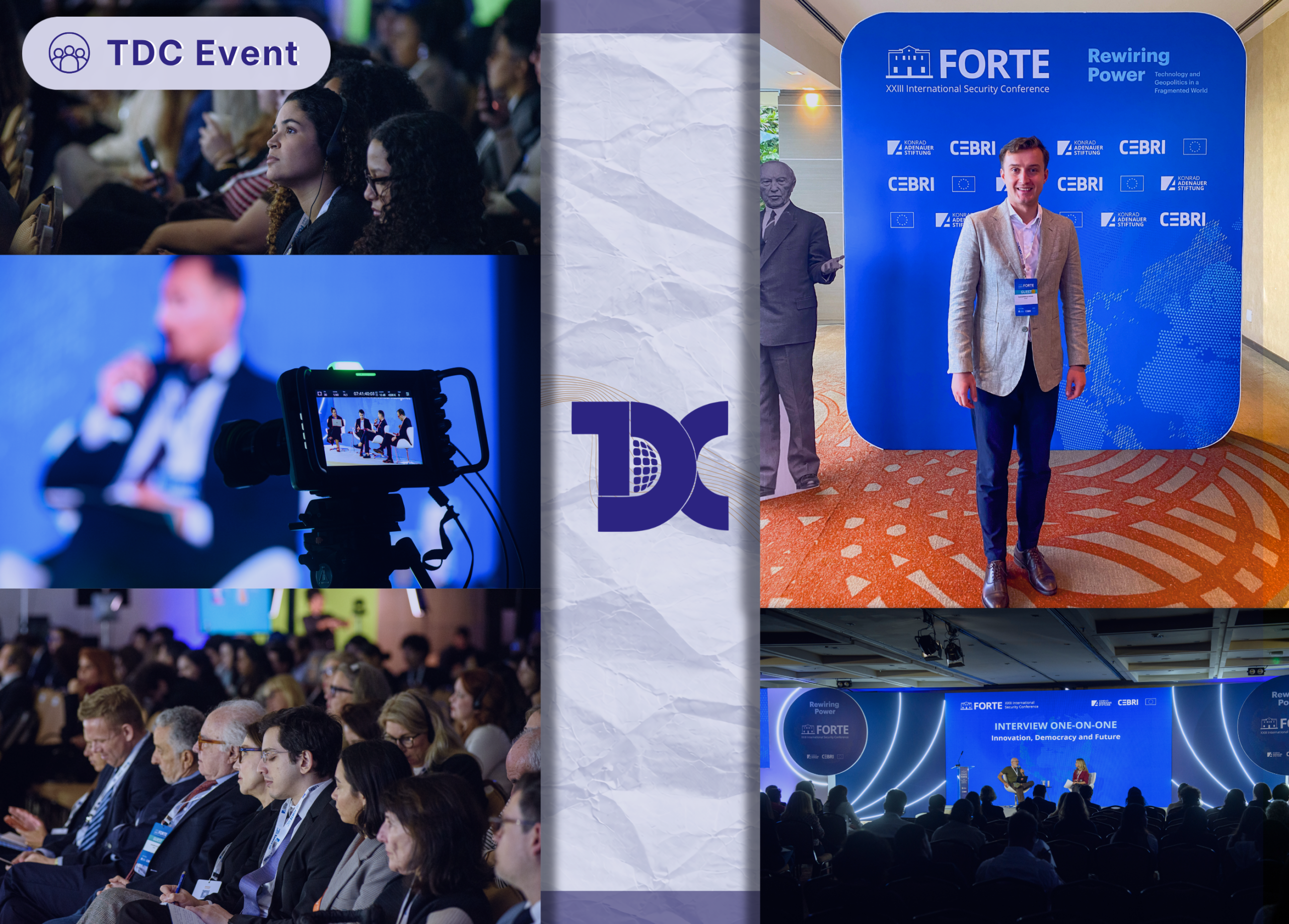
On June 16–17, 2026, the Transatlantic Dialogue Center (TDC) took part in the XXIII FORTE International Security Conference in Rio de Janeiro — the largest security forum in Latin America and a key platform for dialogue between the region and Europe. The conference was co-organized by the Konrad Adenauer Foundation in Brazil (KAS Brasil), the Brazilian Center for International Relations (CEBRI), and the EU Delegation to Brazil.
The 2026 theme, “Rewiring Power: Technology and Geopolitics in a Fragmented World,” brought together policymakers, analysts, and defense experts to examine how technological disruption, artificial intelligence, and defense innovation are reshaping the global balance between democracies and authoritarian regimes. Five panels and a keynote addressed the future of global power in an age of technological disruption, AI and the risks of democratic institutional erosion, defense innovation for Europe and Latin America, the geopolitics of rare earth minerals, and the role of drones, lethal autonomous weapons systems (LAWS), and AI in modern warfare.
Among the speakers were Celso Amorim, Chief Foreign Policy Advisor to the President of Brazil; Benedikt Franke, Vice-Chairman and CEO of the Munich Security Conference (MSC); Brynja Oskarsdottir, Director of the Science and Technology Committee of the NATO Parliamentary Assembly; and Peter Neumann, Professor of War Studies at King’s College London.
Defense innovation and AI emerged as a central thread. Panelists examined how drones, LAWS, and AI-driven systems act as force multipliers on the battlefield while generating novel vulnerabilities for democratic institutions. The adaptation cycles observed in modern warfare require both Europe and Latin America to rethink defense procurement, readiness, and institutional resilience.
Цей geopolitics of critical minerals was identified as a defining strategic fault line. Strategic autonomy and defense supply chains increasingly depend on securing rare earth elements and critical raw materials amid rising global competition — with direct implications for both Europe and Latin America.
The discussions also underscored the urgency of closer coordination between Latin America and Europe on cybersecurity and defense-industrial cooperation, as technological disruption outpaces the capacity of individual states to respond.
TDC was represented by Олександр Сливчук, Координатор програми співпраці з Іспанією та Латинською Америкою. On the sidelines of the conference, Slyvchuk conducted a series of high-level engagements with Brazilian and European think tanks (CEBRI, IESP-UERJ), experts at the University of São Paulo, and representatives of the Brazilian Senate та Міністерство закордонних справ. He also met with leading Brazilian media outlets, including Folha de S.Paulo і Estadão, to advance partnerships on security, technology, and democratic resilience between Ukraine and the region.
TDC welcomes continued cooperation and values opportunities to support education-to-practice exchange on Ukraine’s engagement with Latin America.