

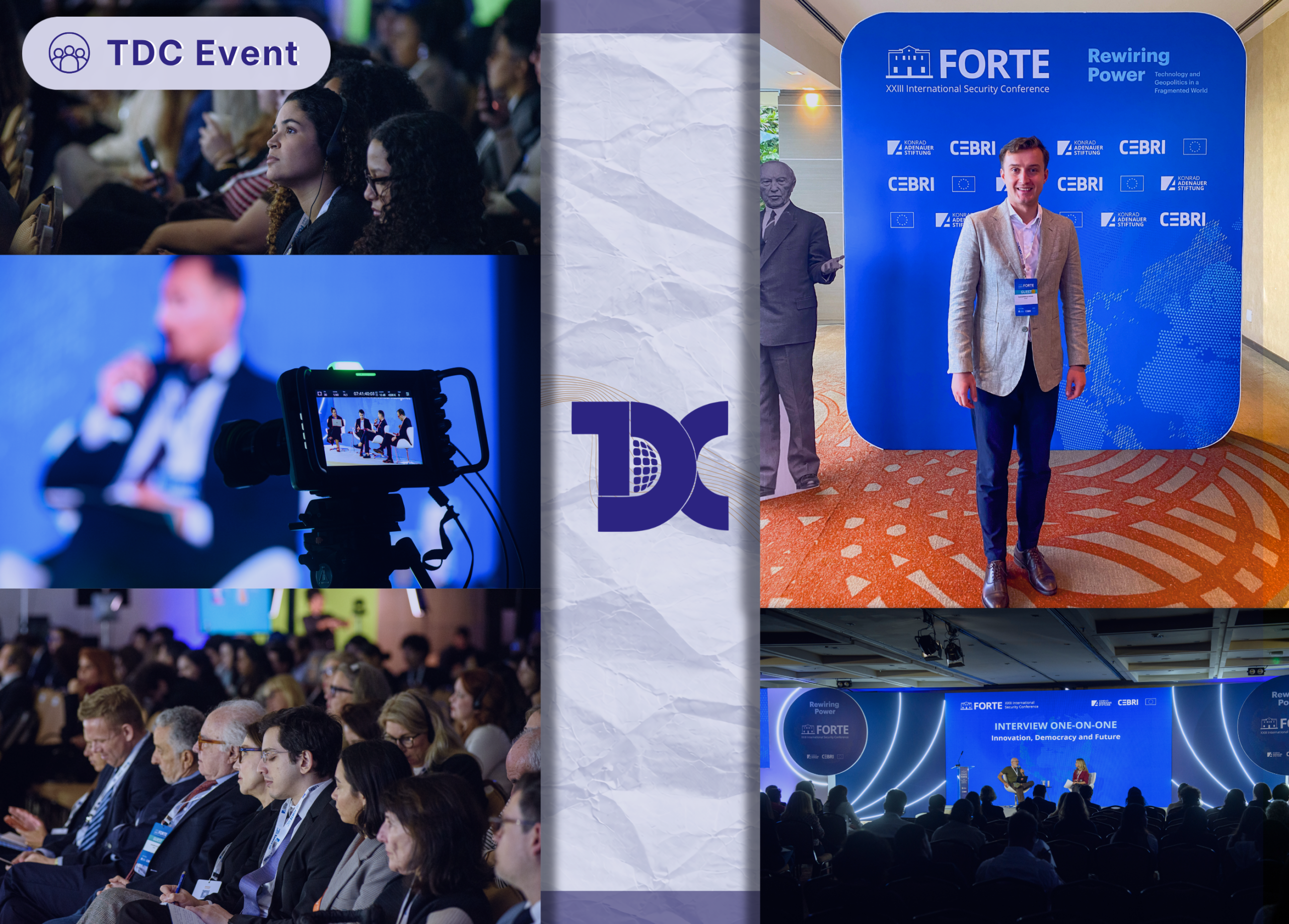
Les 16 et 17 juin 2026, le Transatlantic Dialogue Center (TDC) a participé à la XXIII FORTE International Security Conference à Rio de Janeiro — le plus grand forum de sécurité d’Amérique latine et une plateforme essentielle de dialogue entre la région et l’Europe. La conférence a été coorganisée par la Fondation Konrad Adenauer au Brésil (KAS Brasil), le Centre brésilien des relations internationales (CEBRI) et la délégation de l’UE au Brésil.
Le thème de 2026, «Reconfigurer le pouvoir : technologies et géopolitique dans un monde fragmenté», a réuni des décideurs politiques, des analystes et des experts de la défense afin d’examiner comment les ruptures technologiques, l’intelligence artificielle et l’innovation en matière de défense redessinent l’équilibre mondial entre démocraties et régimes autoritaires. Cinq tables rondes et une allocution principale ont abordé l’avenir de la puissance mondiale à l’ère des ruptures technologiques, l’IA et les risques d’érosion des institutions démocratiques, l’innovation en matière de défense pour l’Europe et l’Amérique latine, la géopolitique des terres rares, ainsi que le rôle des drones, des systèmes d’armes létales autonomes (LAWS) et de l’IA dans la guerre moderne.
Parmi les intervenants figuraient Celso Amorim, conseiller principal du président du Brésil pour les affaires étrangères ; Benedikt Franke, vice-président et directeur général de la Munich Security Conference (MSC) ; Brynja Oskarsdottir, directrice du Comité des sciences et des technologies de l’Assemblée parlementaire de l’OTAN ; et Peter Neumann, professeur d’études sur la guerre au King’s College London.
L’innovation en matière de défense et l’IA ont constitué un fil directeur. Les participants ont examiné comment les drones, les LAWS et les systèmes fondés sur l’IA agissent comme des multiplicateurs de force sur le champ de bataille tout en créant de nouvelles vulnérabilités pour les institutions démocratiques. Les cycles d’adaptation observés dans la guerre moderne obligent l’Europe comme l’Amérique latine à repenser les acquisitions de défense, la préparation opérationnelle et la résilience institutionnelle.
La géopolitique des minerais critiques a été identifiée comme une ligne de fracture stratégique déterminante. L’autonomie stratégique et les chaînes d’approvisionnement de défense dépendent de plus en plus d’un accès sûr aux terres rares et aux matières premières critiques dans un contexte de concurrence mondiale croissante — avec des conséquences directes pour l’Europe comme pour l’Amérique latine.
Les discussions ont également souligné l’urgence d’une coordination plus étroite entre l’Amérique latine et l’Europe en matière de cybersécurité et de coopération industrielle dans le domaine de la défense, les ruptures technologiques dépassant la capacité de réponse des États pris isolément.
TDC était représenté par Oleksandr Slyvchuk, coordinateur du Programme de coopération avec l’Espagne et l’Amérique latine. En marge de la conférence, Slyvchuk a mené une série d’échanges de haut niveau avec des centres de réflexion brésiliens et européens (CEBRI, IESP-UERJ), des experts de l’Université de São Paulo et des représentants du Sénat brésilien et du ministère des Affaires étrangères. Il a également rencontré des médias brésiliens de premier plan, dont Folha de S.Paulo et Estadão, afin de faire progresser les partenariats entre l’Ukraine et la région en matière de sécurité, de technologie et de résilience démocratique.
TDC se félicite de la poursuite de cette coopération et attache une grande importance aux occasions de soutenir les échanges entre la formation et la pratique concernant l’engagement de l’Ukraine en Amérique latine.
Ce texte a été traduit automatiquement à partir de l’original anglais, qui reste accessible en passant le site en anglais.