

D’août à décembre 2025, le Transatlantic Dialogue Center a accueilli un stage à distance pour huit étudiants originaires d’Argentine, du Chili et du Pérou dans le cadre du programme de coopération avec l’Espagne et l’Amérique latine. Les participants représentaient un groupe diversifié d’établissements, dont Universidad Argentina de la Empresa, Universidad Católica de Santiago del Estero, Universidad del CEMA, et Universidad del Salvador en Argentine ; Universidad de Concepción et Universidad Diego Portales au Chili ; et Universidad Nacional Pedro Ruiz Gallo au Pérou. L’objectif du programme était d’offrir à de jeunes chercheurs une expérience pratique du travail analytique, des études sur les médias et de la communication stratégique dans le domaine des affaires internationales.
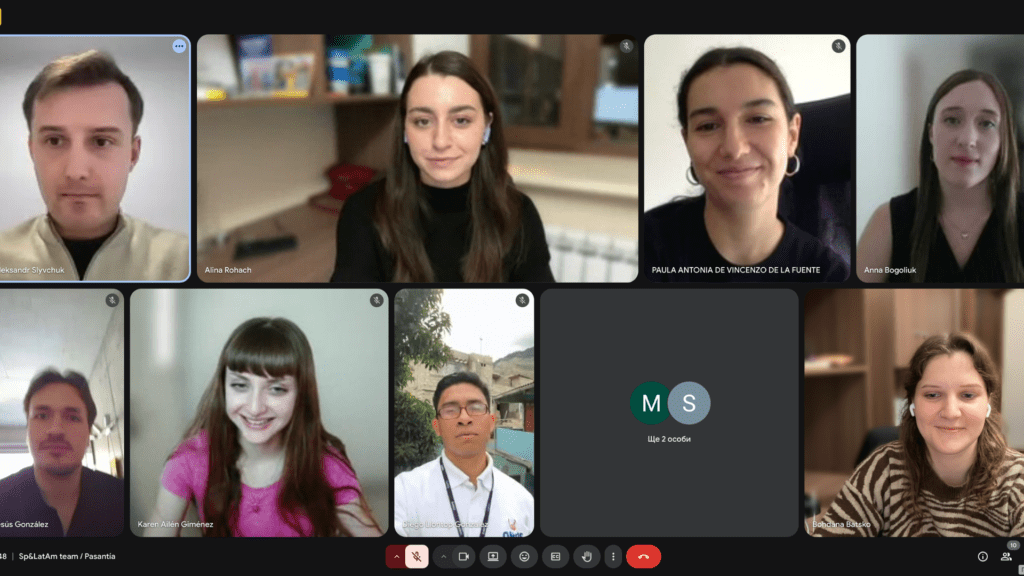
Le projet central du stage était une étude conjointe intitulée « Récits concurrents : comment l’Ukraine fait l’objet d’informations et de désinformation en Amérique latine ». Les stagiaires ont mené plusieurs étapes de recherche, en commençant par la collecte de données et le suivi des médias russes, ukrainiens et latino-américains en espagnol. Ils ont analysé les thèmes dominants, le ton, le cadrage émotionnel et les schémas narratifs. Au cours des étapes suivantes, ils ont produit une évaluation préliminaire et une matrice comparative examinant les différences et les similitudes entre les sources, notamment la présentation visuelle, la charge émotionnelle et les techniques de manipulation. La phase finale a consisté en des enquêtes et une vérification sur le terrain afin de comprendre comment les publics en Argentine, au Chili et au Pérou perçoivent et intériorisent ces récits. L’étude est disponible via le lien indiqué.


Parallèlement au travail analytique, les stagiaires ont contribué aux activités de communication du TDC en documentant le déroulement du stage et en produisant de courtes vidéos pour les réseaux sociaux. Ils ont également participé à l’édition des versions en espagnol de deux grandes publications analytiques du TDC, « SAFE peut-il rendre l’Ukraine plus sûre ? Éclairages sur le nouvel instrument financier européen » et « Le rôle de la Russie dans l’ordre mondial d’après-guerre. Comment la position de la Russie dans le Sud global et au sein des institutions internationales évoluera-t-elle ? ». Les participants ont ainsi pu se familiariser concrètement avec la rédaction axée sur les politiques publiques, les normes méthodologiques et l’adaptation de recherches complexes à un public hispanophone.


Le stage s’est révélé une expérience importante et formatrice pour les participants. Pour beaucoup, il s’agissait de leur premier engagement structuré dans l’analyse comparative des médias et la communication internationale. Comme l’a indiqué Ana Karla Bogoliuk, étudiante en gouvernement et relations internationales à Universidad Argentina de la Empresa :
« Ce stage nous a tous donné l’occasion d’approfondir notre compréhension de la communication internationale au XXIe siècle, de la prolifération des fausses nouvelles et de la propagande, de la composition de l’environnement médiatique latino-américain, des habitudes informationnelles et des opinions de la population, de l’identification des récits, ainsi que du cas étudié : la guerre entre la Russie et l’Ukraine, son contexte et la bataille qui se déroule également dans l’espace informationnel ».
De même, Jesús González Parada, diplômé en sciences politiques et administratives de Universidad de Concepción, a souligné la dimension personnelle du programme :
« Au-delà des résultats académiques, cette expérience a été profondément enrichissante sur le plan personnel. Elle m’a permis d’acquérir de nouvelles connaissances, de développer un regard critique sur la communication internationale, mais surtout de me rapprocher d’une équipe qui, dans l’argot chilien, peut être qualifiée de “bacán”, une équipe où la distance géographique s’est effacée devant la collaboration, laissant place à un sentiment de fraternité qui transcende les frontières ».
Le programme a montré comment les perspectives latino-américaines enrichissent la compréhension des dynamiques mondiales de l’information. Les participants ont mobilisé leur expérience régionale de la fragmentation médiatique, des récits de transition et de la résilience civique pour interpréter la manière dont les messages concurrents sur l’Ukraine sont construits et contestés dans le monde hispanophone. Leur travail a abouti à un cadre analytique structuré qui soutiendra les chercheurs, journalistes et diplomates des deux régions.
Ce projet a bénéficié du soutien de l’International Renaissance Foundation.
Ce texte a été traduit automatiquement à partir de l’original anglais, qui reste accessible en passant le site en anglais.