
Ukraine’s ‘Future Force’ Interview Series: Unmanned Ground Vehicles for Ukraine’s Defense

Clock Icon 4 min read
April 29, 2026

Inhalt

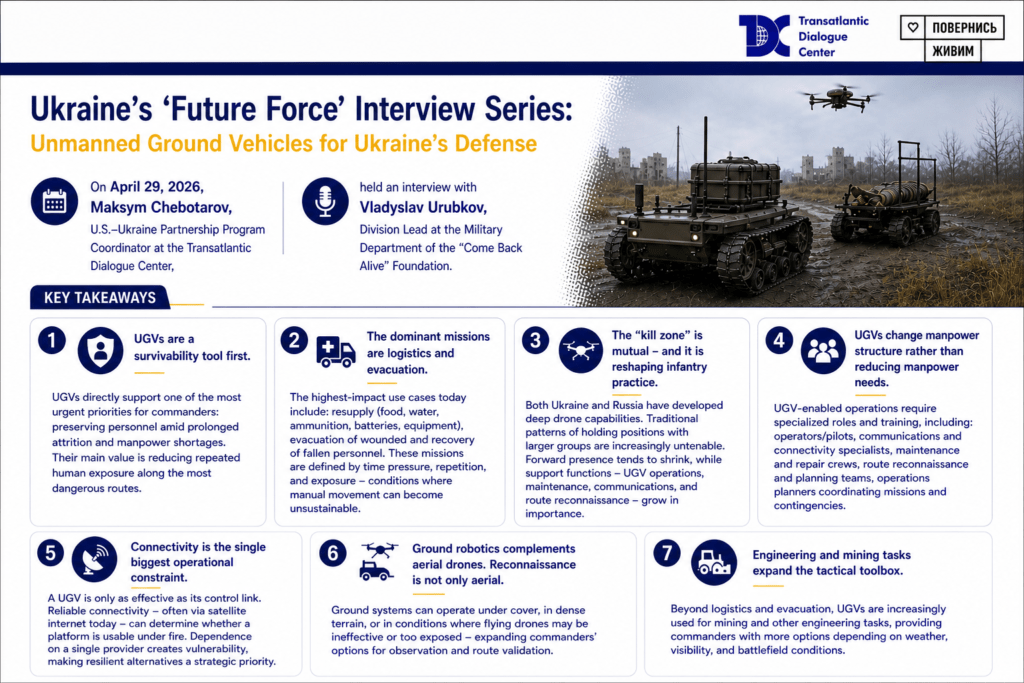
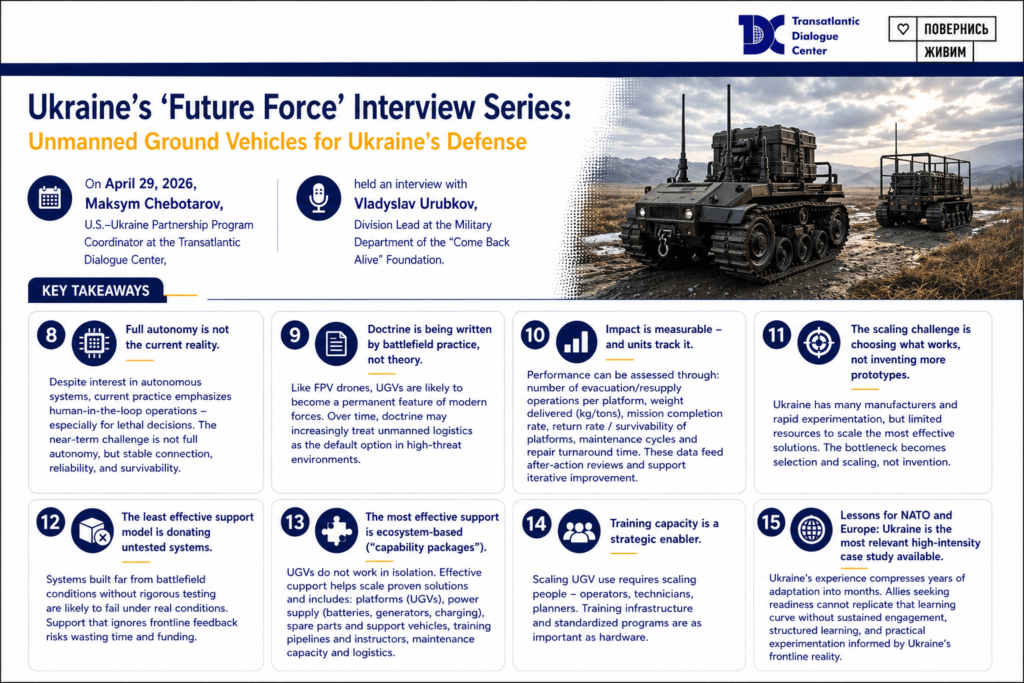
On April 29, 2026, Maksym Chebotarov, U.S.–Ukraine Partnership Program Coordinator at the Transatlantic Dialogue Center, held an interview with Vladyslav Urubkov, Division Lead at the Military Department of the "Come Back Alive" Foundation.

Context

Ukraine’s high-intensity war has expanded the "strike environment" far beyond the immediate frontline. Drones enable persistent surveillance and rapid precision strikes, creating a de facto “kill zone” where routine movement – rotations, resupply runs, and evacuations – can be as dangerous as direct combat.

In this environment, unmanned ground vehicles (UGVs) are shifting from a niche capability to an increasingly routine tool. Rather than serving as futuristic add-on, they are being used for practical battlefield tasks: sustaining positions, reducing exposure on the most dangerous routes, and evacuating wounded personnel when sending people is no longer feasible.

Inhalt

This interview explores how UGVs are used in practice, how units organize around them, what technical bottlenecks – especially communications – shape outcomes, and what international support is most useful if partners want to help Ukraine scale solutions that work under real battlefield conditions.

Wichtigste Erkenntnisse

  • UGVs are a survivability tool first. UGVs directly support one of the most urgent priorities for commanders: preserving personnel amid prolonged attrition and manpower shortages. Their main value is reducing repeated human exposure along the most dangerous routes.
  • The dominant missions are logistics and evacuation. The highest-impact use cases today include: resupply (food, water, ammunition, batteries, equipment), evacuation of wounded and recovery of fallen personnel. These missions are defined by time pressure, repetition, and exposure – conditions where manual movement can become unsustainable.
  • The "kill zone" is mutual – and it is reshaping infantry practice. Both Ukraine and Russia have developed deep drone capabilities. Traditional patterns of holding positions with larger groups are increasingly untenable. Forward presence tends to shrink, while support functions – UGV operations, maintenance, communications, and route reconnaissance – grow in importance.
  • UGVs change manpower structure rather than reducing manpower needs. UGV-enabled operations require specialized roles and training, including: operators/pilots, communications and connectivity specialists, maintenance and repair crews, route reconnaissance and planning teams, operations planners coordinating missions and contingencies.
  • Connectivity is the single biggest operational constraint. A UGV is only as effective as its control link. Reliable connectivity – often via satellite internet today – can determine whether a platform is usable under fire. Dependence on a single provider creates vulnerability, making resilient alternatives a strategic priority.
  • Ground robotics complements aerial drones. Reconnaissance is not only aerial. Ground systems can operate under cover, in dense terrain, or in conditions where flying drones may be ineffective or too exposed – expanding commanders’ options for observation and route validation.
  • Engineering and mining tasks expand the tactical toolbox. Beyond logistics and evacuation, UGVs are increasingly used for mining and other engineering tasks, providing commanders with more options depending on weather, visibility, and battlefield conditions.
  • Full autonomy is not the current reality. Despite interest in autonomous systems, current practice emphasizes human-in-the-loop operations – especially for lethal decisions. The near-term challenge is not full autonomy, but stable connection, reliability, and survivability.
  • Doctrine is being written by battlefield practice, not theory. Like FPV drones, UGVs are likely to become a permanent feature of modern forces. Over time, doctrine may increasingly treat unmanned logistics as the default option in high-threat environments.
  • Impact is measurable – and units track it. Performance can be assessed through: number of evacuation/resupply operations per platform, weight delivered (kg/tons), mission completion rate, return rate / survivability of platforms, maintenance cycles and repair turnaround time. These data feed after-action reviews and support iterative improvement.
  • The scaling challenge is choosing what works, not inventing more prototypes. Ukraine has many manufacturers and rapid experimentation, but limited resources to scale the most effective solutions. The bottleneck becomes selection and scaling, not invention.
  • The least effective support model is donating untested systems. Systems built far from battlefield conditions without rigorous testing are likely to fail under real conditions. Support that ignores frontline feedback risks wasting time and funding.
  • The most effective support is ecosystem-based ("capability packages"). UGVs do not work in isolation. Effective support helps scale proven solutions and includes: platforms (UGVs), power supply (batteries, generators, charging), spare parts and support vehicles, training pipelines and instructors, maintenance capacity and logistics.
  • Training capacity is a strategic enabler. Scaling UGV use requires scaling people – operators, technicians, planners. Training infrastructure and standardized programs are as important as hardware.
  • Lessons for NATO and Europe: Ukraine is the most relevant high-intensity case study available. Ukraine’s experience compresses years of adaptation into months. Allies seeking readiness cannot replicate that learning curve without sustained engagement, structured learning, and practical experimentation informed by Ukraine’s frontline reality.

If you wish to support the Come Back Alive Foundation, please use the official donation page.


The views, thoughts, and opinions expressed in the interview and published on this site belong solely to the speakers and do not necessarily reflect the views of the Transatlantic Dialogue Center, its committees, or affiliated organizations. The key takeaways are provided to inform discussion and do not represent official policy positions.