

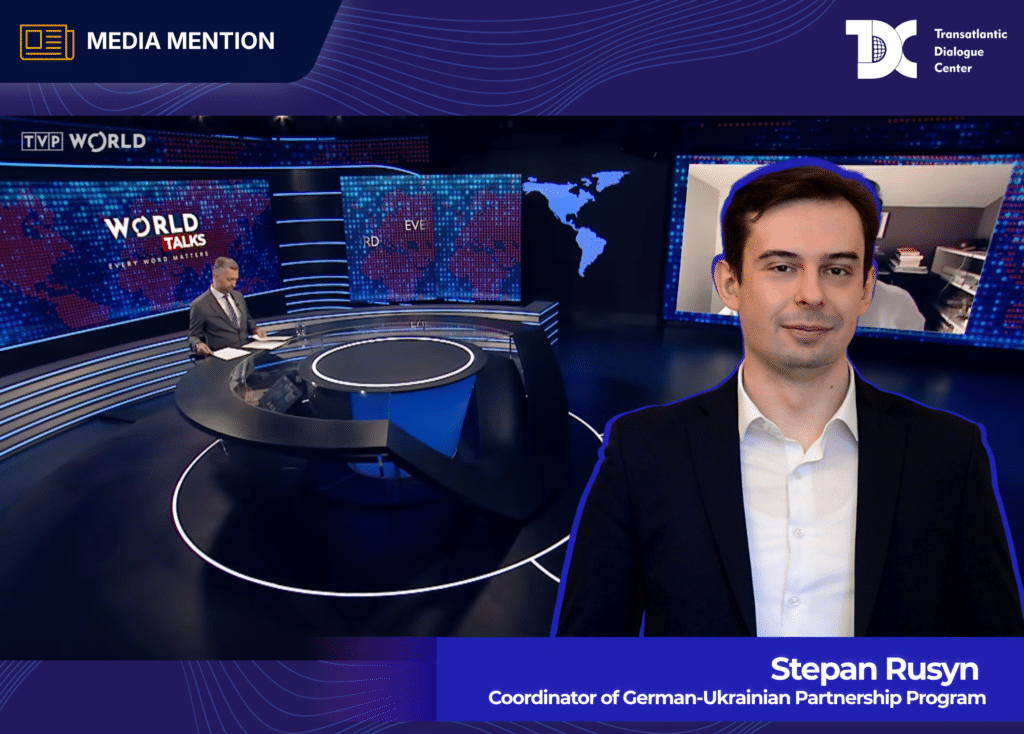
Stepan Rusyn, Coordinator of the Germany-Ukraine Partnership Program at the Transatlantic Dialogue Center, appeared on the September 3, 2026, edition of World Talks on TVP World, hosted by Sascha Fahrbach, to discuss Russia’s growing hybrid warfare activities across Europe, the challenges of protecting critical infrastructure, and European efforts to coordinate a response to Moscow’s sabotage operations. The conversation also addressed political developments in Germany and the growing influence of the far-right Alternative for Germany (AfD).
During the interview, Rusyn highlighted the increasing number of sabotage incidents across Europe being attributed to Russia, noting that establishing responsibility remains a complex and time-consuming process in democratic countries. Referring to the Leipzig airport sabotage plot, he explained how accumulated intelligence and similarities between incidents have helped European authorities identify patterns of Russian involvement. He also discussed Germany’s diplomatic response, including the closure of Russian consulates, while emphasising that such measures have limitations as Moscow increasingly relies on civilians recruited through online platforms to carry out disruptive activities.
Another central topic was the protection of critical infrastructure against hybrid threats. Rusyn stressed that safeguarding airports, energy facilities, transportation networks, and other essential infrastructure requires close cooperation between governments and private operators. He referred to Germany’s OPLAN Deutschland as an example of national efforts to strengthen resilience and prepare for potential security crises within NATO’s collective defence framework. However, the scale and complexity of Europe’s infrastructure make comprehensive protection particularly challenging.
The discussion also focused on the Weimar Triangle meeting between France, Germany and Poland and its importance for developing a coordinated European response to Russian hybrid operations. Rusyn noted that cooperation among these three countries could play a decisive role in building a broader EU consensus on security measures, particularly given their shared assessment of Russian threats and complementary approaches to European defence.
Finally, Rusyn addressed the growing political influence of the Alternative for Germany (AfD) ahead of regional elections and the debate over a potential ban on the party. He explained the legal and political difficulties surrounding such measures, including the possibility of pursuing proceedings against individual regional branches rather than seeking an immediate nationwide ban.
Watch the full interview with Stepan Rusyn: