

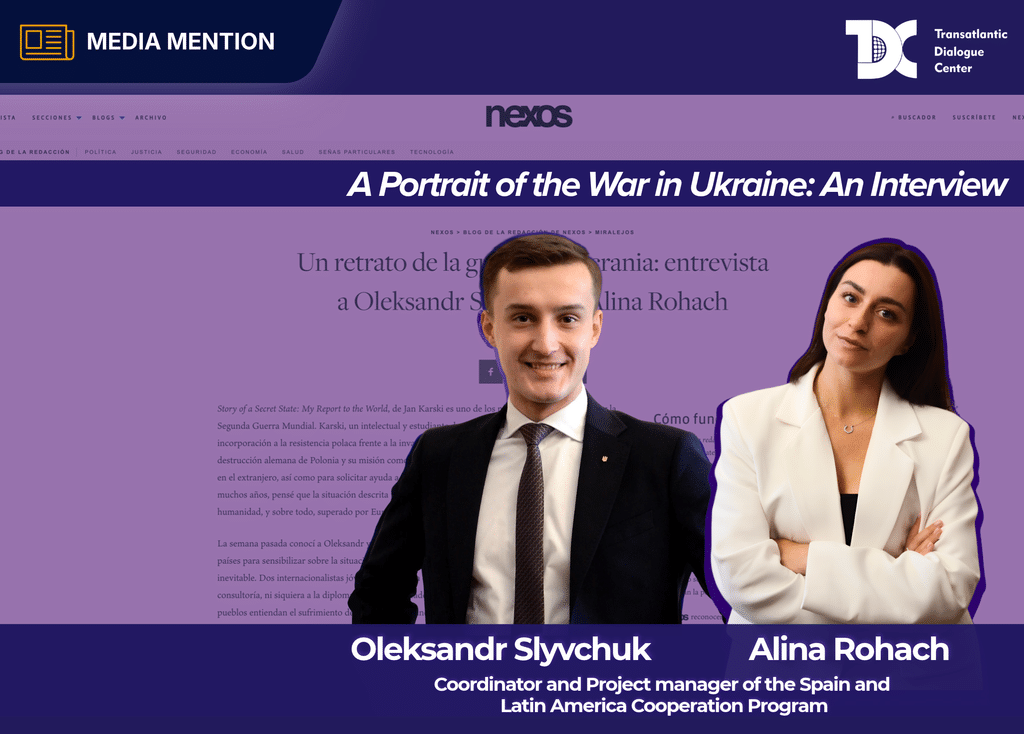
Oleksandr Slyvchuk, Coordinator of the Spain and Latin America Cooperation Program at the Transatlantic Dialogue Center (TDC), and Alina Rohach, Project Manager of the same program, gave an interview to Mexican political analyst Raudel Ávila for the Nexos editorial blog during their visit to Mexico. The conversation covered daily life in Ukraine, the prospects for negotiations, international support, and Latin America’s position on the war.
Describing the situation in Kyiv, Rohach said conditions have worsened over the past month. Russian attacks on energy infrastructure have left the city without stable electricity, heating, or hot water as winter begins. Slyvchuk said most Ukrainians do not expect a ceasefire soon. In his view, Russia is using the winter to increase pressure and is imposing unacceptable conditions, such as demands for more territory.
On international support, Slyvchuk called EU countries Ukraine’s main allies. He noted that Europe understands that supporting Ukraine strengthens its own security. He described the U.S. approach under Donald Trump as more pragmatic and shaped by electoral interests. He nonetheless said the United States remains a key partner, particularly through air defense and Starlink, and that Europe cannot yet replace some of these capabilities.
The interview also highlighted the human dimension of the war. Rohach noted that international debates often treat territorial concessions lightly and overlook what life under occupation means. She pointed to repression of people for speaking Ukrainian, and said this helps explain why Ukrainians are unwilling to accept such compromises. Slyvchuk spoke about the six million Ukrainians living abroad and the toll of constant air raid alarms on society.
On Latin America, Slyvchuk noted that Argentina and Chile have been closer to Ukraine, while Mexico’s adherence to the Estrada Doctrine of neutrality has kept it at a distance. The speakers discussed their work on the International Coalition for the Return of Ukrainian Children. According to them, more than 20,000 Ukrainian children have been abducted by Russia. Several Latin American countries, including Argentina, Chile, Panama, Costa Rica, and Honduras, have joined the coalition. TDC continues to discuss Mexico’s possible membership, but has not yet succeeded.
The interview also touched on the Budapest Memorandum, Russia’s political future, European elections, and the war’s impact on Ukrainian agriculture. In closing, Rohach und Slyvchuk shared personal reflections on nearly five years of war.
Read the full interview via the Link. Bitte beachten Sie, dass der Artikel auf Spanisch veröffentlicht wurde.