

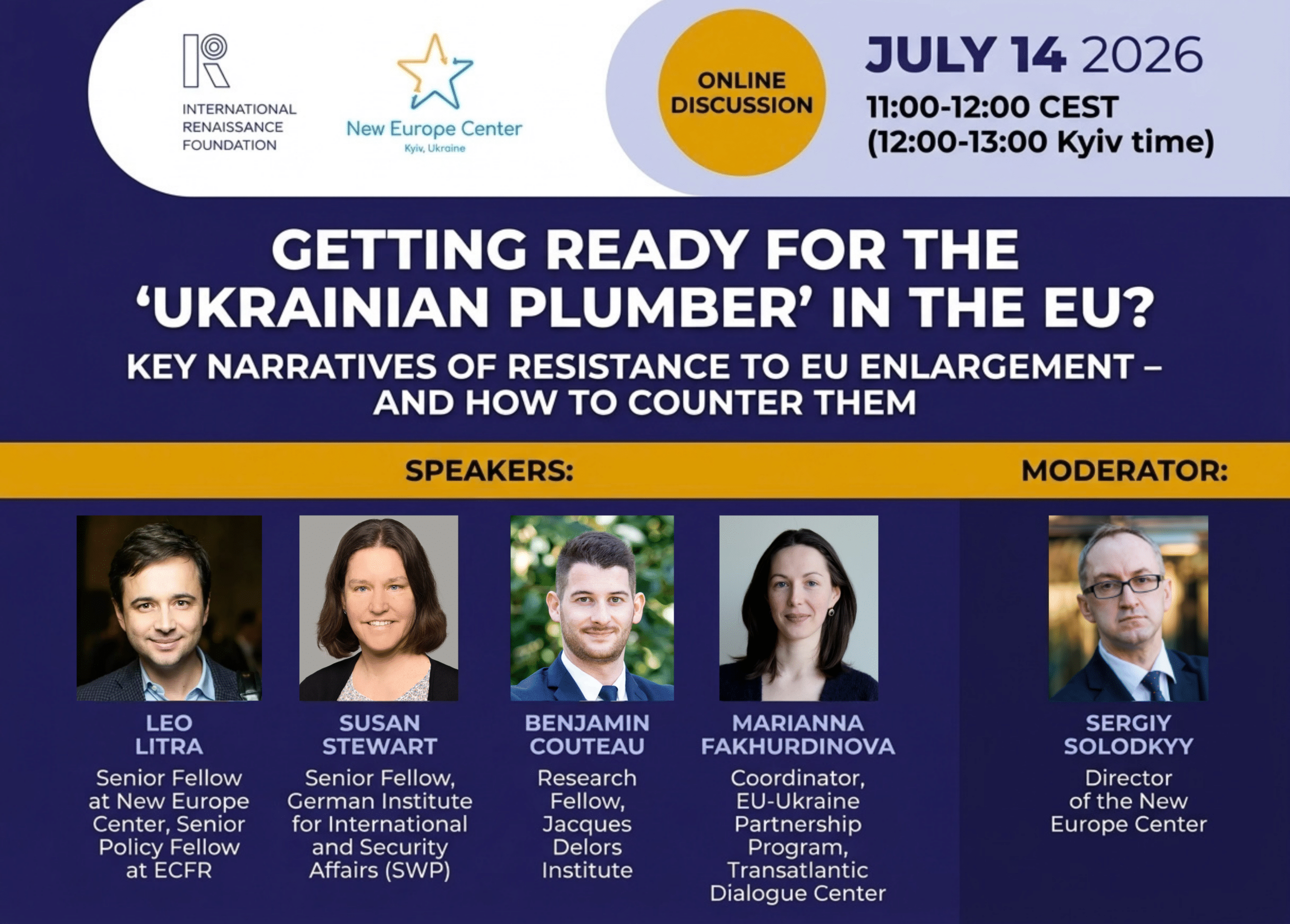
On July 14, the New Europe Center will hold an online discussion, “Getting Ready for the ‘Ukrainian Plumber’ in the EU? Key Narratives of Resistance to EU Enlargement – and How to Counter Them.” The event will be streamed live on the New Europe Center’s Facebook page and YouTube channel.
The discussion will take place from 11:00 to 12:00 CEST / 12:00 to 13:00 Kyiv time. The working language of the event is Englisch.
As Ukraine moves closer to EU membership, narratives warning of the negative consequences of enlargement are likely to become increasingly visible. Similar rhetoric has appeared before in Europe, most notably during the “Polish plumber” debate in France in 2005. At the time, fears that Polish workers would take jobs from French citizens became a powerful political narrative around the proposed EU Services Directive. These fears later proved to be greatly exaggerated, while Poland responded creatively by turning the stereotype into a tourism campaign.
This precedent offers a useful starting point for discussing how similar narratives about Ukraine’s accession to the EU can be anticipated and addressed today. The event will map the key messages already emerging in opposition to Ukraine’s EU membership, examine how they could influence public opinion across EU member states, and explore evidence-based responses available to Ukraine and its partners.
The discussion will feature Marianna Fakhurdinova, Coordinator of the EU–Ukraine Partnership Program at the Transatlantic Dialogue Center, Leo Litra, Senior Fellow at the New Europe Center and Senior Policy Fellow at ECFR; Susan Stewart, Senior Fellow at the German Institute for International and Security Affairs (SWP) und Benjamin Couteau, Research Fellow at the Jacques Delors Institute.
The event will be moderated by Sergiy Solodkyy, Director of the New Europe Center.
The event is organized by the New Europe Center with the support of the International Renaissance Foundation. The views and positions expressed during the event are those of the experts and do not necessarily reflect the position of the International Renaissance Foundation.