
 16 min read
The concept of Ukraine’s articulation of ‘red lines’ in the context of ongoing diplomatic efforts is frequently misinterpreted as a negotiating posture designed to extract concessions. This framing is strategically and empirically flawed. Ukraine’s ‘red lines’ are not bargaining instruments but security thresholds. They define the minimum conditions under which the Ukrainian state can continue to exist as a sovereign actor capable of deterring renewed aggression and exercising independent political choice. They are rooted in Ukraine’s experience since 2014, during which periods of de-escalation without credible enforcement mechanisms consistently failed to produce stability.
As such, the Minsk I and Minsk II agreements were designed to freeze hostilities and create space for political resolution. In practice, the Minsk framework provided monitoring, but it lacked credible attribution, accountability, and enforcement mechanisms, which limited its ability to deter or punish violations.[1] Russian forces and Russia-controlled proxies (the so-called ‘Donetsk and Luhansk People’s Republics’) repeatedly violated ceasefire provisions, used periods of reduced fighting to rotate units and improve tactical positions, and instrumentalized ambiguity to shift responsibility for Russia’s calibrated and creeping escalation.[2] These patterns culminated in the full-scale invasion of 2022.
The lesson drawn in Kyiv is strictly operational: security arrangements that permit degradation of defensive capacity or rely on unenforced commitments create incentives for renewed aggression. As such, ceasefires without enforcement and grounded on ambiguous treaties reasonably tend to favor the militarily revisionist actor.[3]
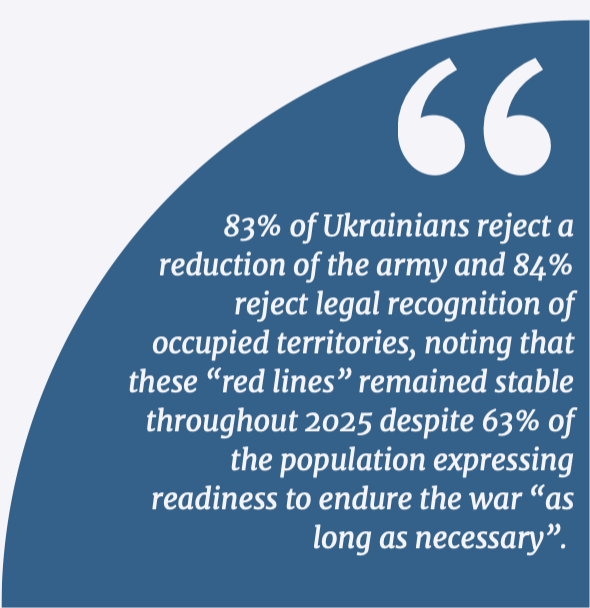
Ukraine’s red lines also reflect domestic legitimacy constraints that are often underestimated in external debates. Public opinion research conducted throughout 2024–2025 indicates a stable societal consensus around minimum security requirements for any negotiated outcome. Surveys show that a majority of Ukrainians reject peace arrangements that involve significant reductions in defense capacity, acceptance of ambiguous security guarantees, or de facto recognition of territorial losses. Importantly, this consensus persists even as war fatigue increases and support for negotiations grows in principle.[4]
The primary red line concerns the preservation of effective self-defense capabilities. Any externally imposed force caps or demilitarization provisions that materially weaken Ukraine’s ability to deter renewed aggression are unacceptable.[5] Ukraine is defending a large, geographically exposed territory against a revisionist adversary that retains substantial conventional and hybrid warfare capacity and has demonstrated both the ability and intent to regenerate forces and adapt operationally based on battlefield experience.[6]
Negotiation drafts conveyed to Ukraine in November 2025 reportedly explored reductions of the Ukrainian Armed Forces to levels as low as 600,000 personnel.[7] Ukrainian negotiators pushed back and secured a ceiling of approximately 800,000, broadly corresponding to the current effective force level required to sustain defense across multiple operational directions. Ukrainian military leadership has consistently emphasized that this figure represents a minimum deterrence threshold, not an optimal or permanent peacetime structure.[8] Importantly, Ukraine’s position is that any personnel ceiling should not constrain its sovereign right to mobilize additional forces in the event of renewed large-scale aggression.
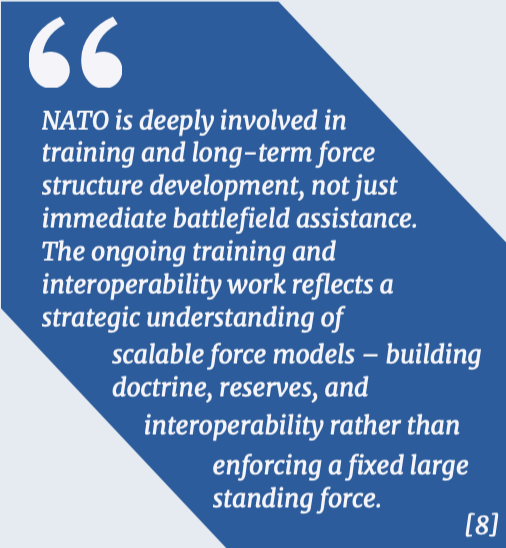
The distinction between force ceilings and force structure is central to Ukraine’s position. Even under an 800,000 cap, Ukraine is unlikely to maintain such troop levels indefinitely in a stable post-war environment due to unsustainable fiscal burden. Recent estimates from the Ministry of Economy, Environment and Agriculture suggests that maintaining the largest army in Europe carries an estimated recurring cost that could exceed $700 billion over the next decade.[9] As, the World Bank and the International Monetary Fund have appraised Ukraine’s reconstruction requirements at $486 billion (nearly triple of Ukraine’s current GDP), the projected defense expenditures of 27.2% of GDP (if no less $500 billion will be directed from the state budget) creates an unsustainable fiscal collision that would siphon capital away from the recovery.[10]
Ukrainian negotiators prioritize a relatively high ceiling of 800,000 personnel not as a permanent staffing target, but as a safeguard for sovereign flexibility. A restrictive, low ceiling may function as a form of ‘pre-emptive disarmament’ by legally preventing the activation of reserves and the expansion of territorial defense forces during a crisis. A ceiling of 800,000 personnel ensures the ‘legal elasticity’ required to respond to Russia’s hostile probing behavior, while its actual force structure will naturally downscale to a more sustainable, professionalized core, supported by trained reserves, territorial defense components, and scalable mobilization infrastructure.[11]
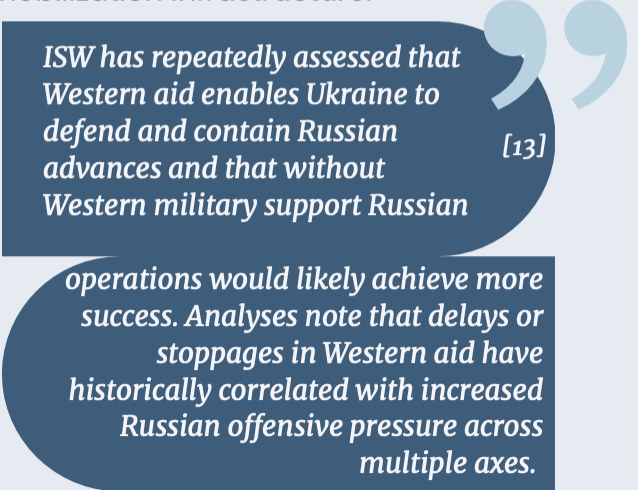
From a deterrence perspective, maintaining sufficient defense capacity is a stabilizing factor rather than an escalatory one. Deterrence theory, as well as NATO’s force posture logic on the Alliance’s eastern flank, rests on the premise that credible defensive capability reduces incentives for offensive action by increasing the expected costs of aggression.[12] Ukraine’s current force posture, supported by Western military assistance, constrains Russia’s ability to achieve operational breakthroughs and limits its capacity to translate numerical advantages into strategic gains.[13]
The Russo-Ukrainian war has also exposed a structural dilemma in contemporary armed conflict: rules of engagement remain vague and inconsistently enforced in the absence of credible international humanitarian law (IHL) enforcement mechanisms. The asymmetry of lawful restraint vs. unlawful coercion creates a persistent imbalance. Democratic states, including Ukraine, deliberately constrain their military operations in accordance with IHL and the principles of distinction, proportionality, and military necessity. Autocratic adversaries, by contrast, face few practical consequences for systematic violations of IHL.
Russia has repeatedly exploited this imbalance by deliberately targeting civilian populations and critical infrastructure, not as collateral damage but as a method of coercion designed to impose humanitarian, economic, and psychological costs on society as a whole.[14] Whereas Russia can concentrate its deterrence capabilities primarily on military and (core) economy-related facilities, Ukraine is forced into strategic overstretch, significantly multiplying the burden of its defense posture. It must simultaneously defend the frontline, protect civilian populations in deep-rear areas, and retain the capacity to conduct counter-offensive operations.
In future conflicts, where such asymmetry is well anticipated, Ukraine will face a structural choice. It should either develop low-cost interception and counter-drone solutions capable of neutralizing large volumes of relatively inexpensive attack systems, while also sustaining defenses against advanced missile threats, or maintain a defense architecture robust enough to protect civilian infrastructure, secure the front line, and preserve operational initiative. In practice, however, it will require both. Such an architecture inevitably demands personnel, resources, and institutional depth. Absent these capabilities, the imbalance between lawful restraint and unlawful coercion will continue to favor the aggressor, transforming full adherence to IHL and restrictive rules of engagement into a strategic vulnerability.
Alternatively, force autocracies to comply with at least the minimum standards of IHL. The challenge lies in identifying realistic and credible mechanisms to achieve this.
The experience since 2014 has also underscored risks associated with premature or externally driven force reductions. Following the initial phase of the Russo-Ukrainian war, Ukraine entered political arrangements, such as the Minsk Protocols and the Normandy Format, that implicitly constrained critical aspects of its defense development. Under these frameworks, for example, Ukraine was pressured to maintain ‘no-fire’ zones and pull back heavy weaponry from the front, which often left units vulnerable to calibrated shelling.[15] These arrangements did not prevent escalation. Instead, they coincided with a period during which Russia rebuilt combat power, refined hybrid warfare instruments, and ultimately launched the full-scale invasion in 2022.[16]
Current negotiation dynamics reflect a clear institutional memory of these failures. Ukrainian negotiators have consistently resisted proposals that prioritize symbolic de-escalation, particularly those that unilaterally front-load Ukrainian force reductions without credible security guarantees. From Kyiv’s perspective, premature demilitarization does not reduce risk. It shifts risk forward in time while improving the aggressor’s strategic position. Preserving effective self-defense capabilities is therefore not an obstacle to peace but a prerequisite for any settlement that seeks to be Just and Durable.
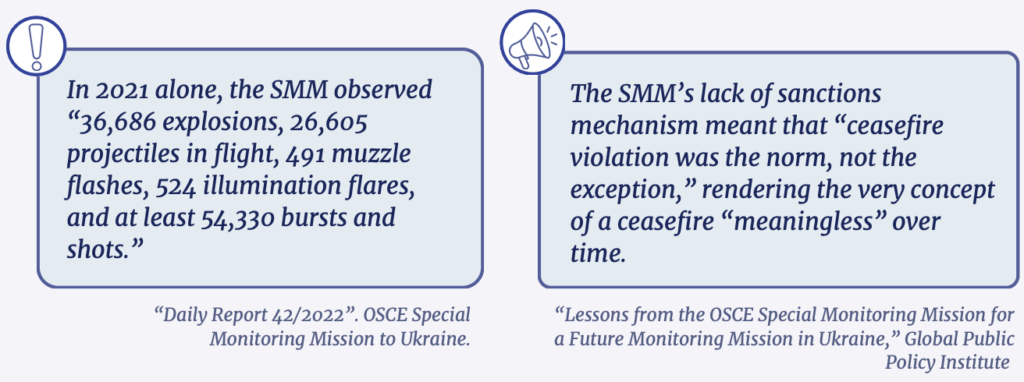
Ukraine’s insistence on robust monitoring as a red line is grounded in empirical experience. Since 2014, Russia has systematically violated ceasefires and de-escalation arrangements whenever detection, attribution, and enforcement mechanisms were weak or absent. During the Minsk process, so-called “silence regimes” (eg. short ceasefires) were repeatedly exploited by Russia to rotate personnel, reposition heavy weapons, improve fortifications, and conduct reconnaissance, all while formally claiming compliance. Reporting by the OSCE Special Monitoring Mission to Ukraine documented tens of thousands of ceasefire violations annually, alongside persistent restrictions on monitor access in areas controlled by Russia or its proxies.[17]
This dynamic persisted beyond Donbas. In the months preceding the full-scale invasion in February 2022, Russia combined the absence of enforceable monitoring with deliberate ambiguity to mask preparations for war. Large-scale force movements were framed as exercises, while diplomatic engagement was used to delay external responses.[18] When escalation occurred, Russia attempted to justify it through manufactured narratives, including claims of Ukrainian provocations and alleged attacks that were not independently verified. Western intelligence services publicly rejected these claims and assessed them as pretext-setting efforts rather than factual incidents.[19]
Against this background, Ukraine treats monitoring not as a confidence-building add-on but as a core security function of any ceasefire arrangement. A ceasefire without continuous observation of troop movements, weapons deployments, and violations along the line of contact produces structural asymmetry. It constrains the defending side, which faces political and diplomatic pressure to demonstrate restraint, while allowing the aggressor to exploit opacity to improve its military position. This asymmetry was repeatedly visible under Minsk-era arrangements and is widely acknowledged in Western analysis as one of the reasons for their failure.[20]
Effective monitoring should also be continuous and extend beyond the immediate line of contact to include rear-area force concentrations, logistics nodes, and movements of restricted systems. Partial or time-limited monitoring regimes create blind spots that can be exploited for escalation preparation. Experience from high-intensity environments shows that even short monitoring gaps can be operationally decisive. For instance, between 2014 and 2022, the OSCE Special Monitoring Mission (SMM) was largely restricted to daylight patrols due to safety protocols. This created a systematic ‘night-time blind spot’ which Russian-led forces exploited to rotate heavy weaponry, reinforce ‘grey zone’ positions, and conduct calibrated shelling under the cover of darkness.[21]
Accordingly, Ukraine’s red line requires monitoring mechanisms that are real-time, technically capable (including space-based), and conducted by credible third parties with full and guaranteed access. This includes persistent surveillance assets, clear reporting chains, and rapid public attribution of violations. Crucially, monitoring should be directly linked to predefined enforcement mechanisms. Observation without consequence does not deter violations; it incentivizes probing behavior and increases the likelihood that manufactured incidents will be used to justify renewed aggression.
For Ukraine, the credibility of any security guarantee hinges not on declaratory commitments but on the existence of predefined and automatic enforcement mechanisms. The post–Cold War European security record demonstrates that guarantees lacking clear triggers, assigned responders, and rapid execution pathways fail to deter revisionist behavior.[22] One of the prominent examples is Russia’s withdrawal of troops and ammunition from the Transnistria of Moldova by the end of 2002. In fact, the Istanbul Document contained no sanctions for non-compliance and no “assigned responder” to oversee the withdrawal, Russia simply ignored the deadline. In the absence of automaticity, enforcement becomes discretionary, politicized, and slow, creating incentives for incremental violations and faits accomplis.
A viable security arrangement must therefore codify in advance what constitutes a violation and what actions activate a response. These triggers must extend beyond large-scale kinetic attacks and include prohibited force movements, deployment of restricted weapons systems, obstruction or expulsion of monitoring missions, and coordinated hybrid actions that directly enable military escalation. Since 2014, Russia has repeatedly exploited ambiguity by operating defined thresholds, combining limited military actions with information operations, legalistic denial, and manufactured narratives.[23]
Equally critical is clarity regarding who responds, through which institutional channel, and within what timeframe. Effective deterrence depends on a pre-set plan between Ukraine and its partners that assigns specific roles for verifying breaches, triggering responses, and executing actions. Security guarantees that rely solely on ad hoc consultations or consensus-based political deliberation risk paralysis precisely when speed is decisive. NATO’s deterrence posture on its eastern flank rests on this logic: predefined response frameworks, forward planning, and readiness reduce uncertainty and deny adversaries exploitable windows of opportunity.[24] Even such preparations do not fully prevent Russia’s probing behavior, including drone incursions, migration pressure, and subversive operations. However, when Europe does project strength, it helps mitigate the risk of further escalation by confining Russia’s actions to operating below established thresholds.[25]
In Ukraine’s case, delayed or purely consultative responses would not only invite Russia’s probing behavior, but even embolden to refuel its war of aggression efforts.[26] Enforcement should also be multidimensional. Military responses may include accelerated arms deliveries, expanded intelligence sharing, and deployment of support assets; political responses may involve suspension of diplomatic engagements or international agreements; economic responses should include pre-agreed sanctions packages triggered automatically by verified violations. Crucially, these measures should not require renegotiation at the moment of crisis. European experience with sanctions since 2014 shows that delays, internal bargaining, and conditionality significantly reduce deterrent effect and allow the aggressor to consolidate gains before costs materialize.
In this context, snapback mechanisms are essential. Any suspension or easing of sanctions or restrictive measures should be explicitly reversible, with automatic reinstatement triggered by clearly defined violations. Snapback provisions reduce incentives for tactical compliance followed by renewed escalation, a pattern repeatedly observed in Russia’s behavior under previous agreements.[27] At a minimum, such mechanisms must restore the pre-existing sanctions regime. However, effective deterrence would ideally require the prior agreement of additional sanctions and restrictive measures that would be automatically imposed in response to verified violations, thereby increasing the marginal cost of renewed aggression rather than merely returning to the status quo ante.
As outlined above, Ukraine’s red lines constitute security thresholds rather than negotiating posture designed to extract concessions.
- Preserving Ukraine’s effective self-defense capabilities reflects a broader European security imperative. Force reductions that undermine deterrence do not localize risk. It shifts risk forward in time while improving the aggressor’s strategic position. Weakening Ukraine’s defensive posture would increase the likelihood of renewed aggression and require Europe to compensate through expanded forward deployments, accelerated rearmament, and sustained high-readiness postures along NATO’s eastern flank.
- Continuous and credible monitoring addresses a systemic vulnerability in European crisis management. Ceasefires without real-time observation and attribution mechanisms create asymmetric advantages for revisionist adversaries, allowing them to prepare for escalation while imposing political and diplomatic restraint on defenders. Absent robust monitoring, instability would defer, increasing the probability of abrupt and less controllable escalation.
- Unambiguous and automatic responses to renewed aggression is central to deterrence beyond Ukraine. Security guarantees that rely on discretionary or delayed enforcement invite probing behavior and incremental violations, with cumulative destabilizing effects. For Europe, this translates into repeated crises, reactive policymaking, and erosion of the credibility of collective security commitments.
Taken together, Ukraine’s red lines are designed to function as a stabilizing constraint, not a veto. They align diplomatic efforts with strategic reality and anchor any prospective settlement in enforceability. Respecting these thresholds offers a pathway to Just and Durable peace. Ignoring them risks transforming short-term calm into a prelude to renewed conflict.
[1] Samuel Charap, Joe Haberman, Katherine Anna Trauger & others, “Guidelines for Designing a Ceasefire in the Russia-Ukraine War,” RAND Corporation, September 17, 2025, https://www.rand.org/content/dam/rand/pubs/research_reports/RRA3900/RRA3987-1/RAND_RRA3987-1.pdf; Eric Ciaramella, “In the Shadow of the Minsk Agreements,” Carnegie Endowment for International Peace, February 10, 2025, https://carnegieendowment.org/research/2025/02/ukraine-russia-ceasefire-security-agreement; Nataliya Bugayova, “Lessons of the Minsk Deal: Breaking the Cycle of Russia’s War Against Ukraine,” Institute for the Study of War, February 11, 2025, https://understandingwar.org/research/russia-ukraine/lessons-of-the-minsk-deal-breaking-the-cycle-of-russias-war-against-ukraine/.
[2] Maksym Chebotarov & Anna-Mariia Mandzii, “Ukraine’s Long War: Changing Strategies and Great Power Competition,” Transatlantic Dialogue Center, November 7, 2025, https://tdcenter.org/2025/11/07/ukraines-long-war-changing-strategies-and-great-power-competition/; Duncan Allan, “The Minsk Conundrum: Western Policy and Russia’s War in Eastern Ukraine,” Chatham House, May 22, 2020, https://www.chathamhouse.org/2020/05/minsk-conundrum-western-policy-and-russias-war-eastern-ukraine-0/minsk-implementation; “The Grand Stalemate of the Minsk Agreements,” Konrad Adenauer Stiftung, February 1, 2019, https://www.kas.de/documents/252038/4520172/The+Grand+Stalemate+of+the+Minsk+Agreements.
[3] Cora Wiehler, “Ceasefire Violations: Why They Occur and How They Relate to Military and Political Aspirations,” International Studies Review, Volume 24, № 4, Steptember 16, 2022, https://academic.oup.com/isr/article/24/4/viac046/6701908.
[4] 83% of Ukrainians reject a reduction of the army and 84% reject legal recognition of occupied territories, noting that these “red lines” remained stable throughout 2025 despite 63% of the population expressing readiness to endure the war “as long as necessary”. “Opinions and Views of Ukrainians on Issues of War and Peace,” Kyiv International Institute of Sociology, December 15, 2025. https://www.kiis.com.ua/?lang=eng&cat=reports&id=1569&page=19; The “absolute majority” of Ukrainians view negotiations without firm security guarantees as a “bad idea” and prioritized the development of self-sufficient defense mechanisms over external promises. “Foreign Policy and Security: Opinions of Ukrainian Society–2025,” New Europe Center, December 15, 2025, https://neweurope.org.ua/en/analytics/zovnishnya-polityka-i-bezpeka-nastroyi-ukrayinskogo-suspilstva-2025/. While a plurality now supports starting talks, 70% specifically reject a reduction of the army to 600,000 troops and 76% reject territorial cessions. “2025 Survey Results: Will Ukrainians Accept the Proposed ‘Peace’ Agreements?” Ilko Kucheriv Democratic Initiatives Foundation / Razumkov Centre, December 29, 2025, https://dif.org.ua/en/article/2025-survey-results-will-ukrainians-accept-the-proposed-peace-agreements.
[5] Chairman of the Verkhovna Rada of Ukraine Ruslan Stefanchuk during a speech on June 6, 2023 stated that “no limits on the Ukrainian Armed Forces” is a threshold that cannot be crossed “physically, legally, or morally.” “Ukraine Reiterates its ‘Red Lines’ Amid Speculations about Military Size, Territory,” Kyiv Independent, November 24, 2025, https://kyivindependent.com/ukraine-reiterates-its-red-lines-amid-discussions-on-military-size-territory/.
[6] Andreas Umland, “A Neutral and Demilitarized Ukraine? Moscow’s Demands of Kyiv in Geostrategic Perspective,” Stockholm Centre for Eastern European Studies, June 1, 2022. https://sceeus.se/en/publications/a-neutral-and-demilitarized-ukraine-moscows-demands-of-kyiv-in-geostrategic-perspective/; Dara Massicot, “How Russia Recovered: What the Kremlin is Learning from the War in Ukraine,” Foreign Affairs, October 8, 2025. https://www.foreignaffairs.com/russia/how-russia-recovered
[7] Nazar Hlamazda, “28-point peace plan for Ukraine-Russia war, Europe’s amendments, and Geneva negotiations,” Gwara Media, 25 November 2025. https://gwaramedia.com/en/28-points-peace-plan-for-ukraine-trumps-proposal-europes-amendments-and-results-of-negotiations-in-geneva/
[8] Commander-in-Chief of the Armed Forces of Ukraine, Oleksandr Syrskyi, stated that a force of 800,000 personnel “guarantees us the repulsion of armed aggression” and supports a planned mobilization process while not limiting Ukraine’s mobilization capabilities. He also noted that earlier proposals to reduce the number to 600,000 were not acceptable and that the 800,000 figure satisfies Ukraine’s requirements. “Ukraine’s commander-in-chief: Troop strength envisaged in “peace plan” is sufficient to repel aggression,” Ukrainska Pravda, December 29, 2025. https://www.pravda.com.ua/eng/news/2025/12/29/8013917/; NATO is deeply involved in training and long-term force structure development, not just immediate battlefield assistance. The ongoing training and interoperability work reflects a strategic understanding of scalable force models – building doctrine, reserves, and interoperability rather than enforcing a fixed large standing force. Ukraine Security Assistance Initiative operational development & NATO Security Assistance and Training for Ukraine reporting; Ukraine’s total military and security forces in the high hundreds of thousands are estimated at ~700.000–900.000 under arms depending on definition. “The Military Balance 2025”, International Institute for Strategic Studies, February 12, 2025. https://www.iiss.org/publications/the-military-balance/2025/russia-and-eurasia/; Ukrainian forces continue to sustain defensive operations across multiple directions, underscoring Ukraine’s enduring defensive capacity even under intense pressure. UK Ministry of Defence’s periodic Defense Intelligence updates tracking battlefield conditions. https://x.com/DefenceHQ
[9] Deputy Prime Minister for European and Euro-Atlantic Integration Taras Kachka and Minister of Economy, Environment and Agriculture of Ukraine Oleksii Sobolev gave a live speech at the World Economic Forum in Davos discussion program, “Ukraine: Futures’ Frontline,” 19 January 2026. https://interfax.com.ua/news/general/1138155-amp.html & https://www.youtube.com/watch?v=c9AJW_UD8II.
[10] Ibid & GTInvest, “How Much Would An 800,000 Troop Peacetime Army Cost Ukraine,” GTInvest Strategic Blog, December 19, 2025, https://good-time-invest.com/blog/ukraine-peacetime-army-cost-800000-troops-300000-reserve-investor-implications/; Ministry of Finance of Ukraine, “Government Approves Draft State Budget 2026: Defense and Security at 27.2% of GDP,” September 15, 2025, https://mof.gov.ua/en/news/kabmin_skhvaliv_proiekt_derzhbiudzhetu-2026-5324.
[11] As the Ukrainian Ministry of Defense stated, the Territorial Defense has evolved from a reserve component into a fully operational combat force [...]. It operates as an integrated mechanism that unites military units, local authorities, and civil society to ensure security and defense at the local level. “Ukraine’s National Resistance System: Territorial Defense as one of the Core Components,” Ministry of Defence of Ukraine, February 19, 2025, https://mod.gov.ua/en/news/ukraine-s-national-resistance-system-territorial-defense-as-one-of-the-core-components; “Experience of Territorial Defense Forces Shapes Ukraine’s New Military Doctrine – Commander Plakhuta,” Ukrinform, October 5, 2025, https://www.ukrinform.net/rubric-ato/4043975-experience-of-territorial-defense-forces-shapes-ukraines-new-military-doctrine-commander-plakhuta.html; “The Size and Structure of the Ukrainian Armed Forces,” Lviv Herald, August 7, 2025, https://www.lvivherald.com/post/the-shape-of-resistance-the-size-and-structure-of-the-ukrainian-armed-forces.
[12] NATO 2022 Strategic Concept, adopted by Heads at the NATO Summit in Madrid, June 29, 2022. https://www.nato.int/content/dam/nato/webready/documents/publications-and-reports/strategic-concepts/2022/290622-strategic-concept.pdf
[13] ISW has repeatedly assessed that Western aid enables Ukraine to defend and contain Russian advances and that without Western military support Russian operations would likely achieve more success. For example, analyses note that delays or stoppages in Western aid have historically correlated with increased Russian offensive pressure across multiple axes. “Russian Offensive Campaign Assessment, February 18, 2024,” Institute for the Study of War, February 18, 2024. https://understandingwar.org/research/russia-ukraine/russian-offensive-campaign-assessment_18-8/
[14] UN investigators found Russia’s drone and missile campaign aims to establish a “permanent climate of terror” and “render much of Ukraine unlivable” to force political capitulation. “UN report: Russia targets civilians in systematic bid to depopulate Ukraine,” Atlantic Council, October 28, 2025, https://www.atlanticcouncil.org/blogs/ukrainealert/un-report-russia-targets-civilians-in-systematic-bid-to-depopulate-ukraine/; Russia “scaled up” remote attacks by 30% in 2024, using less accurate glide bombs and “double-tap” strikes to impose maximum humanitarian and psychological costs on the civilian population. “Bombing into Submission: Russian Targeting of Civilians and Infrastructure in Ukraine,” ACLED, November 6, 2024, https://acleddata.com/report/bombing-submission-russian-targeting-civilians-and-infrastructure-ukraine; Russian strikes in late 2024 and early 2025 cut Ukraine's gas production by 40% in a “deliberate strategy” to disrupt the heating season and create a humanitarian crisis. Kateryna Kontsur, “Ukraine Scrambles to Heat Homes as Russia Bombs Gas Infrastructure,” Razom We Stand, November 1, 2025, https://razomwestand.com/ukraine-scrambles-to-heat-homes-as-russia-bombs-gas-infrastructure/.
[15] Andrzej Wilk, Tadeusz A. Olszański and Wojciech Górecki, “The Minsk agreement: one year of shadow boxing,” OSW Centre for Eastern Studies, February 10, 2016, https://www.osw.waw.pl/en/publikacje/analyses/2016-02-10/minsk-agreement-one-year-shadow-boxing.
[16] Jack Watling and Nick Reynolds, “The Plot to Destroy Ukraine,” Royal United Services Institute (RUSI), February 15, 2023, https://rusi.org/explore-our-research/publications/special-resources/plot-destroy-ukraine.
[17] In 2021 alone, the SMM observed “36,686 explosions, 26,605 projectiles in flight, 491 muzzle flashes, 524 illumination flares, and at least 54,330 bursts and shots.” “Daily Report 42/2022”. OSCE Special Monitoring Mission to Ukraine.23 February 2022. Retrieved 16 June 2022. https://www.osce.org/sites/default/files/2022-02-23%20Daily%20Report_ENG.pdf; The SMM’s lack of sanctions mechanism meant that “ceasefire violation was the norm, not the exception,” rendering the very concept of a ceasefire “meaningless” over time. “Lessons from the OSCE Special Monitoring Mission for a Future Monitoring Mission in Ukraine,” Global Public Policy Institute (GPPi), April 2025. https://gppi.net/assets/Presence-without-Power_Lessons-from-the-OSCE-SMM.pdf
[18] Jack Watling and Nick Reynolds, “Operation Z: The Death of the Russian Way of War,” Royal United Services Institute, April 22, 2022, https://rusi.org/explore-our-research/publications/special-resources/operation-z-death-russian-way-war
[19] “Secretary Blinken’s Remarks at the United Nations Security Council Ministerial Meeting on Ukraine,” U.S. Embassy & Consulates in Italy, February 24, 2022. https://it.usembassy.gov/secretary-blinkens-remarks-at-the-united-nations-security-council-ministerial-meeting-on-ukraine/; Kristian Gustafson, Dan Lomas & others, “Intelligence warning in the Ukraine war, Autumn 2021–Summer 2022,” Intelligence and National Security, Volume 39, №3, 2024, pages 400-419.https://doi.org/10.1080/02684527.2024.2322214
[20] Acknowledging that the “asymmetric nature” of the protocols allowed Moscow to instrumentalize the conflict to veto Ukraine’s domestic and foreign policy, leading to a “strategic dead end.” Gustav Gressel, “The Death of the Minsk Agreements,” European Council on Foreign Relations, February 22, 2022, https://ecfr.eu/article/the-death-of-the-minsk-agreements/.
[21] Nestor Dim, “Місія ОБСЄ ігнорує вимоги розведення сил на Донбасі – не працює вночі, коли стріляють,” Новинарня, October 11, 2016. https://novynarnia.com/2016/10/11/misiya-obsye-ignoruye-vimogi-rozvedennya-sil-na-donbasi-ne-pratsyuye-vnochi-koli-strilyayut/
[22] “The Curse of Security Guarantees for Ukraine,” HIIA Analysis, October 2025. https://hiia.hu/wp-content/uploads/2025/10/Bortnik-The-Curse-of-Security-Guarantees.pdf
[23] This pattern is extensively documented in operational analyses by the Institute for the Study of War, which consistently highlight Russia’s use of ambiguity and incremental escalation to test responses and expand gains without triggering immediate countermeasures.
[24] This logic is explicitly articulated in NATO’s Strategic Concept (2022), which emphasizes that credible deterrence depends on clarity, preparedness, and the ability to respond rapidly to aggression.
[25] “Russians constantly test the limits – what the reaction will be, how far they can go,” Latvian Foreign Minister Baiba Braže said. “A more proactive response is needed. And it’s actions, not words, that send a signal.” “Europe considers cyber ops and NATO drills to counter rising Russian hybrid attacks”, The New Voice of Ukraine, November 27, 2025. https://english.nv.ua/russian-war/europe-weighs-responses-to-russia-s-hybrid-attacks-as-incidents-surge-across-nato-states-50563971.htm; When Russia attempted to "weaponize" migration to destabilize Finland in late 2023, the Finnish government responded with a full, indefinite closure of its 1,340 km border. This “strength-based” response effectively stopped the influx of thousands of migrants. By June 2025, Finland extended its Border Security Act. Finnish Government, “Situation at Finland’s eastern border,” updated June 18, 2025, https://valtioneuvosto.fi/en/situation-at-finlands-eastern-border; Following a surge in Russian airspace violations and threats against underwater infrastructure (such as cables and pipelines), NATO launched the Eastern Sentry and Baltic Sentry operations in late 2025. By heightening patrols and projecting “conventional readiness” through the deployment of frigates and maritime patrol aircraft, NATO successfully raised the “cost of kinetic escalation.” While Russia continued its probing, these activities were confined to non-kinetic interference (like GPS jamming) rather than physical attacks on sovereign infrastructure. “Russia’s Shadow War Against the West,” CSIS, March 18, 2025, https://www.csis.org/analysis/russias-shadow-war-against-west; In response to a thwarted railway bombing plot on the Warsaw-Lublin line–attributed to Russian intelligence–Polish Prime Minister Donald Tusk ordered the closure of the Russian consulate in Poznan and expelled several officials. This “punitive deterrence” signal (moving beyond simple resilience to active punishment) led to a temporary cooling of physical sabotage attempts in Poland. Western intelligence noted that the dismantling of Russian intelligence networks in 2022–2024, combined with such firm diplomatic retaliation, has forced the GRU to rely on “low-quality proxies,” making their operations easier to disrupt. The Moscow Times, “Europe’s Anti-Russian Sabotage Plans Miss the Real Problem,” December 2, 2025, https://www.themoscowtimes.com/2025/12/02/europes-anti-russian-sabotage-plans-miss-the-real-problem-a91313.
[26] The most significant recent precedent for “automaticity” occurred in August 2025, when the European signatories (UK, France, and Germany) triggered the snapback mechanism of the 2015 Iran Nuclear Deal (JCPOA). This provides a concrete example of how “veto-proof” mechanisms can be executed when one party demonstrates “significant non-performance.” “The E3 triggers snapback sanctions against Iran 2025,” UK Parliament Research Briefing, September 25, 2025, https://commonslibrary.parliament.uk/research-briefings/cbp-10330/; A critical piece of context for “renewed escalation” occurred on December 29, 2025, with an alleged drone attack on Putin’s residence in Valdai. Russia used this incident to harden its negotiating stance, while Ukraine and Western intelligence assessed it as a potential "pretext-setting" event designed to disrupt U.S.-brokered talks and to “drive a wedge” between Kyiv and the President Trump Administration. “Russia says it gave US proof of foiled Ukraine hit on Putin residence,” dpa/MIA, January 2, 2026, https://mia.mk/en/story/russia-says-it-gave-us-proof-of-foiled-ukraine-hit-on-putin-residence
[27] The importance of reversibility and automatic reimposition mechanisms in sanctions regimes is exemplified by the snapback provision incorporated into United Nations Security Council Resolution 2231 (2015), which allowed for the automatic reimposition of previously suspended sanctions on Iran if specified conditions were violated, preserving leverage without requiring fresh political negotiation.
This publication was compiled with the support of the International Renaissance Foundation. It’s content is the exclusive responsibility of the authors and does not necessarily reflect the views of the International Renaissance Foundation.