

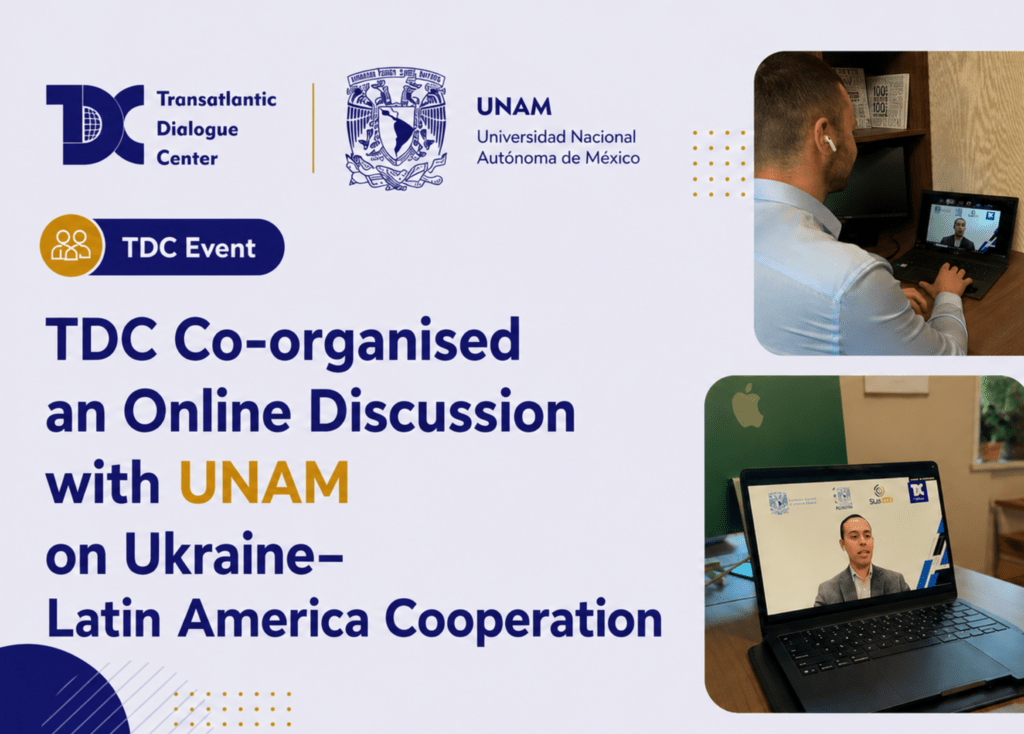
On 7 May, the Transatlantic Dialogue Center (TDC) co-organised, together with the National Autonomous University of Mexico (UNAM), a public academic talk titled “Ukraine–Latin America Relations in Contemporary International Relations: Political, Economic, and Diplomatic Potential.”
The lecture was delivered by Oleksandr Slyvchuk, Coordinator of the Spain and Latin America Cooperation Program at TDC, with commentary by José Joel Peña Llanes, Full-time Professor at the Faculty of Higher Studies Acatlán, UNAM. The discussion brought together International Relations students (primarily UNAM, as well as other universities), academics, and colleagues from think tanks for an exchange on Ukraine–Latin America cooperation and perspectives.
Key points raised during the talk included:
- the strengths and constraints of Ukraine–Latin America cooperation: shared democratic values and a similar vision of international order, but historically limited attention, modest diplomatic presence, and low trade volumes;
- how mutual interest in Ukraine and Latin America has increased sharply since 2022 as a result of Russia’s full-scale invasion;
- the changing information environment: while pro-Kremlin disinformation was more visible early in 2022, the space for propaganda has narrowed over time, sympathy toward Ukraine has grown, and narratives such as “Nazis in Ukraine” have become increasingly marginal;
- a persistent challenge in the region: perceptions of the U.S. and NATO as antagonists — and the need to clearly explain that Russia is not “defending itself from NATO” by attacking Ukraine, and that the claim that NATO expansion “provoked” the war is a myth;
- the importance of dispelling another entrenched misconception: Russia is not a defender of “left” ideas or vulnerable groups — this narrative is rooted in Soviet-era framing, while today Russia advances far-right, revisionist positions and systematically violates international law;
- an encouraging takeaway: Mexico’s academic community largely interprets the Russo-Ukrainian war accurately, including as a violation of international law — even as Mexico’s long-standing neutrality continues to shape cautious engagement with some international initiatives related to the war;
- the significant untapped potential for Ukraine–Mexico cooperation, especially at the academic and media levels: UNAM’s strong interest in partnering with Ukrainian counterparts highlights concrete next steps, including exchanges, joint lectures, panels, debates, and deeper collaboration that helps address the previous gap in sustained engagement.
We thank UNAM and all participants for an engaged and substantive discussion. As a co-organiser of this exchange, TDC looks forward to developing further cooperation between Ukrainian and Mexican academic and expert communities.