

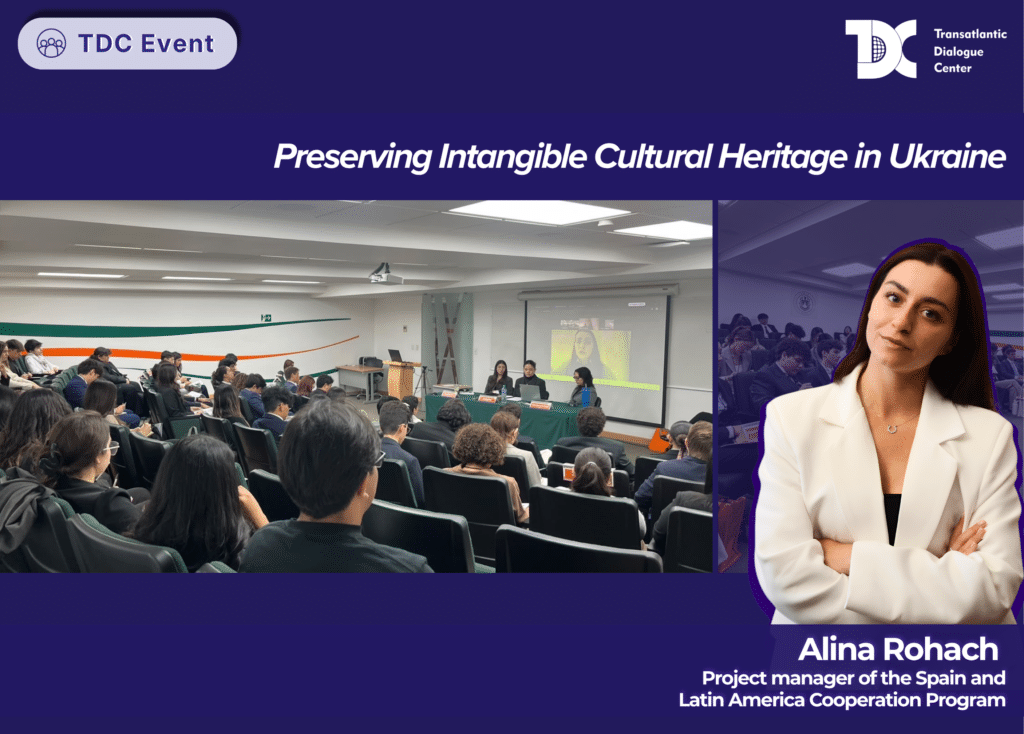
Alina Rohach, Project Manager of the Spain and Latin America Cooperation Program at Transatlantic Dialogue Center (TDC) took part as an invited speaker in the 39th Latin American Model United Nations Conference (LAMUN XXXIX) at the Universidad de las Américas Puebla (UDLAP) in Mexico.
The lecture was delivered for participants of the UNESCO Committee at the invitation of the School of Social Sciences, the Department of International Relations and Political Science, and the General Secretariat of LAMUN XXXIX. The audience included Mexican high school and university students taking part in the simulation of UN bodies.
The lecture, titled “Preserving Intangible Cultural Heritage in Ukraine amid Displacement and Social Disruption Resulting from Armed Conflict,” focused on how Russia’s war against Ukraine threatens not only cultural sites and infrastructure, but also the living cultural practices that communities preserve and pass on across generations.
A key point of the lecture was that Russian aggression endangers both tangible and intangible cultural heritage. While museums, libraries, historical monuments, and cultural infrastructure are directly damaged by the war, there is also a less visible threat: the destruction of the social environments where traditions, crafts, songs, knowledge, customs, and cultural practices are transmitted.
The lecture also addressed cultural identity as one of the central dimensions of Russia’s war against Ukraine. Particular attention was given to Russia’s policies in temporarily occupied Ukrainian territories, including restrictions on the Ukrainian language, the replacement of Ukrainian education with Russian curricula, and the rewriting of historical narratives. These practices affect not only education, but also the ability of future generations to maintain a connection with their language, culture, and historical memory.
Another focus was the impact of forced displacement on intangible heritage. When communities are separated across different regions and countries, traditional ways of transmitting cultural knowledge between generations are disrupted. At the same time, displaced Ukrainian communities continue to preserve their practices, adapt them to new conditions, and create new spaces for Ukrainian culture abroad.
The lecture also highlighted that the destruction of cultural infrastructure has consequences beyond the loss of physical buildings. The destruction of cultural centers, art schools, libraries, and community spaces also means the loss of places where communities learned, gathered, organized cultural events, and passed on traditions.
An important part of the discussion was the role of UNESCO and international mechanisms for protecting cultural heritage during armed conflicts. The key message was that protecting Ukraine’s cultural heritage is not only about preserving monuments and cultural objects, but also about supporting the people and communities who carry living traditions.
Participation in LAMUN XXXIX offered an opportunity to bring Ukraine’s experience to young audiences in Latin America, particularly in Mexico. As LAMUN brings together students who learn to analyze international challenges, conduct diplomatic negotiations, and develop solutions within the framework of UN bodies, Ukraine’s presence in such academic discussions helps deepen understanding of the consequences of Russian aggression and strengthens international dialogue on the protection of culture.