

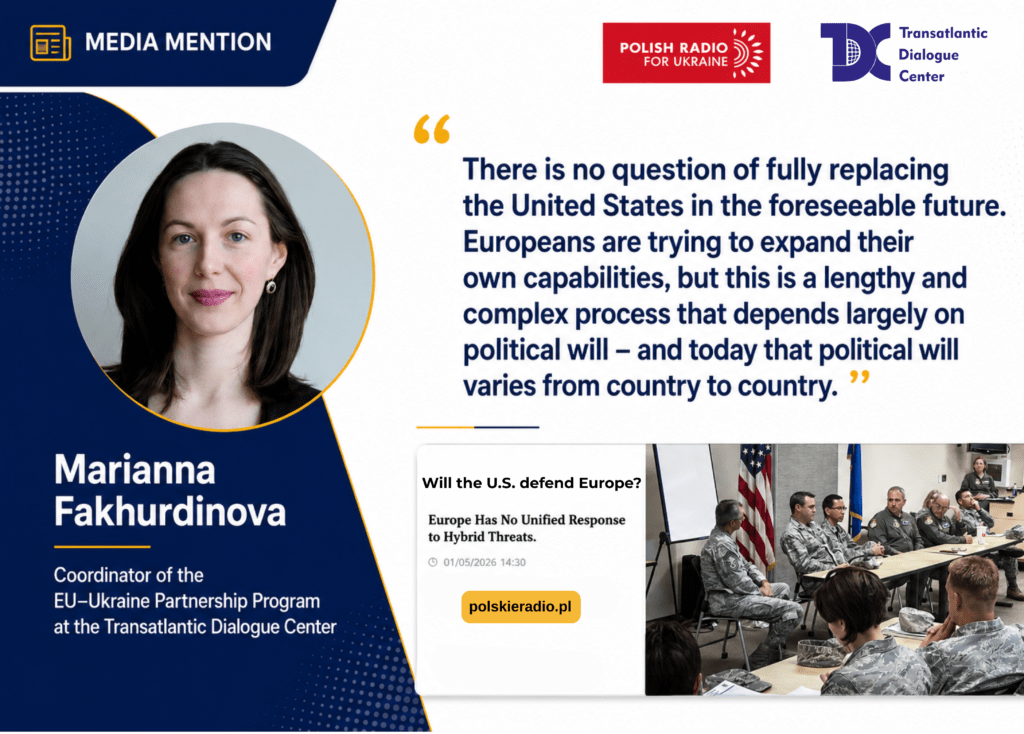
Marianna Fakhurdinova, Coordinadora del Programa de Asociación UE-Ucrania del Transatlantic Dialogue Center, ofreció un comentario a Polish Radio for Ukraine sobre la preparación de Estados Unidos y Europa para defender el flanco oriental de la OTAN ante las crecientes amenazas rusas.
Fakhurdinova subrayó que el desafío clave no reside solo en incidentes concretos, como las incursiones de drones en el espacio aéreo europeo o la actividad de la «flota fantasma» rusa, sino también en la ausencia de una estrategia integral y coherente para disuadir a Rusia. Según ella, las respuestas europeas a los ataques híbridos siguen siendo en gran medida ad hoc, mientras Europa continúa buscando un modelo eficaz de coordinación en materia de seguridad.
Subrayó que, incluso en los casos en que la amenaza es clara, los Estados miembros de la UE suelen actuar de manera fragmentada. Las decisiones siguen tomándose a nivel nacional, ya que el control sobre la política de seguridad continúa siendo una cuestión muy sensible para los gobiernos nacionales. Como resultado, la respuesta parece incoherente: algunos países detienen buques vinculados a la «flota fantasma» rusa, mientras que otros no lo hacen; de manera similar, no hubo una respuesta unificada y firme a las incursiones de drones rusos en el espacio aéreo de la UE.
Fakhurdinova también abordó el debate sobre la autonomía estratégica de Europa. Señaló que un alejamiento completo del armamento estadounidense y una rápida sustitución del papel de Estados Unidos no son escenarios realistas en esta etapa. Según algunas estimaciones, una transición de este tipo podría costarle a Europa alrededor de 1 billón de dólares. Aunque la UE ya está invirtiendo en programas de defensa y ha asignado 150 000 millones de euros para el rearme, el ritmo de estos cambios sigue siendo insuficiente.
Subrayó además que la dependencia de Europa respecto de Estados Unidos no es solo financiera, sino también tecnológica. Esto incluye capacidades críticas como los sistemas de defensa aérea Patriot, los sistemas de misiles de largo alcance, la logística, la inteligencia y el paraguas nuclear estadounidense. Estos elementos desempeñan actualmente un papel central no solo en el apoyo a Ucrania, sino también en el sostenimiento de la arquitectura más amplia de la seguridad europea.
Al mismo tiempo, Fakhurdinova señaló que Europa está desarrollando gradualmente sus propias capacidades de defensa, pero que se trata de un proceso largo y complejo que depende en gran medida de la voluntad política de cada Estado. Por tanto, en su evaluación, sustituir plenamente a Estados Unidos no es una perspectiva a corto plazo; más bien, la prioridad debería ser una coordinación europea más sólida, una inversión sostenida y una planificación estratégica.
Lea el artículo completo a través del enlace.