
 25 min de lectura
En 2025, la Unión Europea se enfrentó a una presión creciente para reformar su postura de defensa en respuesta a la continua agresión de Rusia contra Ucrania y a las crecientes dudas sobre las garantías de seguridad estadounidenses bajo la agenda ‘America First’ de la segunda administración Trump. La guerra también ha expuesto una profunda fragmentación en la defensa europea, incluyendo una interoperabilidad limitada de armas, duplicación de esfuerzos de adquisición y grandes disparidades en los presupuestos de defensa y las capacidades industriales entre los Estados miembros.
Reconociendo la imperiosa necesidad estratégica de fortalecer la postura de disuasión europea y brindar apoyo sostenido a Ucrania, la UE adoptó el instrumento SAFE como parte del Plan Rearm Europe/Readiness 2030 en marzo de 2025. Basándose en dos iniciativas anteriores de la UE, EDIRPA (adquisición común) y ASAP (aumento de municiones), SAFE las supera significativamente en términos de escala de financiación. Sin embargo, persisten dudas sobre cómo los Estados miembros utilizarán este instrumento, si logrará el impacto previsto en la industria de defensa europea y cómo Ucrania se beneficiará de él. Este informe político explora estas cuestiones.
El Plan ReArm Europe/Readiness 2030 tiene como objetivo impulsar las capacidades de defensa europeas y la base industrial a través de varios medios financieros, uno de los cuales es el Reglamento Seguridad y Acción para Europa (SAFE), adoptado el 27 de mayo de 2025. El objetivo principal del mecanismo SAFE es incentivar la adquisición militar común entre los Estados miembros mediante la asignación de hasta 150 mil millones de euros en préstamos respaldados por el presupuesto de la UE.
El instrumento busca reducir los costos de producción, disminuir la fragmentación y mejorar la interoperabilidad en toda la UE en el ámbito de la defensa y la seguridad. De manera más amplia, está diseñado para hacer que Europa sea más soberana y responsable de su propia defensa. De manera positiva para Kyiv, los países del EEE/AELC y Ucrania también pueden beneficiarse parcialmente del SAFE bajo ciertas condiciones.
Los dos objetivos principales de los nuevos instrumentos financieros de la UE, según se describe en el Libro Blanco, son:
Ante las actuales carencias de capacidades en la UE y las lecciones aprendidas en el campo de batalla en Ucrania, la Comisión Europea ha priorizado las siguientes categorías de equipamiento para ser adquiridas bajo el esquema de financiación SAFE:
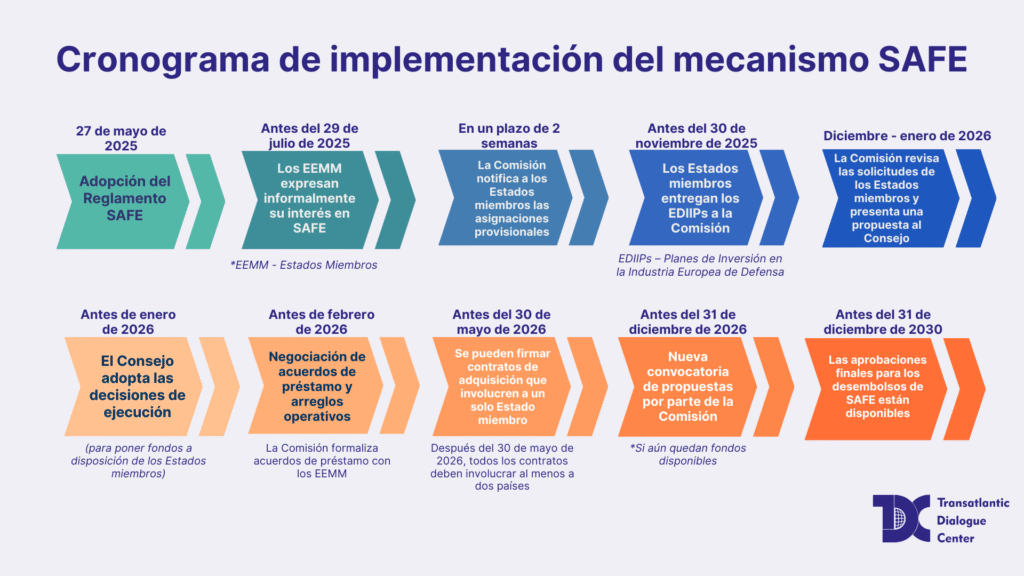
La Comisión Europea ha establecido un cronograma para que los Estados miembros se conviertan en beneficiarios de fondos bajo el mecanismo SAFE:
Para garantizar la eficacia del mecanismo SAFE, la Comisión Europea ha establecido varios requisitos clave que los beneficiarios de la financiación deberán cumplir.
1. Adquisición común
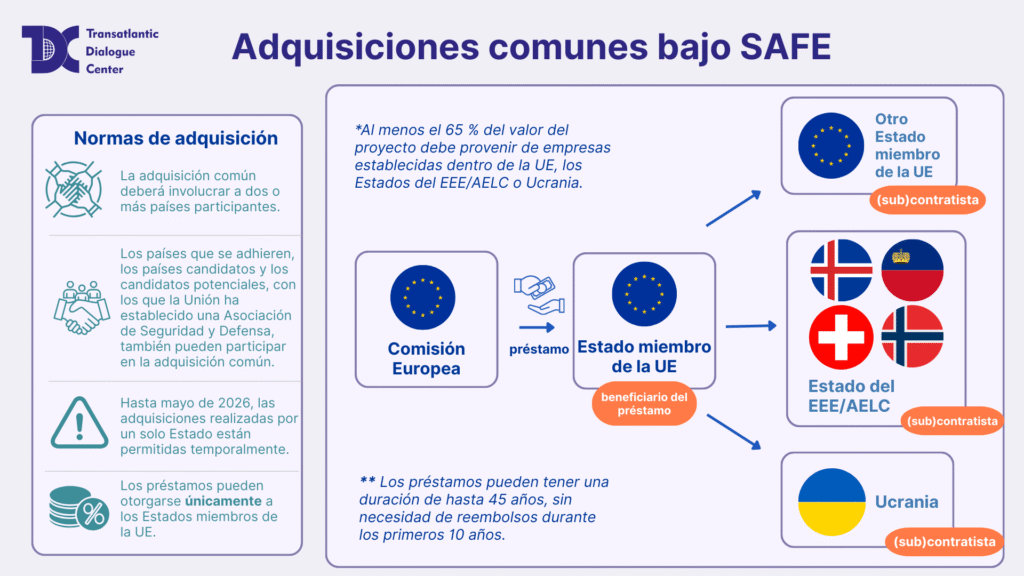
Los proyectos deberían involucrar normalmente al menos dos participantes (por ejemplo, dos Estados miembros, un Estado miembro y un país del EEE/AELC o Ucrania, o un Estado miembro y otros terceros países*). Como excepción a la regla, las adquisiciones realizadas por un solo Estado están permitidas temporalmente durante una fase inicial.
2. Regla de “Comprar europeo”
Al menos el 65% del valor del proyecto debe provenir de empresas establecidas en la UE, los Estados del EEE/AELC o Ucrania. Un máximo del 35 % del coste estimado de los componentes del producto final puede proceder de proveedores o subcontratistas externos de terceros países (por ejemplo, Estados Unidos).
3. Acceso a los préstamos
Los préstamos están disponibles en condiciones altamente favorables: pueden tener una duración de hasta 45 años, sin obligación de reembolso durante los primeros 10 años. Además, hasta el 15 % de los fondos puede desembolsarse por adelantado para facilitar el inicio de los proyectos.
Cabe destacar que los préstamos solo pueden concederse a los Estados miembros de la UE. Si un tercer país, como Ucrania, participa en una adquisición común, los fondos se desembolsarán al Estado miembro correspondiente. Basándose en su Plan de Inversión en la Industria Europea de Defensa, ese Estado miembro asignará la financiación entre las actividades aprobadas.
El instrumento SAFE es un paso pragmático hacia el fortalecimiento de las capacidades de defensa de UE en respuesta a las crecientes amenazas geopolíticas. Su principal ventaja radica en su objetivo de promover la contratación común, con la intención de fomentar una mayor colaboración entre las industrias de los Estados miembros y reducir la fragmentación en el mercado de defensa de la UE. Al exigir que el 65% del gasto se dirija a la producción con sede en la UE, SAFE busca fortalecer la base industrial de defensa de Europa, al tiempo que adopta un enfoque europeo holístico, en lugar de estrictamente exclusivo de la UE, al permitir la participación de terceros países como Ucrania, los miembros de EEE/AELC y los países que se adhieren, candidatos y potencias candidatos.
A pesar de los ambiciosos objetivos de la UE en el marco de SAFE, su escala global sigue siendo modesta. Si bien, los funcionarios de la Comisión señalan que el tamaño de SAFE (150.000 millones de euros) representa más de la mitad del gasto anual en defensa de los estados miembros de la UE, esta cifra parece modesta en relación con sus objetivos. Según algunas estimaciones, la reducción de la dependencia de Estados Unidos, como se prevé en el Reglamento SAFE, requeriría cerca de 1 billón de dólares. Durante décadas, la UE ha dependido en gran medida de los EE.UU. para el transporte aéreo, las comunicaciones por satélite y el reabastecimiento aéreo, y el 78% de la adquisición de defensa europea en 2022-2023 se gastó en productos no europeos. SAFE por sí solo no puede cubrir estos gastos y tiene varias limitaciones que siguen sin resolver.
Dado que SAFE está diseñado para abordar rápidamente las deficiencias críticas en la capacidad, funciona como una línea de crédito que puede no ser atractiva para todos los países. En primer lugar, los préstamos se contabilizan como deuda nacional, y los Estados miembros con un margen fiscal limitado pueden tener dificultades para utilizar SAFE de forma eficaz. En términos sencillos, el margen fiscal se refiere a la capacidad de un gobierno para asumir deuda adicional sin pointer en peligro la estabilidad financiera.
No todos los países de la UE están en la misma posición a este respecto: los que tienen niveles de deuda más altos tienen menos margen fiscal, y viceversa. Francia, por ejemplo, tiene actualmente uno de los mayores déficits presupuestarios (-5,8%) de la UE y una deuda presupuestaria bastante alta (alrededor del 113%) pero aspira a alear el gasto en defensa al 3-3,5% del PIB. A partir del julio de 2025, Francia ha expresado su interés en los préstamos SAFE, aunque probablemente por una suma modesta.
Además, el endeudamiento a los tipos de interés de la UE no es atractivo para todos los Estados miembros. SAFE permite esencialmente a la UE recaudar hasta 150.000 millones de euros en los mercados de valores y volver a prestarlos a los Estados miembros a tipos de interés comparativamente bajos. Con los rendimientos de los bonos de la UE en torno a 3% se espera que los préstamos SAFE tengan un tipo similar. Esto presenta una ventaja significativa para los países con mayores costos de endeudamiento — como Rumania (7%), Polonia (5,4%) y la República Checa (4,3%) — que se beneficiarán del acceso a una financiación más barata a nivel de la UE.
Sin embargo, para muchos Estados miembros, la brecha entre los costos del endeudamiento de la UE y los nacionales es relativamente pequeña, Los países más ricos con fuertes calificaciones crediticias (AAA) — como Alemania (2,6%), los Países Bajos (2,8%), Suecia (2,4%) y Dinamarca (2,5) — tienen pocos incentivos para utilizar SAFE ya que sus propios costos de endeudamiento son más bajos que los de la UE. Dinamarca, por ejemplo, ha declarado abiertamente que no planea utilizar préstamos SAFE, prefiriendo financiar sus inversiones en defensa de forma independiente. En septiembre, sin embargo, se convirtió en el último Estado miembro de la UE en manifestar interés por recibir préstamos del mecanismo SAFE. Según se informa, la posibilidad de apoyar a Ucrania a través de SAFE impulsó al país a tomar esta decisión.
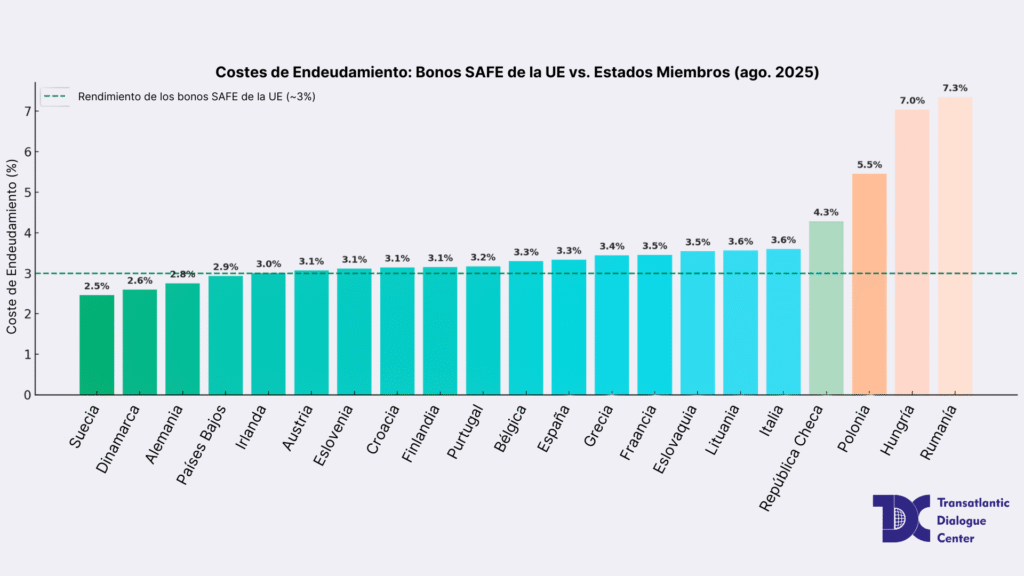
Al 1 de septiembre de 2025, diecinueve Estados miembros de la UE habían expresado su interés en solicitar préstamos por un total de 150.000 millones de euros. Estos incluyen a Bélgica, Bulgaria, Chequia, Dinamarca, Estonia, Grecia, España, Francia, Croacia, Italia, Chipre, Letonia, Lituania, Hungría, Polonia, Portugal, Rumanía, Eslovaquia y Finlandia.
Si bien algunos Estados miembros parecen estar genuinamente comprometidos con el fortalecimiento de su postura de defensa — Polonia, por ejemplo, ha reunido proyectos por valor de aproximadamente 45.000 millones de euros —, otros pueden utilizar SAFE de forma más simbólica, señalando su apoyo a los objetivos de defensa de la UE sin un compromiso sustancial. Italia, por ejemplo, ha expresado su interés por 14.000 millones de euros, mientras que Grecia busca 1.270 millones de euros. Se esperan las solicitudes de financiación finales y los planes detallados de inversión de la industria de defensa europea en noviembre, pero la forma en que los países decidan gastar los fondos (de forma colaborativa o independiente) puede importar más que la cantidad que se gastará.
El mercado de defensa de la UE siegue estando muy fragmentado, y la contratación se lleva a cabo normalmente a nivel nacional y a menudo favorece a las industrias nacionales. Esto conduce a la pérdida de oportunidades de sinergias y economías de escala, lo que se ve agravado por una diversidad de plataformas excesiva entre los Estados miembros y la ausencia de una normativa de exportación armonizada en toda la UE.
Los objetivos de SAFE — contratación común, reducción de la fragmentación del mercado y mejora de la interoperabilidad — solo pueden alcanzarse si los países actúan con unidad y voluntad política, en lugar de competir por los fondos. La desconfianza mutua podría fácilmente hacer que los intereses nacionales superan a las iniciativas comunes, socavando el propósito del programa.
En este contexto, es poco probable que SAFE aborde eficazmente el proteccionismo nacional, a pesar de su intención de colaboración. Según las normas actuales, los préstamos SAFE requieren solicitudes de al menos dos Estados miembros, pero durante el primer año, hasta mayo de 2026, los Estados miembros individuales también pueden solicitarlos de forma independiente. Además, a petición ce algunos Estados miembros, la Comisión ha permitido que los programas de defensa existentes se financien en el marco de SAFE.
Estas condiciones pueden no ofrecer suficientes incentivos para una cooperación amplia, y los Estados miembros pueden en su lugar usar la SAFE principalmente para reforzar sus propias industrias. Esta tendencia ya es evidente en las solicitudes preliminares presentadas a partir de julio de 2025, con los Estados miembros supuestamente presentando propuestas individuales que priorizan las industrias nacionales. Por ejemplo, funcionarios polacos afirman que Varsovia probablemente usará la financiación para apoyar la producción nacional de equipos, como drones y sistemas anti-drones bajo la iniciativa “Escudo Oriental”, munición de artillería, obuses autopropulsados Krab, vehículos Rosomak y camiones logísticos Jelcz.
Si la mayoría de los 19 países solicitantes presentaran propuestas individuales, casi agotarían SAFE, convirtiendo una herramienta concebida para la adquisición común en un instrumento de financiación individual.
De esta manera, SAFE corre el riesgo de no lograr su objetivo de promover la contratación común y reducir la fragmentación en el mercado de defensa de la UE. Este riesgo aún podría ser mitigado por la Comisión, que toma la decisión final sobre la asignación de fondos; sin embargo, tanto los criterios para estas decisiones como el organismo específico dentro de la Comisión responsable, junto con su experiencia, siguen sin estar claros.
Dado lo anterior, SAFE no debe considerarse una solución sostenible a largo plazo para la seguridad Europa. El propio reglamento que establece SAFE lo define como un instrumento temporal y ad hoc, complementario a las iniciativas existentes de la UE como el Fondo Europeo de Defensa (FED). No es la primera vez que la UE utiliza el artículo 122 del Tratado de Funcionamiento de la Unión Europea (TFUE) para ofrecer asistencia financiera de emergencia. Durante la pandemia de COVID-19, la UE lanzó el instrumento SURE bajo la misma base jurídica para apoyar el empleo.
Sin embargo, el sector de la defensa y la seguridad difiere fundamentalmente de áreas como el desempleo: el gasto en defensa no pude tratarse como una desviación temporal de las normas fiscales. Esto hace que la naturaleza a corto plazo de SAFE sea su principal limitación. Para las empresas de defensa a ambos lados del Atlántico, la principal barrera para aumentar la producción no es la falta de financiación en sí, sino la ausencia de pedidos gubernamentales predecibles a largo plazo. La defensa requiere una inversión constante y a lo largo plazo en ligar de una financiación de emergencia única.
Para aprovechar los cimientos de SAFE y abordar sus limitaciones, la UE tendrá que adoptar mecanismo de financiación más permanentes y centralizados para garantizar una autonomía estratégica duradera. Un ejemplo es el Mecanismo Europeo de Defensa (MED) propuesto, un organismo intergubernamental que centralizaría la adquisición y las capacidades de defensa europea, al tiempo que aplicaría la cooperación a través de la financiación compartida y las normas vinculantes.
Una estrategia coordinada con un presupuesto sustancial (por ejemplo, 500 000 millones de euros en cinco años) puede ser la única forma de abordar la persistente fragmentación del mercado de defensa de la UE. La propuesta de la Comisión de asignar 131.000 millones de euros a la defensa en el próximo Marco Financiero Plurianual es poco probable que resuelva este problema.
Hasta ahora, para que SAFE lore el impacto deseado, los Estados miembros deberían asumir un papel proactivo. La UE he creado un instrumento financiero fuerte y prometedor, pero su éxito depende en última instancia de cuán eficaz y ambiciosamente los Estados miembros decían implementarlo.
Disposiciones clave para la participación de Ucrania como tercer país
A menudo se afirma que Ucrania puede participar en SAFE en igualdad de condiciones con los Estados miembros de la UE y beneficiarse en gran medida del proceso. Sin embargo, esto solo es parcialmente cierto.
La novedad del mecanismo SAFE reside en el hecho de que los productores de armas y las empresas tecnológicas de Ucrania pueden participar en la contratación común como (sub)contratistas, junto con las empresas con sede en la UE, recibiendo financiación del préstamo adquirido por un Estado miembro de la UE.
El 65% de los componentes del producto final deben proceder de los Estados miembros de la UE, los países del EEE/AELC o Ucrania. En este sentido, Ucrania puede considerarse, de hecho, parte de Europa. Por el contrario, los países adherentes, los países candidatos y otros países de la UE (denominados en el Reglamento SAFE como ‘otros terceros países’) también pueden participar en SAFE como subcontratistas, pero en condiciones mucho más estrictas. Sus contribuciones se consideran originarias de “fuera de la Unión” y solo pueden constituir hasta el 35% del producto final.
El territorio de Ucrania también puede utilizarse para finales de fabricación, ya que, según el Reglamento SAFE,
“la infraestructura, las instalaciones, los activos y los recursos de los contratistas y subcontratistas involucrados en la contratación común que se utilicen para los finales de la contratación común se ubicarán en el territorio de un Estado miembro, un Estado AELC del EEE o Ucrania."
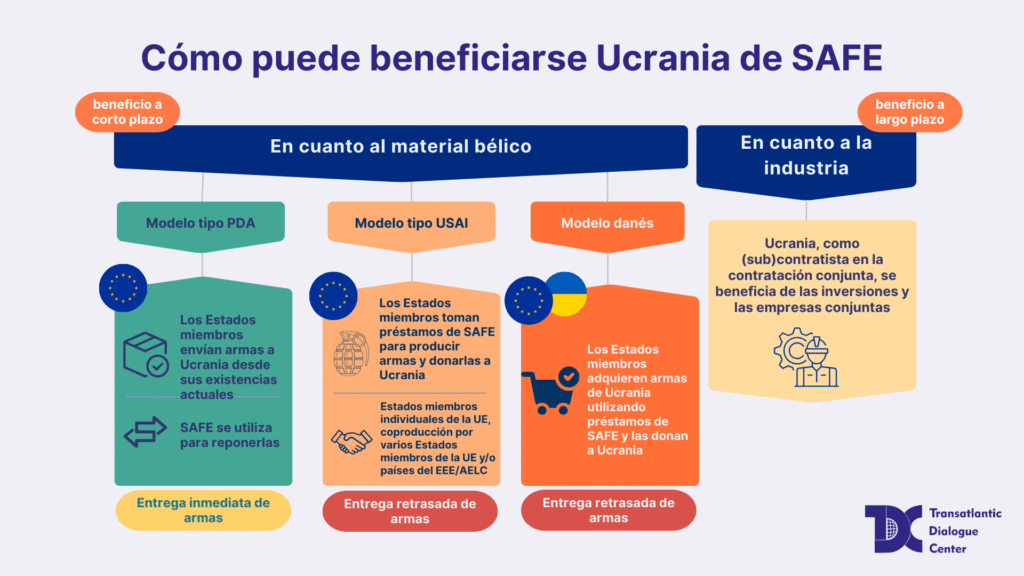
Una de las formas en que Ucrania puede beneficiarse del mecanismo SAFE es siendo designada como receptora de equipos entregados como ayuda militar. El Reglamento SAFE contiene una cláusula separada que anima a los Estados miembros a incluir, cuando sea pertinente, una descripción de la participación prevista de Ucrania en sus actividades planificadas en sus Planes Europeos de Inversión en la Industria de Defensa. En una resolución reciente, el Parlamento Europeo incluyó una cláusula que animaba a los Estados miembros a dedicar una parte significativa de sus Planes Europeos de Inversión en la Industria de Defensa a la asistencia a Ucrania. Dentro del marco de las disposiciones de SAFE, parecen factibles varios escenarios:
Idealmente, además de promover la contratación común, el instrumento financiero SAFE también tenía como objetivo alentar a los Estados miembros a aumentar el apoyo militar a Ucrania. La idea subyacente es proporcionar apoyo financiero a los Estados miembros de la UE para que adquieran nuevos equipos militares para sí mismos, lo que les permitiría proporcionar equipos de las existencias actuales a Ucrania. Esto daría resultados rápidos para Ucrania al tiempo que garantiza que los Estados miembros reciban un reabastecimiento garantizado (un mecanismo similar a la Autoridad Presencial de Retiro de los Estados Unidos (PDA)). Sin embargo, mucho dependerá de las decisiones políticas y las prioridades nacionales de cada Estado miembro, así como del ritmo de implementación de SAFE.
Al igual que en el esquema anterior, Ucrania puede ser designada como receptora potencial de equipo militar adquirido por los Estados miembros en el marco del instrumento financiero SAFE. Sin embargo, este escenario retrasaría el apoyo a Ucrania, ya que los procedimientos de adquisición y el establecimiento de nuevas líneas de producción llegarían tiempo (un mecanismo similar a la Iniciativa de Asistencia de Seguridad de Ucrania de los Estados Unidos (USAI)).
El problema clave radica en los incentivos para que los Estados miembros donen los equipos recién producidos a Ucrania, en lugar de reponer sus propias existencias. Como alternativa, Ucrania puede colaborar con los Estados miembros que han proporcionado previamente equipos esenciales y que Ucrania todavía necesita para animarlos a suministrar unidades adicionales de los mismos sistemas, esta vez financiadas a través del instrumento financiero SAFE.
En este escenario, Ucrania se beneficiará de la fabricación local de equipo de defensa en cooperación con empresas de la UE que operan en territorio ucraniano. Este enfoque es similar a elementos del “modelo danés”, que permite a los países interesados financiar la industria de defensa de Ucrania y donar los equipos producidos a Ucrania. Encabezado por Dinamarca, el ‘modelo danés’ se ha convertido en el primer mecanismo para involucrar la contratación directa de fabricantes de defensa ucranianos. Este modelo podría servir como modelo para la contratación financiada por SAFE, que involucra a las empresas de defensa y tecnología de Ucrania y sus instalaciones en Ucrania.
En el marco de SAFE, sin embargo, la distinción clave radica en la participación obligatoria de los Estados miembros de la UE como receptores de préstamos. Técnicamente, un Estado miembro de la UE puede desembolsar los fondos a una empresa europea, que producirá junto como una empresa ucraniana utilizando las instalaciones de esta última en territorio ucraniano. Como alternativa, un Estado miembro de la UE que reciba un préstamo podría adquirir armas de una empresa ucraniana, actuando como contratista único, y donarlas a Ucrania. En este caso, la prohibición de exportación de Ucrania no se aplicaría.
A corto plazo, la financiación SAFE combinaría rápidamente con soluciones probadas en la guerra para las necesidades actuales de Ucrania. Dado que michas industrias ucranianas obtienen componentes de la UE, las inversiones también beneficiarían a la industria europea, lo que permitiría a los socios seleccionar contratistas ucranianos de confianza y garantizar la seguridad de la cadena de suministro.
A largo plazo, con Ucrania designada como (sub)contratista del Estado miembro de la UE que recibe el préstamo SAFE, no solo el ejercito ucraniano se beneficiaría de SAFE como receptor de equipo, sino que también las industrias ucranianas se benefician como beneficiarias de inversiones a largo plazo y empresas conjuntas con socios europeos.
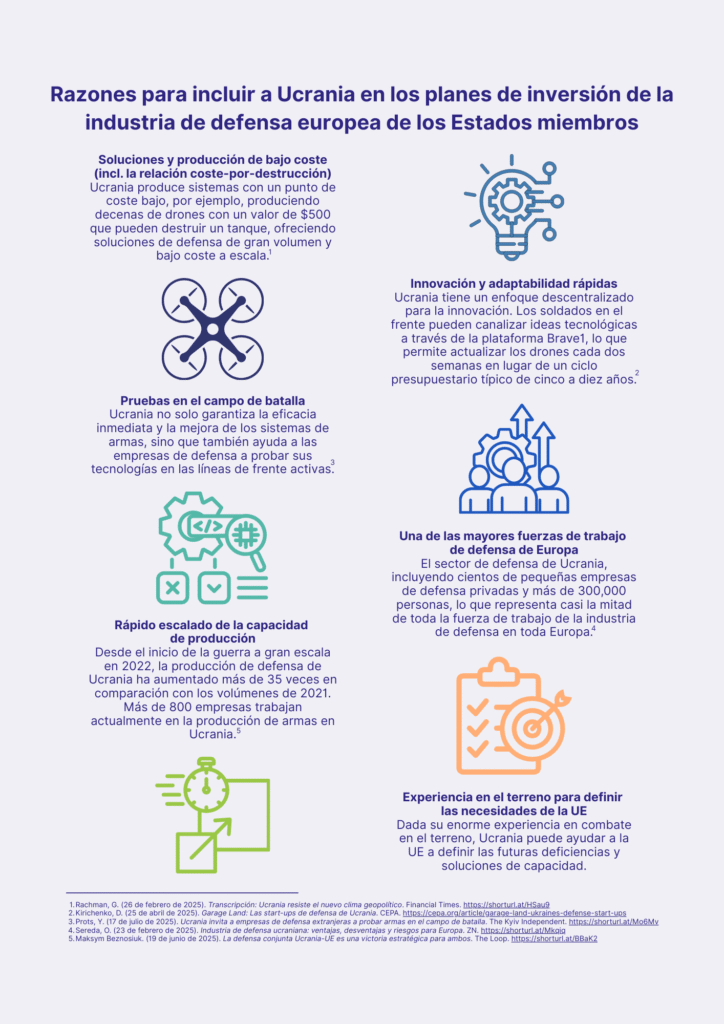
La industria de defensa ucraniana se encuentra entre las que se desarrollan y expanden más rápidamente en el mundo. Desde el inicio de la invasión a gran escala de Rusia, Ucrania ha multiplicado por treinta y cinco su capacidad de producción: de 1.000 millones de dólares en 2022 a 35.000 millones de dólares en 2025. Sin embargo, en 2024, Ucrania solo logró asegurar alrededor de 10.000 millones de dólares en financiación. Las inversiones financiadas por SAFE podrían liberar aún más el potencial de las industrias ucranianas al expandir sus líneas de producción, acelerar los plazos de entrega y ampliar proyectos innovadores ya probados en combate.
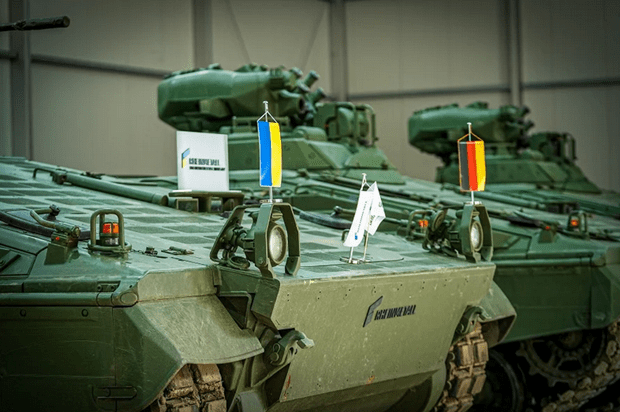
Además, permitir que las empresas ucranianas participen en empresas conjuntas representa un cambio positivo en la mentalidad, otorgando a la industria de defensa ucraniana al menos un acceso parcial a la colaboración con empresas europeas. Este es un paso importante hacia una integración más amplia de los productores de armas de Ucrania en el ecosistema de defensa europeo, lo que ayuda a promover la estandarización, la interoperabilidad y a mejorar la rentabilidad. A finales de 2024, Ucrania ha establecido cinco empresas conjuntas con fabricantes de armas occidentales, incluyendo empresas de Alemania y Lituania. Además, empresas europeas, como la alemana Rheinmetall, comenzaron a construir instalaciones de producción en Ucrania, mientras que la británica BAE Systems se está asociando con empresas locales para dar servicio y mantener su equipo. El fabricante francoalemán KNDS planea una cooperación similar, y el Grupo Checoslovaco está instalando plantas de municiones en el país. La SAFE podría proporcionar otro impulso importante en esta dirección.
Persisten las dudas sobre las oportunidades reales de participación de Ucrania. A pesar del objetivo proclamado de SAFE de establecer un mecanismo adicional para mejorar el apoyo a Ucrania, sus disposiciones clave y las condiciones de participación surgieren de que los beneficios potenciales de Ucrania pueden ser de alcance limitado.
Una de las principales preocupaciones es sí los Estados miembros de la UE estarían realmente dispuestos a incluir a Ucrania en sus Planes Europeos de Inversión en la Industria de Defensa. Dado que Ucrania solo puede participar como uno de los (sub)contratistas, los Estados miembros pueden tender a centrarse en impulsar las capacidades de sus productores de defensa nacionales. Además, los problemas de confianza y la falta de prioridades comunes pueden impedir que los países interesados planifiquen proyectos conjuntos con Ucrania, ya que puede llevar más tiempo y requerir procesos de diligencia debida adicionales.
La Comisión, a su vez, también tiene herramientas muy limitadas a su disposición para influir en las decisiones de los Estados miembros. Al mismo tiempo, Ucrania corre el riesgo de perder la oportunidad de obtener beneficios reales de este instrumento financiero debido al corto plazo para la presentación de los Planes Europeos de Inversión en la Industria de Defensa de los Estados miembros.
También hay desafíos por parte de Ucrania. Si bien el reglamento SAFE permite que su territorio se utilice para la coproducción, esto entra en conflicto con la prohibición de exportación que Ucrania ha promulgado desde la invasión de 2022. De acuerdo con la legislación ucraniana, específicamente la Ley ’sobre el control estatal de las transferencias internacionales de bienes militares y de doble uso,’ la exportación de artículos de defensa está generalmente prohibida y solo procede realizarse con la debida autorización de las autoridades estatales designadas.
Por lo tanto, técnicamente, cualquier equipo fabricado en Ucrania con financiación de SAFE debería permanecer para uso final dentro del país, a menos que el gobierno levante la prohibición de exportación.
Sin embargo, esto no se aplica a las empresas ucranianas que están registradas en los Estados miembros de la UE y tienen instalaciones de fabricación allí.
Además, las barreras legales relacionadas con el control de terceros países y las restricciones de propiedad intelectual en Ucrania pueden crear obstáculos adicionales para la participación de Ucrania en la contratación común. Al mismo tiempo, la creciente red de aceleradores de I + D, centros de innovación y asociaciones de Ucrania carece de mecanismos de protección de la propiedad intelectual (PI) suficientemente sólidos. Un marco sólido de protección de la PI fomentaría la participación ucraniana en las iniciativas de defensa europeas y mundiales.
Dicho marco sugiere que no hay garantía de que Ucrania sea incluida sistemáticamente en las inversiones planificadas. Sin fuertes incentivos o herramientas de coordinación para priorizar la participación de Ucrania, existe el riesgo de que los Estados miembros persigan agendas puramente nacionales, dejando de lado la colaboración con los actores de la industria de defensa ucraniana.
En mayo - junio de 2025, el ministro de Defensa de Ucrania describió las prioridades de Ucrania para la financiación de SAFE y lo que el país puede ofrecer a la UE. Ucrania está particularmente interesada en la contratación y producción conjunta de las siguientes categorías de equipos:
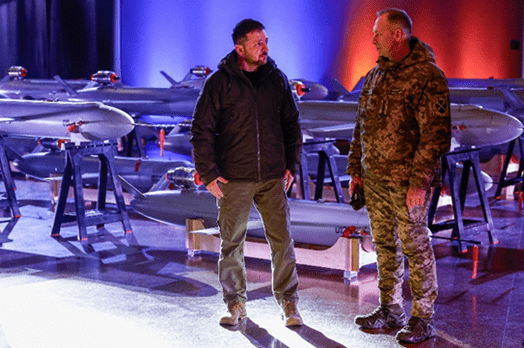
Ucrania está particularmente interesada en la contratación común con los países nórdicos y Alemania, que tienen tanto las capacidades como el interés en apoyar a Ucrania. Sin embargo, los préstamos SAFE ofrecen tipos de interés poco atractivos para estos países. A pesar de ello, los Países Bajos, Dinamarca, Noruega, Suecia y Alemania, casa uno con economías fuertes, han prometido recientemente 1.500 millones de dólares para comprar armas de fabricación estadounidense para Ucrania a través de la iniciativa de la Lista de Requerimientos Priorizados para Ucrania (PURL) de la OTAN. Ucrania también ha señalado su interés en trabajar con los principales proveedores europeos de sistemas de defensa aérea y municiones, como Francia e Italia.
Según se informa, países como Portugal, España, Francia, Bulgaria y Eslovaquia podrían estar interesados en incluir a Ucrania en sus Planes de Inversión de la Industria de Defensa Europea. Entre los Estados miembros interesados en acceder a los préstamos de la SAFE, existe un gran entusiasmo por la colaboración con Ucrania en el desarrollo, despliegue e intercambio de tecnología de vehículos aéreos no tripulados. Croacia y Letonia ya han discutido la asignación de fondos de la SAFE para las necesidades de Ucrania con el presidente Zelenski y el ex primer ministro Shmyhal.
Los siguientes estudios de casos describen posibles escenarios en los que los préstamos SAFE podrían utilizarse para apoyar la producción conjunta de defensa entre la UE y Ucrania.
1. República Checa y Ucrania: ampliación de la producción de municiones
La necesidad sostenida de municiones de Ucrania puede utilizarse para ilustrar cómo podría funcionar en la práctica el modelo de adquisición SAFE.
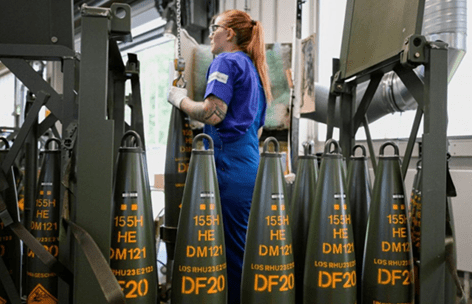
Según el Libro Blanco de la UE, la Unión se comprometió a entregar un mínimo de dos millones de cartuchos de munición de artillería de gran calibre al año. La República Checa, que ha expresado su interés en contratar préstamos SAFE, ha sido uno de los principales proveedores de munición de artillería de 155 mm a Ucrania. En particular, en octubre de 2024, Czechoslovak Group (CSG) anunció la conclusión de un acuerdo con la empresa ucraniana de municiones de artillería para producir municiones localmente en Ucrania. Según el comunicado de prensa de CSG, CSG y Ukrainska Bronetechnika producirán 100.000 cartuchos de artillería en 2025, y la producción aumentara a más de 300.000 al año a partir de 2026. La producción tanto en la República Checa como en Ucrania tienen como objetivo aumentar el suministro para el ejército ucraniano y reducir los costos.
Dado que los proyectos en curso también pueden recibir financiación en el marco del mecanismo SAFE, CSG Y Ukrainska Brotenechnika pueden solicitar financiación SAFE para ampliar sus capacidades de fabricación en Ucrania, reducir aún más los costos y proporcionar a Ucrania equipos de vital importancia. En este caso, Ukrainska Bronetechnika podría actuar como subcontratista, cuyas instalaciones en Ucrania se utilizarán para la producción local con subministros adicionales a las Fuerzas Armadas de Ucrania.
2. Estonia y Ucrania: potencial de financiación de SAFE de la alianza euro ucraniana USHORAD
En mayo de 2025, Ucrania y Estonia formaron la Alianza de Tecnología de Defensa Aérea para Ucrania, con el objetivo de
“cubrir las deficiencias críticas en la capacidad de defensa aérea de muy corto alcance (USHORAD) y establecer una asociación industrial de defensa europea-ucraniana capaz de una rápida innovación y producción escalable.”
En el marco de esta cooperación, DefSecIntel Solutions (Estonia), los socios de la industria de defensa ucraniana (Gauss Glide, Drone space labs, LLC Proinvest, Vk Systems, EW Spectrum) y Weibel Scientific (Dinamarca) han acordado integrar la tecnología de radar de Weibel con los sistemas de defensa aérea de muy corto alcance (USHORAD) de DefSecIntel y los efectores de interceptación ucranianos en plataformas de defensa totalmente automatizadas y escalables. Dicha iniciativa representa un paso hacia el desarrollo de soluciones conjuntas para satisfacer la necesidad actual de Ucrania de sistemas anti-drones y apoyar iniciativas europeas más amplias, como el Muro de Drones Bálticos.
Si se evalúan los criterios de elegibilidad, este proyecto cumple un requisito clave del mecanismo SAFE. Representa un posible modelo emblemático para la cooperación transfronteriza de defensa entre la UE y Ucrania con relevancia directa en el campo de batalla y beneficios industriales escalables para las propias necesidades de seguridad de Europa. Como tal, representa un fuerte candidato para una posible financiación en el marco de SAFE.
Para los Estados miembros de la UE:
Para Ucrania: