

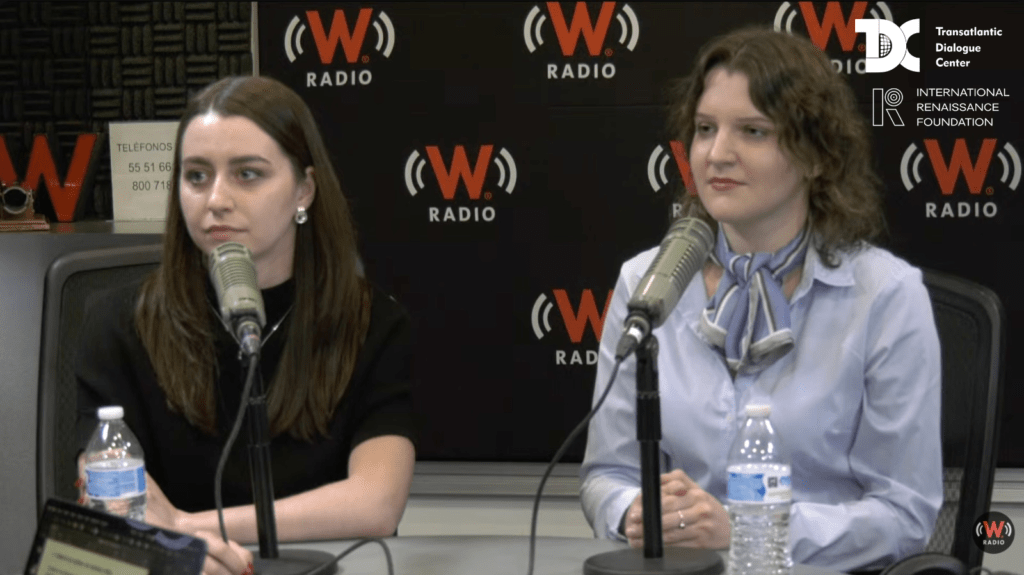
On 3 March 2026, Alina Rohach, Project Manager of the Spain and Latin America Cooperation Program at the Transatlantic Dialogue Center, and Bohdana Batsko, Project Assistant in the same program, joined W Radio for an interview hosted by Enrique Hernández Alcázar.
The conversation addressed the state of the war after four years and why Ukrainians increasingly describe it as a “long war”. Reflecting on negotiations and the search for peace, Batsko stressed that Ukrainian society and the government want peace, yet Russia continues to use negotiations to buy time while advancing maximalist public demands that leave little room for genuine dialogue.
A key segment focused on the regionalization of the conflict and its links to broader instability, including Iran. Rohach argued that global turbulence does not make Ukraine less relevant — rather, Ukraine’s experience is increasingly applicable to other regions. She highlighted the Russia–Iran connection, including Iran’s provision of “Shahed” drones used in attacks across Ukraine, and pointed to the wider implications of cooperation among autocratic regimes.
Discussing sovereignty and international law, Batsko emphasized that Ukraine is defending its independence and the principle that force cannot be used to achieve political ambitions. She underlined that international law prohibits the use of force and that Ukraine, even as a smaller state than Russia, has the right to define its own future.
The interview also examined the role of the United States and the risks of “quick peace” framing. Rohach noted that repeated promises to end the war rapidly have not reflected the complexity of the conflict, and that the tense Zelenskyy–White House episode was a serious blow for Ukrainian society given how essential U.S. support remains. She added that while some actors may seek a fast end to the war, Ukrainians prioritize sovereignty and territorial integrity — shaping what “ending the war” can realistically mean.
In the closing part, the speakers discussed Latin America’s engagement and the information dimension of the war. Batsko pointed to the challenge of limited access to accurate information about Ukraine in parts of the region, while Russia actively seeks to legitimize its aggression through information operations. Both speakers also highlighted humanitarian cooperation as a realistic pathway: Rohach noted that Chile, Argentina, and Costa Rica participate in the International Coalition for the Return of Ukrainian Children, and emphasized that Mexico’s consistent UN voting matters — while encouraging Mexico to play a more active role aligned with its foreign policy principles and international law.
Watch the full W Radio interview via the link.
This project was supported by the International Renaissance Foundation.