

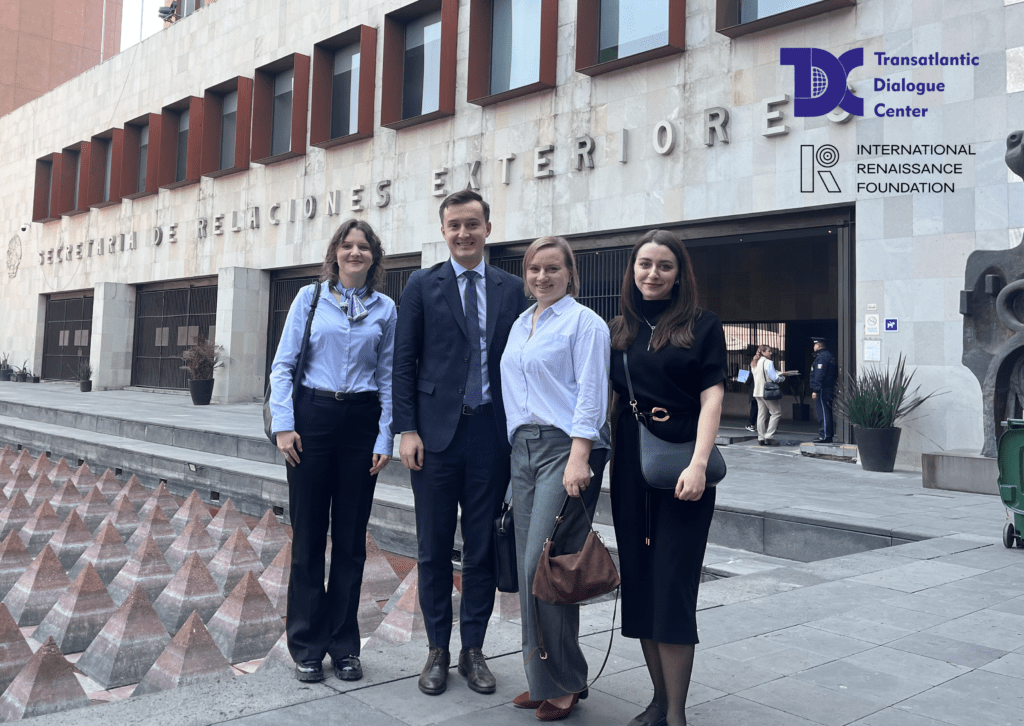
On 3–4 March 2026, as part of the advocacy visit to Mexico, the Transatlantic Dialogue Center (TDC) and the International Renaissance Foundation (IRF) held a series of working briefings in Mexico City with Mexico’s Ministry of Foreign Affairs and the Secretariat of Environment and Natural Resources (SEMARNAT). The meetings focused on humanitarian priorities linked to Russia’s war against Ukraine, as well as the environmental and climate consequences of the war.
At the Ministry of Foreign Affairs, the TDC–IRF delegation — Oleksandr Slyvchuk, Alina Rohach, Bohdana Batsko, and Olha Kvashuk — met with representatives of the General Directorate for United Nations Affairs and the General Directorate for Europe. The discussion addressed Mexico’s reaffirmation of support for Ukraine’s territorial integrity and national identity, the U.S.-mediated Ukraine–Russia peace talks (including prisoner exchanges as a positive step, alongside the need for further progress), and the legal and practical challenges of holding elections during wartime.
A particular focus was placed on the humanitarian dimension of Russia’s aggression, including the deportation and forced displacement of Ukrainian children (with more than 20,000 documented cases) and mechanisms for identification, protection, family reunification, and safe return. The delegation also discussed the International Coalition for the Return of Ukrainian Children and possibilities for Mexico to join it, as well as the human rights situation of Ukrainian civilians in the context of international humanitarian law.
On 4 March, a separate briefing at SEMARNAT brought the environmental agenda into focus. Alina Rohach and Olha Kvashuk discussed the environmental and climate dimension of Russia’s war against Ukraine, including ecocide and war-related damage to protected areas, forests, wetlands, rivers, and coastal ecosystems; landmines and explosive remnants of war; and the climate impact and emissions generated by the war.
We are grateful to the NGO “Ecodiya” for professional consultations ahead of the visit and for sharing research that supported our analytical preparation. We also thank TDC interns Natalia Kozhevnikova and Yuliia Stefanyk for their contribution to the visit’s analytical groundwork.
This project was supported by the International Renaissance Foundation.