

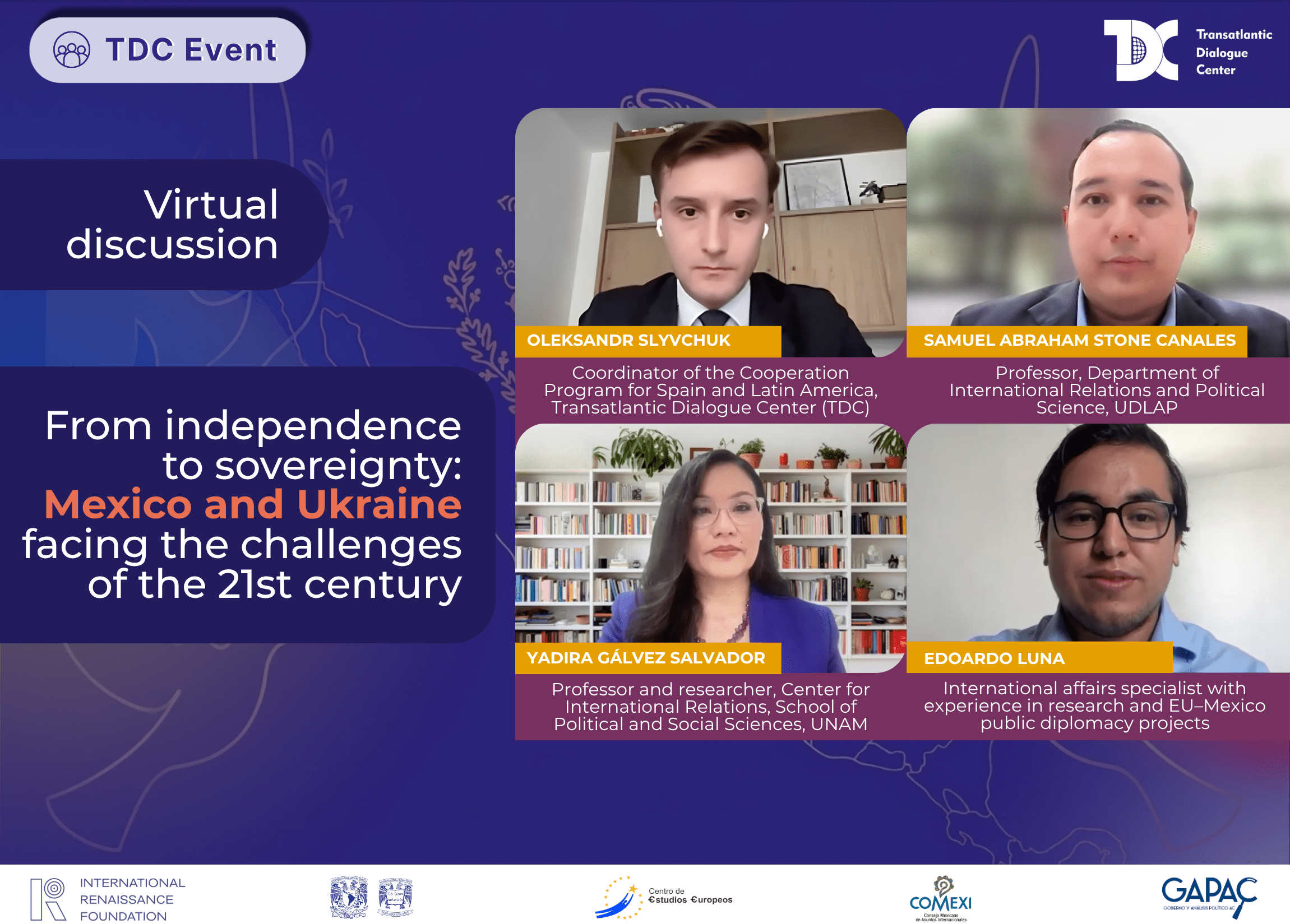
On September 10, the Transatlantic Dialogue Center (TDC) hosted a virtual discussion titled “From Independence to Sovereignty: Mexico and Ukraine Facing the Challenges of the 21st Century.” The event was held online in Spanish to mark Mexico’s Independence Day, in dialogue with Ukraine’s Independence Day on August 24, and brought together Mexican and Ukrainian perspectives on what sovereignty means in today’s international environment.
The discussion featured Oleksandr Slyvchuk, Coordinator of the Spain and Latin America Cooperation Program at TDC; Yadira Gálvez Salvador, Professor and Researcher at the Center for International Relations, Faculty of Political and Social Sciences, National Autonomous University of Mexico (UNAM); and Samuel Abraham Stone Canales, Coordinator of Graduate Programs in International Relations and Political Science at the Universidad de las Américas Puebla (UDLAP). The event was moderated by Edoardo Luna, an international affairs specialist with experience in EU–Mexico public diplomacy.
The conversation placed the different historical and geopolitical experiences of Mexico and Ukraine in dialogue. Participants discussed how states can exercise sovereignty in the 21st century, preserve freedom of decision without isolation, and reduce asymmetric economic, military, technological, and information dependencies that may limit national autonomy.
A key theme of the discussion was that strategic autonomy does not mean isolation or complete self-sufficiency. Rather, it means the ability to make sovereign decisions, diversify partnerships, and prevent external dependencies from becoming instruments of pressure. In this context, participants reflected on Mexico’s close economic integration with the United States, which has brought significant benefits but also created vulnerabilities. They stressed the need to diversify Mexico’s international relations without replacing one asymmetric dependence with another.
Ukraine’s experience offered another perspective on sovereignty under pressure. Participants noted that, despite continued reliance on international partners, Ukraine has significantly strengthened its domestic capabilities, particularly in drone, missile, and ammunition production. External assistance, in this sense, can support the development of national capacity rather than replace it.
The discussion also addressed the principle of non-intervention. Speakers emphasized that non-intervention should not imply indifference when another state’s sovereignty and territorial integrity are violated by force. For Mexico, as a middle power, defending a rules-based international order is also a strategic interest: legal norms help constrain the use of force by major powers.
Participants also highlighted the challenge of Russian propaganda and information influence in Mexico as part of the broader problem of hybrid warfare and the erosion of the rules-based international order. One concrete humanitarian step discussed was Mexico’s potential participation in the International Coalition for the Return of Ukrainian Children, which would support the return of children forcibly transferred by Russia while remaining consistent with Mexico’s tradition of neutrality and commitment to human rights.
The discussion concluded with the idea that sovereignty is not only a historical achievement, but an ongoing responsibility. Both Mexico and Ukraine need long-term policies to strengthen national capabilities, diversify partnerships, and expand their room for maneuver in an increasingly unstable international environment.
A recording of the discussion is available via the link.
TDC thanks Oleksandr Slyvchuk, Yadira Gálvez Salvador, and Samuel Abraham Stone Canales for their contributions, as well as Edoardo Luna for moderating the discussion. We are also grateful to Ambassador Rubén Beltrán for sharing his written reflections and to César Edoardo Santos for his contribution to the preparation of the event. Our appreciation extends to COMEXI, UNAM’s Center for International Relations and Faculty of Political and Social Sciences, UDLAP, GAPAC, and everyone who helped make this Ukrainian–Mexican dialogue possible.
The event took place as part of a project supported by the International Renaissance Foundation.