

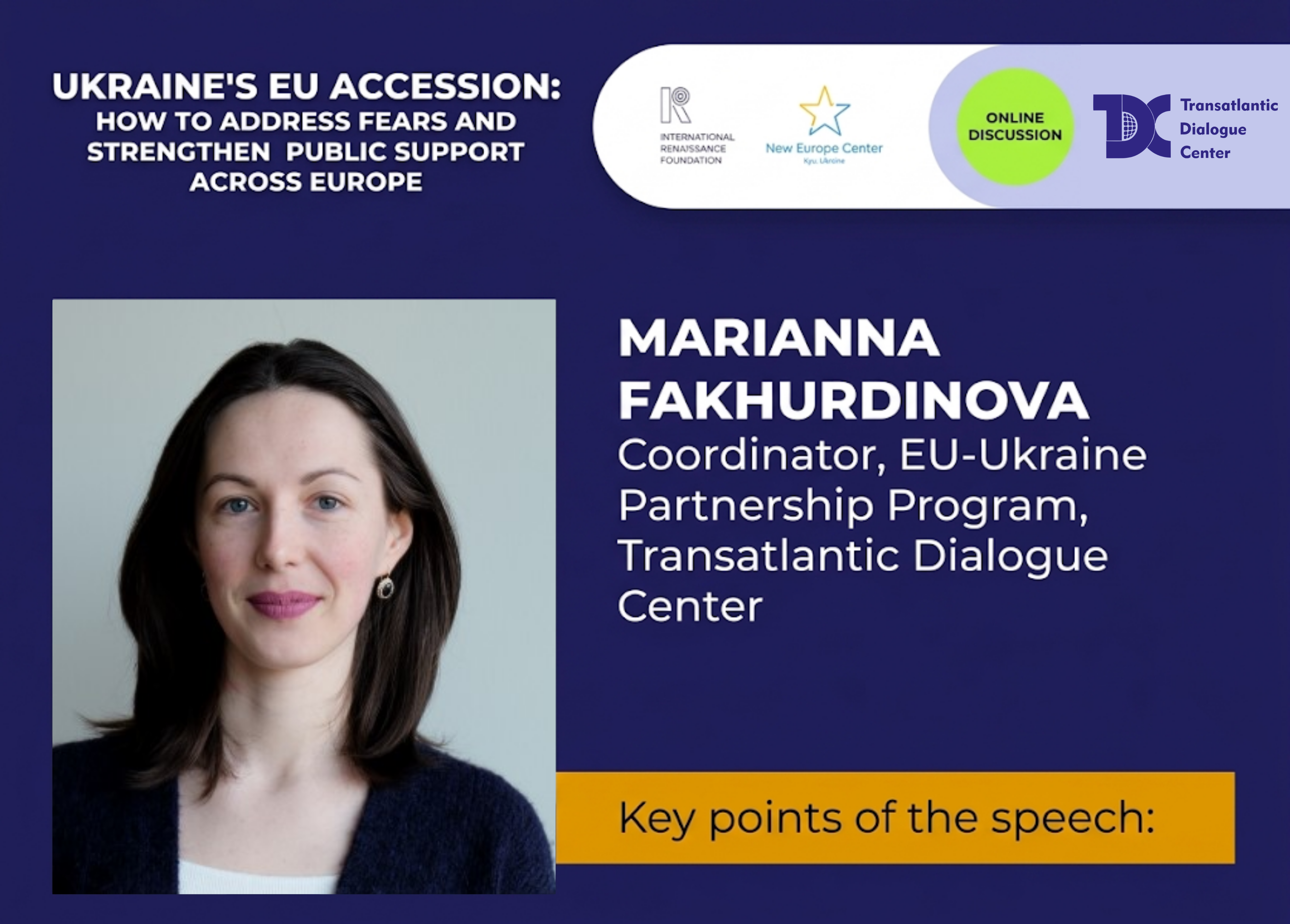
Marianna Fakhurdínova, Coordinator of the EU–Ukraine Partnership Program at the Transatlantic Dialogue Center, spoke during the New Europe Center’s online discussion “Getting Ready for the ‘Ukrainian Plumber’ in the EU? Key Narratives of Resistance to EU Enlargement – and How to Counter Them.” The discussion focused on how Ukraine’s future EU membership is perceived across member states and how narratives of resistance to enlargement can be addressed.
In her remarks, Fakhurdinova argued that Ukraine’s path toward EU membership depends not only on reforms, but also on the ability to understand and respond to the concerns of European societies. She stressed that many fears surrounding enlargement are based on genuine political, economic, or social concerns rather than hostility toward Ukraine, and should therefore be addressed openly rather than dismissed.
Fakhurdinova emphasized that Ukraine needs country-specific communication strategies across the EU. Public attitudes toward enlargement differ significantly depending on each member state’s historical experience, domestic politics, and economic priorities. A single European narrative will not be enough; Ukraine should work with local experts, civil society representatives, and opinion leaders who can become credible advocates for its accession.
Referring to the well-known “Polish plumber” debate during previous waves of EU enlargement, Fakhurdinova noted that Ukraine’s image in Europe is far more multifaceted than any single stereotype. Alongside the image of the Ukrainian farmer, she pointed to the Ukrainian drone producer, the Ukrainian soldier, and Ukrainian AI and IT entrepreneurs as examples of what Ukraine can bring to the European Union.
She also highlighted one of Ukraine’s main communication challenges: the vicious circle between politics, media, and public opinion. Politicians often justify their positions by referring to public attitudes, while those attitudes are shaped by political rhetoric and media coverage. For this reason, Ukraine needs to engage not only policymakers, but also broader societies across Europe.
A central point of Fakhurdinova’s remarks was that Ukraine should communicate not only why fears about accession are misplaced, but also how Ukraine’s membership would strengthen the EU. This includes addressing what she described as “positive fears” — concerns that Ukraine could become a strong and competitive success story within the EU market.
Fakhurdinova also stressed that Ukraine’s resilience has already changed the European Union’s approach to security. Since Russia’s full-scale invasion, the EU has begun financing military assistance to a third country, developed new defense instruments, and taken on a stronger security role. In this sense, Ukraine is already contributing to Europe’s security before becoming a member state.
Finally, she argued that the enlargement debate should honestly address the EU’s own structural challenges, including labor shortages, food security, critical raw materials, and defense capabilities. Rather than presenting Ukraine as a competitor, communication should show how Ukraine can complement the EU and strengthen its resilience, competitiveness, and strategic autonomy.
The event was organized by the New Europe Center with the support of the International Renaissance Foundation. The views and positions expressed during the event are those of the experts and do not necessarily reflect the position of the International Renaissance Foundation.