

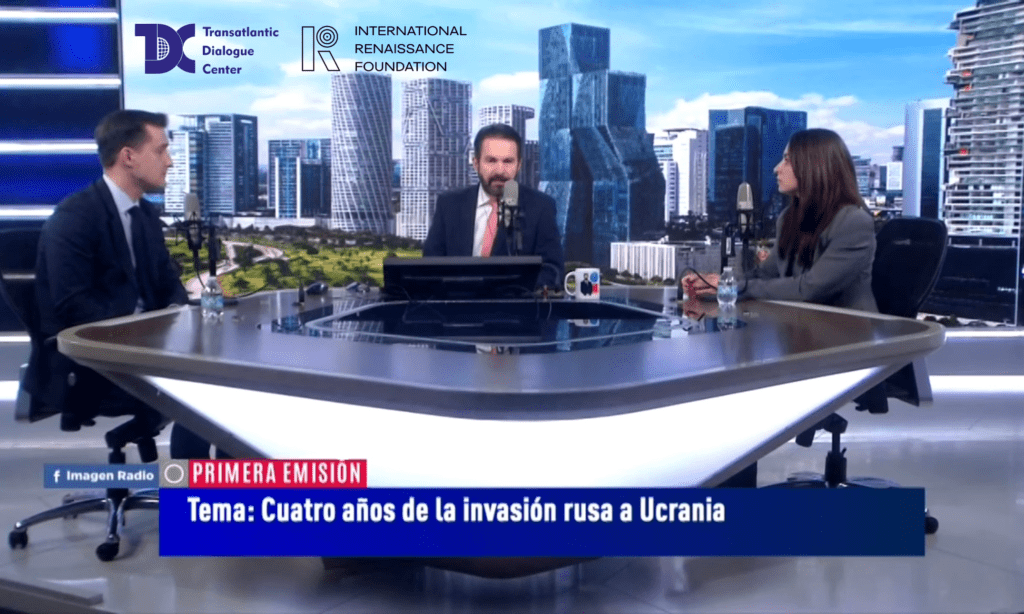
On 4 March 2026, Oleksandr Slyvchuk, Coordinator of the Spain and Latin America Cooperation Program at the Transatlantic Dialogue Center (TDC), and Alina Rohach, Project Manager of the same program, joined Imagen Radio for a live interview hosted by Pascal Beltrán del Río.
Asked about the “real mood” in Ukraine after four years, Rohach described a society living with fatigue and frustration after a particularly harsh winter and constant attacks far beyond the front line — yet still determined to resist, because Ukrainians understand the stakes as freedom and survival as an independent state.
Slyvchuk framed the war as a long-term confrontation rather than a conflict with a “quick fix”. He argued that Ukraine has consolidated its resistance and that expectations of rapid peace are unrealistic, while Russia remains a continuing threat — meaning Ukraine is preparing for a prolonged period of confrontation.
Both speakers discussed a shifting global landscape in which multilateral tools are weakening and aggression risks being normalized. Slyvchuk stressed that the post–World War II order “no longer exists” in the way it once did, linking today’s turbulent phase to Russia’s actions beginning in 2014 and escalating in 2022 as part of a broader global confrontation.
A key part of the discussion focused on Latin America’s role. Rohach emphasized the importance of building understanding and cooperation across the region. Slyvchuk was more critical, noting that support limited to voting at the UN does not translate into practical results, especially when pro-Russian narratives continue to circulate widely in parts of Latin America.
Looking to concrete avenues for action, Rohach highlighted humanitarian cooperation — including initiatives aimed at returning Ukrainian children abducted by Russia and related accountability mechanisms. Slyvchuk addressed disinformation directly, challenging the narrative that NATO “provoked” the war and underscoring that Russia is responsible for the attacks and civilian harm — making accurate information and proactive engagement essential.
Watch the full Imagen Radio interview via the enlace.
Este proyecto contó con el apoyo de la International Renaissance Foundation.