The Role of Social Media in Youth Radicalization: The 2025 German Federal Election Case
30min read
By Oksana Labiak
Dezember 3, 2025
Contents
4 MB
Introduction
The 2025 German federal election exposed a profound transformation in youth political behavior. Disillusioned with traditional parties and frustrated by repeated crises, young voters turned to ideological extremes rather than centrist moderation. Their choices were driven less by consistent ideology than by emotional engagement, authenticity, and the search for meaning in politics. Social media platforms have become decisive arenas where these attitudes are shaped, amplified, and radicalized. This study explores how digital communication, populist strategies, and charismatic online figures have redefined political mobilization among German youth, offering insights relevant to many established democracies facing similar generational shifts.
Young Voters Reject the Center
The global financial crisis of 2008 initially fueled widespread public disenchantment with traditional political parties, which were seen as failing to address socio-economic grievances. This growing dissatisfaction created an opening for extremist narratives from both the far-left and far-right to gain legitimacy. This trend was further exacerbated by more recent crises, such as the COVID-19 pandemic and the war in Ukraine, which significantly impacted Europe’s politics and economy. These events have contributed to heightened domestic polarization and a rejection of post-WWII liberal, globalist norms. As a result, parties like Alternative for Germany (German: Alternative für Deutschland, AfD ) and The Left (German: die Linke) have successfully capitalized on these sentiments.+
“ The political center is losing Germany’s youngest voters „
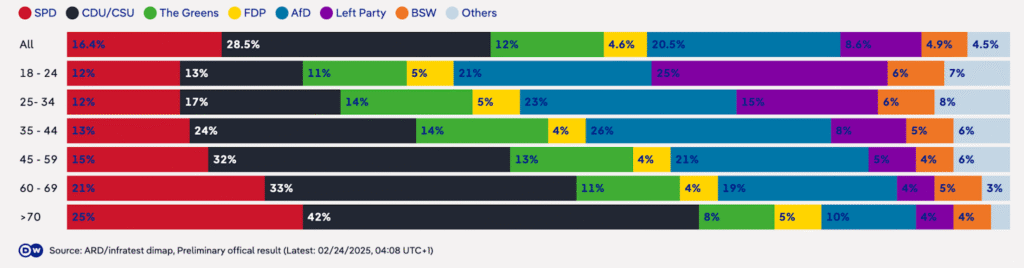
Young people between the ages of 18 and 24 increasingly leaned toward the ideological extremes in the German federal election 2025, casting their ballots more frequently for either the far-right AfD (21%) or the far-left The Left (25%). In contrast, the traditionally dominant parties, the Social Democratic Party of Germany (German: Sozialdemokratische Partei Deutschlands, SPD) and the Christian Democratic Union of Germany (German: Christlich Demokratische Union Deutschlands, CDU), registered their weakest support among this youngest cohort of voters. The Greens, once a staple of youth political engagement, also recorded one of their lowest vote shares in this demographic. Nevertheless, the AfD’s strongest overall support is projected among voters aged 35-44, while older generations, particularly those over 60, remain more inclined to vote for the SPD and the CDU. Compared with the 2021 election, support for the Left among young voters rose by a record 17 percentage points, while support for the AfD increased by 14 points. This generational shift is driven by many factors, including economic transformations, political crises, and the digitalization of political communication. Among these, the digitalization of politics stands out as a powerful yet underexamined force.
Nowadays, social media provides a space where political identities are shaped, shared, and reinforced, often beyond the scope of traditional oversight. Platforms such as Instagram, TikTok, YouTube, and X allow political actors to target young audiences through algorithm-driven, personalized content that fosters ‘filter bubbles’, which limit exposure to diverse perspectives and reinforce existing biases. Populist radical actors skillfully combine emotionally charged messages, humor, and simplified slogans to resonate with young users who may feel frustrated or marginalized. By reducing complex societal issues to binary oppositions, for example, ‘us’ versus ‘them’, they further polarize discourse. In this process, political communication itself becomes simplified, condensed into short videos or meme-like posts designed to capture attention quickly and elicit emotional responses from younger audiences. This phenomenon accelerates the spread of extremist narratives, undermines democratic engagement, and weakens the pluralistic foundations of democratic institutions.
“Algorithm-driven content traps young users in filter bubbles that reinforce existing biases „
Within the broader trend, Germany offers a valuable case for exploring how social media actively shapes political attitudes and contributes to the normalization of extremist rhetoric. The case of the AfD and the Left illustrates how social media can enable new forms of political mobilization that diverge from traditional campaigns. By prioritizing direct language and strong emotional appeal, the parties have succeeded in reaching and mobilizing young voters more effectively than many mainstream competitors.
Overall, the 2025 election results suggest that the political center faces declining resonance with the electorate’s youngest members. Instead, the ideological poles represented by the socialist left and the nationalist right are progressively shaping the mobilization patterns of Germany’s youth. This trend, if sustained, could contribute to the exacerbation of political polarization and complicate coalition-building in future electoral cycles.
The Digital Turn in German Electoral Politics
“More than half of voters admit uncertainty about which online sources they can trust „
The German electoral system has recently undergone substantial legal and political changes aimed at enhancing its functionality and fairness. The amended Federal Election Law, which came into effect in June 2023, sought to reduce the size of the Bundestag from 733 to 630 members and eliminate overhang and compensation mandates through the introduction of the second-vote coverage mechanism (German: Zweitstimmendeckung). The electoral timeline was modified after a vote of no confidence in December 2024 led to the dissolution of the Bundestag and the scheduling of snap elections on 23 February 2025. The accelerated schedule forced political parties to adjust their campaign strategies within a limited period. As a result, many parties adopted digital tools and online platforms as primary means of outreach.
The transformations in how electoral information is consumed and disseminated are driven by two trends: the increasing digitalization of political communication and the declining influence of traditional media. Recent data from a representative survey conducted by Bitkom among 1,002 eligible voters between the second and fourth weeks of 2025 reveals a significant diversification of media usage. While personal conversations (82%) and television broadcasts (76%) remain the most trusted sources of electoral information, digital platforms have become firmly established as the third most important source (69%). This category encompasses websites, mobile applications, digital media content, social networks, and messaging services. Among digital channels, news websites and apps are the most utilized (63%), followed by social media platforms (51%). The hybridization of traditional and digital media consumption indicates a shift away from linear, top-down communication models toward more participatory and multi-directional forms.
63% of respondents agree that electoral success today is contingent on active engagement in social networks. Nevertheless, a notable 68% of respondents believe that mainstream parties have failed to fully grasp the strategic importance of social media. In contrast, 78% consider populist parties, most prominently the Alternative for Germany, to have significantly expanded their influence through skillful use of these platforms. This digital asymmetry has particular implications for younger voters: 66% of survey participants express concern over the AfD’s influence on youth through social networks. Although 80% report that their own voting decisions have not been influenced or only marginally influenced by parties’ social media presence, the cumulative effect of digital campaigning, especially among more susceptible segments of the electorate, cannot be dismissed.
“Voters are ever more reliant on external tools and technologies to evaluate competing political agendas while the democratic process is challenged by disinformation and the erosion of trust in online sources „
The 2025 Bundestag elections mark a departure from traditional electoral dynamics in Germany in several respects. Firstly, voters are ever more reliant on external tools and technologies to evaluate competing political agendas. For instance, 28% of respondents report difficulties in understanding party platforms, and 32% have already made use of digital decision-making aids such as Wahl-o-Mat. What is more, 43% of voters can envision using AI-based systems to guide their electoral decisions, which is a sign of the growing trust in algorithmic mediation.
Secondly, the democratic process is challenged by disinformation and the erosion of trust in online sources. A substantial majority (75%) believes that German democracy is insufficiently prepared to counter disinformation effectively. Moreover, 56% of respondents admit they are often uncertain about which online sources are trustworthy. All in all, as the line between traditional and digital campaigning continues to blur, both opportunities for engagement and risks to democratic integrity become more evident. The augmented reliance on digital tools alters how voters access and assess political information, and also introduces new vectors for influence, manipulation, and polarization.
Drivers of Youth Radicalization
“Young voters want clarity, honesty, and visible action — not political ambiguity „
Youth support for the far-left and far-right parties is not necessarily rooted in longstanding belief systems but in a desire for systemic disruption. The AfD, for example, appeals to young men seeking clarity and control in an uncertain world, while the Left attracts young women invested in social justice and anti-discrimination causes. Specifically, among 18-24-year-olds, over a third of women voted for The Left, whereas approximately one-quarter of male voters favoured the AfD. The perceived lack of action and responsiveness from centrist parties has pushed youth voters toward groups that promise immediate and uncompromising change. At the same time, many of these voters remain open to switching parties in the future. What they are looking for is a sense of security, honesty, and effectiveness in politics. They value direct communication, visible action, and a certain level of determination, even if it sometimes appears radical.
Young voters tend to exhibit a deep skepticism toward political elites and institutions. This generation has come of age amid multiple crises, such as financial instability, a global pandemic, climate emergencies, all of which have contributed to the belief that the current political system is incapable of delivering meaningful results. Consequently, many young people turn to radical parties not out of ideological alignment, but due to the rejection of the status quo.
Empirical data from 2024 underscores the extent to which specific socio-political and economic concerns drive this realignment. According to the Shell Energy study, 81% of Germans aged 12-25 identified the war in Ukraine as their primary worry, followed by poverty (67%) and environmental pollution (64%). While both The Left and the AfD channel youthful frustration into political mobilization, the ideological content and sociocultural framing of their appeals differ distinctly.
“Radical parties offer young people what the center does not: determination „
The Left articulates its radicalism in terms of inclusivity, social equity, and redistribution, positioning itself as the defender of marginalized groups and the guarantor of socio-economic rights. Its rhetoric emphasizes solidarity across ethnic and cultural boundaries, with migration viewed as a humanitarian imperative rather than a societal threat. In contrast, the AfD’s radicalism rests on exclusionary nationalism, advocates restrictive immigration policies, and promotes cultural homogeneity as a means to restore social stability. Where the Left seeks to expand the scope of the welfare state to encompass all residents, the AfD seeks to restrict it, prioritizes citizens over non-citizens, and treats social policy as a tool for the preservation of national identity.
Credit: TTRex – Thinktank Rechtsextremismus und Das Progressive Zentrum
The focus group material, conducted by the polling agency Pollytix, in collaboration with Das Progressive Zentrum (DPZ) and the Thinktank Rechtsextremismus (TTRex), reveals that young voters who support the AfD view other political parties with a mix of criticism, disappointment, and occasional respect. The CDU (Union) and SPD are seen as old, traditional parties that no longer bring new ideas. Many AfD voters feel these parties have made too many promises without real action, especially on issues like childcare or economic policy. Some AfD voters say they used to support the CDU because of shared positions, but lost faith due to the CDU’s weak performance in both government and opposition. They criticize the party for not following through on important reforms and believe it lacks strength and consistency. Despite this, many still see the CDU as the party closest to them ideologically, and some even support the idea of cooperation between the CDU and AfD.
Parties like the FDP, The Greens (German: Die Grünen), and The Left are viewed more critically. The Greens are described as strange or unrealistic; however, some AfD voters respect the Greens for being clear and consistent in their views, especially on energy policy and women’s rights. The new party, The Sahra Wagenknecht Alliance – Reason and Justice (German: Bündnis Sahra Wagenknecht – Vernunft und Gerechtigkeit) remains comparatively less familiar to many young AfD voters. However, being represented in the Bundesrat and the European Parliament, and known for its left-wing populist and eurosceptic positions, its ideas are sometimes praised, as it is also seen as a new player with potential. It is worth noting that young AfD supporters are not completely closed to voting for other parties again in the future, if those parties prove they can act honestly, consistently, and with more focus on the needs of younger generations.
Role of Social Media in Shaping Youth Political Preferences
This section presents a content analysis of the online presence of five major German political parties – the Christian Democratic Union (CDU), the Christian Social Union (CSU), the Alternative for Germany (AfD), the Social Democratic Party (SPD), and The Left (Die Linke) – on TikTok and Instagram during the electoral campaign period. The research period covers the timeframe from 17 December 2024 to 22 February 2025. The selection of these dates corresponds to the logic of the electoral cycle in Germany. The starting date coincides with the day on which Germany’s major political parties officially presented their electoral programmes, thereby formally marking the beginning of the active campaign phase. This followed a vote of no confidence in Chancellor Olaf Scholz, passed by the Bundestag on 16 December, which led to the dissolution of the government and the decision to hold snap federal elections, scheduled for 23 February 2025. The end date of the study is defined as the final full day before the election date. This point constitutes a logical boundary of pre-election communication, as it marks the conclusion of public campaigning. The selection of these dates makes it possible to capture the entire scope of the partiesʼ digital activity on social media during the official campaign window.
The analysis is structured around the following key criteria: Number of followers on TikTok and Instagram; Total number of posts published during the official campaign window; Nature of the video and visual content, classified as: Positive (e.g., self-promotion, highlighting achievements, or presenting proposals), Negative (e.g., attacks on opponents), Humorous or meme-based content, which may contribute to virality and informal engagement; Core messages conveyed in the campaign and consistency of messaging with the official party platform, evaluating the degree to which the three main campaign messages align with the respective party manifestos or whether they involve simplification, populist reframing, or thematic deviations; the role of political personalities on social media.
Methodology
The analysis was conducted manually in order to ensure a high degree of accuracy and contextual understanding. Every post published by the selected parties on TikTok and Instagram within the defined campaign period was individually reviewed and coded according to the established criteria. This process included recording quantitative metrics such as follower counts, total number of posts, and frequency of content types, as well as qualitative assessments of tone, message framing, and alignment with the official party platform. All coding decisions were made by the researcher to maintain consistency across the dataset, and the resulting dataset served as the basis for both descriptive statistical summaries and interpretative analysis.
Number of Followers (as of June 11, 2025)
On TikTok, a platform known for its younger, more politically disengaged but emotionally reactive user base, the AfD stands out with a substantially higher follower count (607.8K) than any other party. This far-right party significantly outpaces even mainstream actors, such as the SPD (87.2K) and the CDU (83.4K). The Left also shows considerable reach with 411.4K followers, suggesting a relatively strong online presence among left-leaning youth audiences. In contrast, the CSU maintains a smaller TikTok following of 161.1K, likely reflecting its more regional and conservative profile. Interestingly, the regional CSU boasts a larger TikTok following (161.1K) than the nationwide CDU (83.4K). This disparity may be explained, at least in part, by differences in the duration of their activity on the platform: while the CDU published its first TikTok post only on 26 February 2024, the CSU began posting as early as 8 March 2021, thereby benefiting from a substantially longer period to build its audience. On Instagram, the Left again demonstrates significant digital outreach with 512K followers, followed by the AfD with 320K and the CDU with 198K. The SPD and CSU trail behind at 155K and 84.3K, respectively. These figures suggest that while the AfD dominates TikTok, the Left commands a larger base on Instagram.
Total Number of Posts During the Campaign Window
Interestingly, the AfD, despite its large follower base, published only 23 TikTok posts during the campaign period. This suggests a reliance on viral reach and algorithmic amplification rather than high-volume content production. Conversely, the CDU and SPD were the most active on TikTok, with 158 and 157 posts respectively, which indicates a more traditional approach to visibility through consistent posting. On Instagram, the CDU again leads in terms of volume with 346 campaign-period posts, followed closely by the SPD (299) and the CSU (276). The AfD (122) and The Left (175) appear to have adopted a more moderate posting strategy.
CDU
CSU
AfD
SPD
The Left
Number of followers (TikTok)
83,4k
161,1k
607,8k
87,2k
411,4k
Number of followers (Instagram)
198k
84,3k
320k
155k
512k
Total number of posts during the campaign window (TikTok)
158
62
23
157
126
Total number of posts during the campaign window (Instagram)
346
276
122
299
175
Nature of the Video and Visual Content
CDU – Positive tone, economic focus
Despite sharing a common policy platform and forming a joint parliamentary group in the Bundestag, the CDU and the CSU maintained distinct social media strategies. Although the parties did not compete electorally within the same federal states (the CDU runs outside Bavaria, the CSU exclusively in Bavaria), their online communication remained largely separate. During the analyzed period, only 11 posts were shared jointly by CDU and CSU, and just 6 posts involved both CSU and CDU leader Friedrich Merz. This limited overlap highlights the institutional and communicative autonomy of the two parties and reveals their need to uphold separate identities under Germany’s election system, which requires each party to meet the 5% threshold independently.
A key feature of the Christian Democratic Union’s 2025 federal election campaign is its clear focus on economic policy as the party’s primary means of gaining support and shaping its message. However, the CDU’s campaign did not frame economic policy as one issue among many, but rather as the central domain through which all other challenges, such as social stability, demographic change, technological innovation, and national sovereignty, must be addressed. Predominantly, the party relied on positive content, emphasizing policy proposals, economic renewal, and leadership competence. A significant portion of the party’s video and infographic output focused on tangible reforms such as tax reductions, pension system innovation, deregulation, and investment in digital infrastructure. These materials were typically presented using clear visuals, optimistic slogans, for instance, #wiedernachvorne (#forwardagain), and inclusive imagery targeting the middle class, small businesses, and young families. Merz was depicted not only as an alternative to Scholz, but as a force capable of reversing a decade-long drift in Germany’s economic leadership.
Yet, the CDU also published a lot of negative material, primarily in opposition to the traffic-light coalition (SPD, Greens, FDP), and directly attributed the long-term decline to policies implemented under Chancellor Olaf Scholz and Minister for Economic Affairs and Climate Action Robert Habeck. These messages frequently leveled accusations of fiscal mismanagement, indecision, and moral weakness. The AfD was likewise positioned as a dangerous, undemocratic force, and the CDU expressly ruled out any cooperation with the far-right party.
Though less dominant, humorous elements were employed for viral engagement and relatability, and played a complementary role. The Valentine’s Day post, for instance, juxtaposed the emotional symbolism of love with civic responsibility and economic recovery: “Today: give your heart to love. On February 23: to your country”. This dual address blended personal sentiment with nationalist appeal, promoting voter turnout in a way that is emotionally resonant yet ideologically aligned.
ENG: Today: give your heart to love. On February 23: to your country
A clear instance of hybrid content in the CDU’s 2025 digital campaign, which mixed irony with pointed political criticism, is exemplified by social media posts that satirically depicted ordinary citizens, coincidentally named Habeck, Lindner, and Scholz, casting their votes for Friedrich Merz and the CDU. While the individuals are unrelated to the actual government officials, the shared surnames evoked immediate associations with the leaders of the Green Party, FDP, and SPD, respectively. This play on the former government’s leaders underscored the CDU’s strategic use of irony and humor to suggest widespread dissatisfaction. The caption, “even the traffic light coalition chooses political change”, reinforced the idea that the need for a political and economic shift was self-evident.
CSU – Confrontation over consensus
The visual and narrative strategies used by the Christian Social Union (CSU) during the campaign period reveal a predominantly negative and confrontational tone, interwoven with selected positive messaging around Bavarian identity, security, and economic competence. Humorous or informal content was relatively scarce, but when present, it was subtle and served a functional symbolic purpose rather than entertainment.
The CSU’s campaign on social media was heavily saturated with negative messaging, particularly directed at the “traffic light” coalition. Repeated attacks were made on the federal government’s cannabis legalization law, energy transition policies, migration agenda, and gender language policies. What is more, while sharing certain restrictive positions on immigration or national identity, the CSU firmly differentiated itself by portraying the AfD as dangerous, anti-European, and destructive to German interests.
The CSU did make targeted use of positive content, particularly when emphasizing the regional pride and cultural distinctiveness of Bavaria. The party promoted Bavaria as a successful model within Germany in terms of electric vehicle registration, venture capital investment, and job creation in the auto sector. These served to convey competence, tradition, and innovation within a single regional narrative. The CSU’s digital presence, while not heavily reliant on humor, strategically incorporated subtle, culturally resonant content. A prime example is a video where a waitress serves “Halbe Hendl” (half chicken) and “Halbe Bier” (half-liter beer), captioned: “No half measures – vote for CSU with both votes!”.
AfD – Satire as persuasion
Negative content, characterized by its strongly adversarial nature, forms the predominant category. Over one-fifth of the AfD’s Instagram posts contain sharp criticisms of specific politicians or parties, with extensive textual justifications for their failings. This includes aggressive attacks directed at political opponents, particularly the “traffic light” coalition, but also extending to the CDU/CSU. A significant aspect of this negative framing involves the use of scapegoating and fear appeals, primarily concerning migration. Key political figures like Olaf Scholz, Nancy Faeser, and Angela Merkel were routinely vilified, held responsible for various national “failures” ranging from nuclear phase-out and mass immigration to COVID-19 restrictions. Even the CDU was often depicted as a “false alternative” complicit in the mismanagement of the country. Accusations of double standards, censorship, and bureaucratic overreach aimed to construct an image of a repressive liberal elite antagonistic to the “real people”.
Positive content featured the AfD’s proposed policy alternatives, such as a return to nuclear energy, an end to CO2 taxes, bureaucracy reduction, tax cuts for small and medium-sized enterprises (SMEs), and the promotion of “remigration” without financial incentives. The party’s communication strategy sought to present itself as the “Volkspartei” (people’s party), thereby claiming to be the exclusive voice that challenges established elites and lobbying interests. Furthermore, the AfD actively endorsed figures like Donald Trump, and presented his “mega-decisions”, for example, Paris Agreement withdrawal and two-gender policy, as a model for its own decisive action in Germany; this linked its agenda to a successful, populist, nationalist approach and asserted the AfD would prioritize national interests to “make Germany great”.
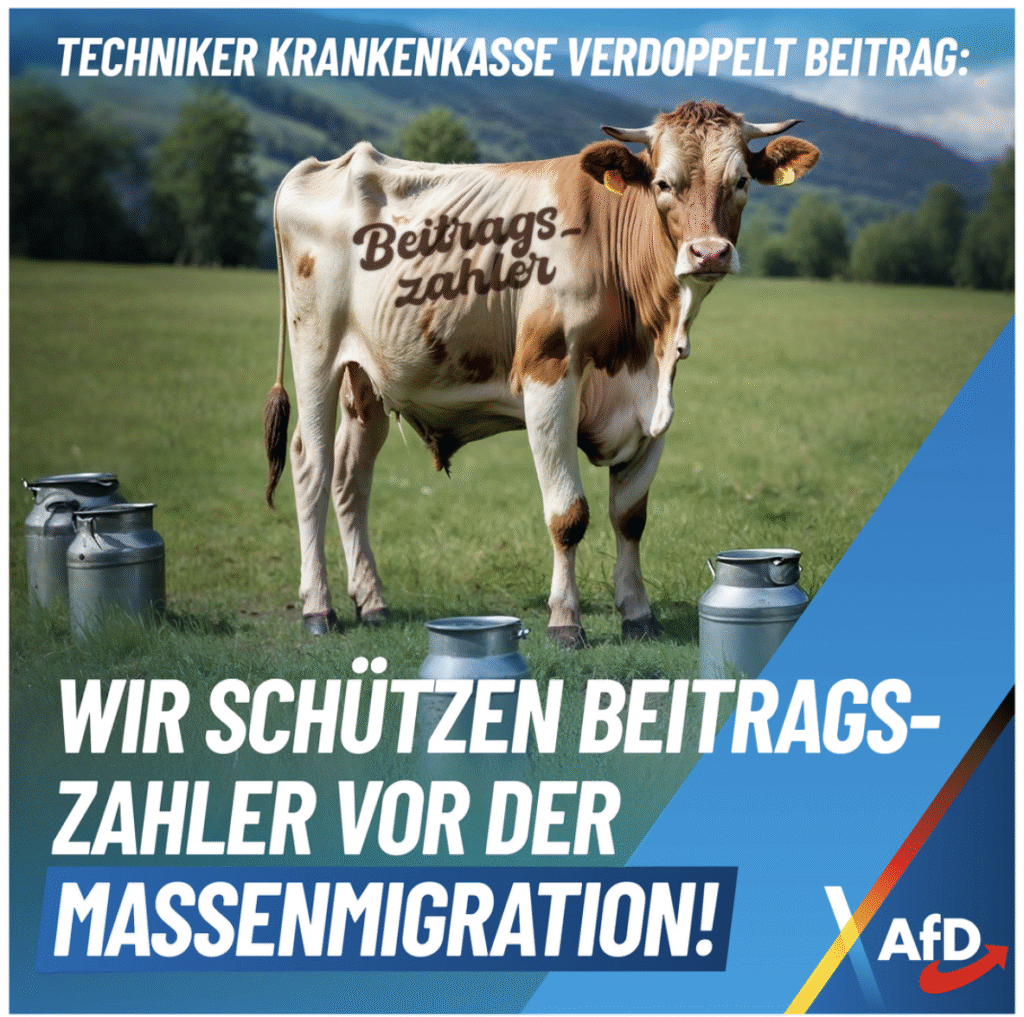
The AfD’s communication strategy distinctly combined satire and populism, which achieved significant digital impact through its reliance on humorous and meme-based content. A key element of this strategy rests on visual metaphors, such as the “taxpayer cow”. This imagery portrays ordinary citizens under exploitation by the state, for example, through increased health insurance contributions. The depiction shows deliberate exaggeration: an exhausted cow surrounded by buckets that symbolize extracted funds, thereby strengthening a narrative of systemic injustice and governmental overreach.
Humor and irony also permeated AfD’s attacks on political figures. Angela Merkel received a portrayal as a symbol of elite detachment and failed leadership; her taxpayer-funded post-retirement office, for instance, earned the label “luxury command center” amid reports of growing poverty. What is more, references to “North Korean-style applause” mocked her continued influence within the CDU. Chancellor Olaf Scholz was similarly targeted through ridicule. His Davos speech warning against right-wing extremism was reframed as an attack on Elon Musk, whom AfD positions as a populist ally. Scholz was labeled a “Pöbler im Kanzleramt” (a heckler in the chancellery); this portrayal was paired with hyperbolic claims that Germany was increasingly isolated in a world governed by right-wing parties, mocking the political mainstream’s labeling of conservative governments abroad as “far-right”.
SPD – Policy first, personality second
The SPD’s social media campaign is distinguished by two key characteristics: programmatic promise and direct political opposition. The positive content is extensive and policy-focused; a significant portion of campaign videos focus on presenting SPD’s concrete policy proposals, such as the planned increase in the minimum wage to €15 by 2026, investment incentives through the “Made in Germany Bonus”, as well as measures to reduce taxes for 95% of citizens. Moreover, these proposals are illustrated with tangible, everyday examples, for instance, additional income for a family of four or free school meals, thus reinforcing voter relatability. Olaf Scholz is at the center of these visual communications. His presence is consistent; he appears in numerous speech excerpts, interview snippets, and campaign videos where he explains party policies and articulates his vision for Germany.
Simultaneously, the campaign exhibits a strong antagonistic dimension, given that at its core there is a systematic use of contrast and opposition, manifested through the dichotomy between Olaf Scholz and Friedrich Merz, and more broadly between the SPD and the CDU/CSU. Merz is portrayed as lacking vision and as someone whose economic proposals disproportionately benefit the wealthy. These oppositional messages serve to mobilize support through a strategy that resonates in polarized political environments. This contrast is sharpened through slogans like “While one [Merz] writes books, the other [Scholz] works”. Another example includes mockery of the CDU’s symbolic campaign to reduce kebab prices, which the SPD counters by emphasizing its focus on securing fair wages rather than making superficial promises. Furthermore, the campaign adopts a critical tone when confronting the AfD and its challenges to German democratic norms. The SPD draws a sharp moral boundary, repeatedly stating that “there will be no cooperation with the far-right”.
In addition to the positive and oppositional content, the SPD also deploys humorous and meme-based elements. These often adopt viral formats, such as the “Nobody: … SPD: …” meme structure, used to ironically contrast policy slogans with the party’s actual priorities, for example, “We say we want economic growth. But really, we want better public transport”; youth-oriented slang and casual language used by senior party figures, such as Lothar Binding’s use of terms like “slay” and “vibes” to describe the party conference atmosphere. This layer of informality does not dilute the campaign’s seriousness; rather, it humanizes the SPD’s brand and enhances its shareability within digital spaces.
The Left – Pop culture meets class politics
A significant portion of The Left’s visual content was explicitly positive in nature, characterized by emphasis on social justice and clearly articulated policy proposals. Numerous reels and carousel posts were dedicated to explaining the party’s core policy positions on housing, energy justice, public healthcare investment, and abolishing VAT for basic goods. These materials employed simple visual layouts, infographics, or dynamic explainer formats narrated by party figures such as Heidi Reichinnek or Jan van Aken.
Moreover, videos and posts that highlighted internal growth, successful demonstrations, and digital tools, like the rent calculator or heating cost checker, underscored The Left’s strategic innovation and responsiveness. Hence, the party strived to show itself as effective and oriented toward action, rather than just an opposition voice. Informative clips that clarified voting mechanisms, for example, the difference between first and second votes, especially with younger influencers explaining them in relatable language, contributed to democratic literacy while promoting the party’s agenda.
On the other hand, there was a robust layer of negative content aimed at delegitimizing political adversaries, particularly the AfD and the CDU/CSU. Friedrich Merz was condemned for “breaking his promise” by cooperating with the AfD and the call to ban the AfD was accompanied by comparisons to the Nazi party. Furthermore, references to billionaire influence and corporate lobbying often included concrete statistics, for instance, 40 million euros in lobbying expenditures by the finance industry, which lent factual weight to ideological criticism. Visuals targeted figures like Elon Musk, Oliver Bäte (Allianz), and DAX CEOs by depicting them as “climate wreckers” and “democracy destroyers” who leveraged their wealth for influence. Slogans such as “Tax the DAX” and “The AfD has Musk – we have you” amplified the critique; this functioned to present The Left as an ethical watchdog.
What distinguished The Left’s communication strategy in this current electoral cycle was its extensive use of humorous and meme-based content, designed to appeal to young voters. For instance, a Valentine’s Day campaign with lines like “Are you a wealth tax? Because you make my heart race” humorized class politics through romantic tropes. Similarly, Christmas-themed content contained a rewritten version of “Santa Baby” with political demands instead of gifts: “No Cum-Ex chancellor, no Blackrock Merz”. To embed ideological messages in pop-cultural references, The Left employed ideologically coded humor. For instance, a stylized image compared party leadership to a 1990s boy band, which both mocked and celebrated political branding. Further, this humor associated Santa Claus with socialism (“Santa Claus is a Red”) or showed Elon Musk as a fascist-leaning billionaire to critique neoliberal tech elites. Additionally, The Left used edgy stylizations for serious topics such as economic injustice, fascism, or class warfare. It capitalized on the visual grammar of meme culture, including surreal cuts, dramatic zooms, and ironic captions. This approach allowed The Left to stay culturally relevant and to highlight the absurdity of elite privilege or right-wing rhetoric.
Core Messages and Consistency of Messaging with the Official Party Platform
CDU/CSU
1.Economic revitalization
The CDU/CSU’s social media messages about economic revitalization largely aligned with their official election program. Social media highlights included proposals for tax-free overtime, a 25% corporate tax cut, an “active pension” (up to €2,000/month tax-free), and calls for reduced bureaucracy and energy costs. They also emphasized support for farmers, families, and small and medium-sized enterprises (SMEs), criticized the government’s economic policies, and promoted child investment accounts. The official program detailed these same principles and laid out the groundwork for comprehensive tax reform, deregulation, pension changes, and growth support within a social market economy. Themes of bureaucracy reduction and innovation were also shared. However, a notable difference was in rhetoric because posts utilized more emotional and polarizing language that was absent from the official, more restrained critique. The CDU’s “We make your kebab and schnitzel affordable! How? By reducing the sales tax on food in restaurants from 19% to 7%. Thus, #policychange will also affect your wallet” is an exemplary social media message. It connects to daily life, promises direct financial benefit, simplifies policy, and aligns with the party’s stated goal of reducing the gastronomy tax. This example highlights the CDU’s skill in translating complex economic policy into an appealing, and relevant message for the general public.
Restrictive migration policy
The CDU/CSU’s restrictive migration approach on social media aligned in substance with the official program but diverged in style and depth. The goals are identical across formats: stopping illegal migration, implementing border controls and rejections at entry, increasing deportations with enhanced legal bases for removal, and maintaining a clear separation between asylum seekers and labor migrants with differentiated procedures. The official platform remained institutional and focused on legal procedures, EU reforms, and administrative tools. In contrast, social media used emotionally charged calls to action and hyperbolic everyday expressions, such as “No money for criminals!”, “Anyone who demands a caliphate has no home here!”. For broader appeal, digital content framed naturalization as a national threat and cited isolated violent incidents to suggest systemic asylum policy failure.
Rebuilding national security and defense capabilities
The central themes, such as zero tolerance for crime, strengthening law enforcement, and enhancing internal security, were consistent across both formats. Posts referencing recent attacks emphasized urgency and the need for stronger state authority, which corresponds to the program’s call for expanded surveillance, tougher criminal laws, and better-equipped security services. However, the social media content simplified some details: it focused more on domestic crime and public fear, while the official program outlined legal reforms, digital surveillance tools, and NATO defense commitments. Abstract slogans like “Germany must be safe again” replaced precise proposals, and emotional appeals overshadowed specific reforms, especially in geopolitical and institutional areas.
AfD
Restriction of immigration
The AfD’s official program promoted sovereignist, restrictionist, and remigration-oriented policies. Key principles include restoring border control, exiting the EU asylum system, cutting welfare benefits for migrants, initiating mass deportations and reforming asylum rights. Social media posts restated these priorities, spotlighted individual migrant criminal acts as systemic threats, demanded complete border closures and denial of entry to undocumented arrivals, and presented sharp criticism of other parties for their immigration stances. Despite thematic alignment, the AfD’s social media messaging differed significantly in tone, employing isolated violent incidents involving migrants, for instance, attacks in Magdeburg or Aschaffenburg, to generalize “mass migration” as inherently dangerous.
Energy sovereignty
Both platforms advocated for a return to nuclear power and continued reliance on fossil fuels, while strongly opposing renewable energy subsidies and CO2 taxation. Social media utilized populist framing and blamed the traffic-light coalition and the CDU for high energy prices and an “ideological energy transition”, a rhetorical extension of the manifesto’s more technocratic critique of market distortions and climate-based regulation. While the core ideological thrust, a rejection of climate-based policy in favour of fossil and nuclear re-industrialization, was consistent across platforms, social media employed rhetorical simplifications. It used emotionally charged language, for example, “green madness”, “climate fraud”, offered vague calls for “cheap energy” rather than detailed policy proposals like Nord Stream restoration, and simplified blame assignment to specific political opponents.
Economic protectionism and anti-bureaucracy
Online advocacy for abolishing the “solidarity surcharge” and broad tax cuts corresponded with the program’s pledges. Both communication channels also emphasized deregulation, with social media criticizing “senseless EU rules” and “bureaucratic monsters”, while the official program detailed specific measures like abolishing the Supply Chain Due Diligence Act, simplifying data protection, and streamlining approval procedures for SMEs and agriculture. However, while substantively consistent, the AfD’s social media strategy simplified policy and used populist framing. This includes a “workers vs. foreigners” binary, where social media posts linked foreigners to the burden on welfare, a more ethno-nationalist and reductive framing than the program’s broader institutional critique of social transfers. At the same time, the nuanced tax reform proposals in the official program were reduced to oversimplified slogans like “More net income from gross wages!” on social media.
SPD
Promoting economic justice
While social media adopted a more populist tone, the core claims on taxation, wages, and investments were drawn from the platform’s evidence-based projections. The party’s commitment to raising the minimum wage to €15, a flagship campaign promise, was consistently presented in both digital communications and the program as a direct means to boost real household income. Fiscal policy emphasized tax relief for low- and middle-income earners while increasing contributions from the wealthiest, thus mirroring social media claims of tax reductions for 95% of the population. The “Made in Germany” investment bonus and the €100 billion Germany Fund, prominent in the platform, supported social media points of job security and economic growth through strategic investment. Finally, proposals to cap electricity charges and reduce VAT on food in the official program strengthened the broader message of making living more affordable. However, social media simplifications reinterpreted complex economic goals through emotionally resonant statements, such as: “We say we want economic growth. But what we really want is to save your job”, or “We say we want more net income from gross income. But actually, we want affordable coffee and groceries for your grandmother”. Therefore, these formulations bridged policy sophistication and popular sentiment.
Ensuring social security
The digital emphasis on pension stability, family support, affordable housing, and elderly care found comprehensive policy backing within the program. For instance, the social media promise of a legally guaranteed 48% pension level within the first 100 days directly mirrored the manifesto’s central tenet of stabilizing statutory pensions, linking it to the value of lifelong work and social fairness. Similarly, social media highlights on increased child benefits, tax relief for parents, and free school lunches were thoroughly grounded in the program’s strategy to combat child poverty and support working families, including specific proposals for expanded parental leave and institutionalized free meals. Lastly, the social media theme of capping out-of-pocket care costs and improving care work conditions was embedded in the party’s formal program, which proposed a “solidarity-based” long-term care model emphasizing labor rights and shared social responsibility.
Defending democracy
The SPD’s social media messaging on democratic protection aligned with its 2025 electoral program. The party’s unequivocal rejection of cooperation with far-right extremists in its online communications was strongly articulated throughout the official platform, which outlined a comprehensive approach to countering extremism, including intensified oversight, funding deprivation, and prevention of infiltration into public institutions. While social media broadly asserted the importance of law enforcement and institutional strength for democratic order, the program detailed significant expansions in police capacity, legal reforms, and cybersecurity infrastructure as vital safeguards. The platform also emphasized proactive democratic renewal through participatory mechanisms like citizens’ assemblies, which, while not prominently featured in social media, complemented the party’s broader commitment to democratic engagement. Finally, the SPD’s consistent emphasis on anti-discrimination, civic inclusion, and a modern citizenship law, present in both communication channels, bolstered its vision of an open, participatory, and pluralistic polity.
The Left
1. Radical redistribution of wealth through progressive taxation
This Left’s message wasn’t just a catchy phrase; it was an accurate reflection of the party’s official program and core beliefs. On social media, the party used emotionally charged language to highlight growing wealth inequality and advocate for redistributive justice. Posts like “There should be no billionaires” and “Tax the rich, relieve the 85%” and memes invoking Elon Musk as a symbol of wealth-driven impunity sought to mobilize voters and clearly distinguish The Left from other political parties. Their detailed program outlined these very proposals: reintroducing a progressive wealth tax, implementing a one-time wealth levy, reforming income and corporate taxes, capping managerial salaries, and improving transparency to combat tax evasion.
Rent control and housing justice
The party’s online presence consistently characterized housing as a social right, not a commodity, consistent with its program’s “Housing must not be a luxury” stance. Slogans like “Rent is too high? We will help you!” supported the platform’s call for politically achievable rent control and affordable housing by curbing corporate influence. Social media posts keenly promoted specific policy proposals from the platform: heating cost audits, nationwide rent cap, rent calculator tool, protection against evictions, and corporate abuse. The messaging targeted working-class renters and marginalized groups by humanizing systemic issues through individual stories, which reinforced the party’s role as a “social voice in the Bundestag”. Furthermore, social media also previewed the party’s proactive legislative ambitions for a post-election period, like organizing a national Rent Summit.
Investment in public health and care work
Both the social media and the program advocated for care guided by need, not profit. Posts called for “at least 100,000 additional nurses” and addressed burnout, thus mirroring the program’s detailed proposals for increased staffing, better pay, improved schedules, and collective agreements for all healthcare staff. What is more, the campaign emphasized how unequal access exacerbates social inequality, and it was consistent with the program’s focus on eliminating class-based barriers through a unified public health insurance scheme. While some detailed policy points, such as rural health infrastructure or drug policy, appeared less frequently in social media posts or were absent entirely, this reflected a prioritization for campaign visibility rather than a contradiction.
The Role of Political Personalities on Social Media
Beyond party accounts, individual political figures play a significant role in shaping political preferences on social media platforms. In youth-dominated digital spaces, political leaders often become symbolic representations of their parties’ values, style, and credibility. Their visibility, messaging style, and personal narratives can either humanize or radicalize a party’s image, particularly among undecided or apolitical younger audiences who engage more with personalities than with institutions. This interaction highlights the influence of charismatic political figures, creating what political scientist Uwe Jun refers to as a “pull effect” (Sogwirkung) – a crucial aspect of youth political behavior. Although the 18-24 age group constitutes less than ten percent of the electorate, their disproportionate support for radical parties played a decisive role in their electoral gains. Jun attributes part of this behavior to the strong influence of media personas. For instance, Heidi Reichinnek, the charismatic figurehead of the Left, has effectively mobilized support through social media by tapping into themes of social justice and inclusivity. Similarly, AfD politicians have capitalized on digital platforms to disseminate emotionally charged, simplistic narratives that appeal to youth disillusionment and desire for clarity.
This subsection analyzes the social media activity of four prominent political figures during the campaign period: Friedrich Merz (CDU/CSU), Alice Weidel (AfD), Olaf Scholz (SPD), and Heidi Reichinnek (The Left). Among these figures, Alice Weidel clearly dominated in terms of TikTok followers (975.2K) and overall posting frequency, which made her the most influential individual political figure. Her following on Instagram (681K) also surpassed all other candidates analyzed. The intensity of her presence suggested not only an algorithmic success but also a well-strategized attempt to personalize and rebrand the AfD’s message through a more approachable figure. In contrast, Olaf Scholz, the leader of the SPD, maintained a moderately strong digital presence (358.8K on TikTok, 303K on Instagram) with regular posting but less viral traction. Compared to Merz’s more traditional, quantity-driven approach, Reichinnek’s success on TikTok appeared to be rooted in a more issue-specific strategy that resonated with the platform’s younger user base. Her ability to amass a considerable following with minimal output highlighted qualitative differences in digital outreach.
Friedrich Merz (CDU/CSU)
Alice Weidel (AfD)
Olaf Scholz (SPD)
Heidi Reichinnek (The Left)
Number of followers (TikTok)
182,6k
975,2k
358,8k
619,1k
Number of followers (Instagram)
300k
681k
303k
709k
Total number of posts during the campaign window (TikTok)
108
145
110
38
Total number of posts during the campaign window (Instagram)
182
249
163
103
Alice Weidel as a Youth-Friendly Face of the AfD
The exceptional online popularity of Alice Weidel among younger users deserves particular attention when considering radicalization and image rebranding. While the AfD has been widely associated with right-wing populism and extremist discourse, Weidel appears to be a strategic counter-image to these associations. Weidel’s public persona is perceived as calm, composed, and intellectually grounded. These attributes distinguish her from more overtly radical figures within the AfD, such as Björn Höcke. This personalized admiration serves a dual purpose: on the one hand, it neutralizes the perception of the AfD as an extremist party, and on the other, it provides emotional and aesthetic legitimacy that resonates with youth. Weidel’s identity as a lesbian woman with a multiracial family further complicates media stereotypes about AfD’s rigid conservatism. Moreover, her perceived deviation from the party’s more radical wing is interpreted by some as proof that the AfD is not monolithic in its extremism. Therefore, Weidel can be seen as a normalizing agent for the party’s platform, which allows moderate or undecided young users to engage with AfD content without feeling aligned with far-right ideology.
Heidi Reichinnek as a Digital Mobilizer for The Left
As co-leader of the party in the Bundestag, she transformed from a relatively unknown politician in early 2025 into the central figure behind the party’s unexpected electoral resurgence. Her public persona, characterized by rapid, impassioned speech, visible leftist iconography such as a tattoo of Rosa Luxemburg, and a willingness to confront political opponents directly, has been amplified across TikTok and Instagram. Reichinnek’s online rhetoric, particularly her viral parliamentary denunciations of conservative leader Friedrich Merz’s cooperation with the far-right AfD on migration restrictions, crystallized her role as a symbolic “firewall” against the far right. This positioning reframed The Left from a fragmented, declining party into a force of moral opposition. Her communicative style, which combined ideological confrontation with cultural engagement through techno events and influencer collaborations, blurred the boundaries between political rallying and youth subculture.
Summary on Digital Campaign Impact in Germany’s 2025 Election
The 2025 German federal election revealed a sharp generational shift, with young voters (18-24) favouring ideological extremes: 25% for The Left and 21% for the AfD. Compared to 2021, youth backing for The Left rose by 17 points and for the AfD by 14, which reflects broader disillusionment with centrist politics. This shift is rooted in economic crises, the pandemic, the war in Ukraine, and especially the digitalization of politics. Social media platforms intensify populist messages through personalized content, emotional appeals, and binary oppositions. The growing appeal of ideological poles at the expense of the political center signals a potential entrenchment of polarization and poses challenges for future democratic cohesion and coalition formation.
The Bundestag election followed major electoral reforms, including a reduced parliament size and the elimination of overhang mandates. The unexpected dissolution of the parliament and the accelerated electoral timeline compelled parties to shift rapidly toward digital campaigning. The data show that digital media is now one of the key information sources, though mainstream parties appear to be outperformed by populists like the AfD and The Left in the realm of social media communication. While most voters report minimal personal influence from digital content, tools like Wahl-o-Mat and AI-based aids are gaining popularity. Rising concerns about disinformation and trust in online sources point to both the opportunities and risks of Germany’s democracy.
Youth support for Germany’s far-left and far-right parties in 2025 is driven less by ideology than by frustration with political stagnation and a desire for decisive change. While The Left resonates particularly with young women through its emphasis on social justice, inclusivity, and redistribution, the AfD appeals more to young men with messages of order, cultural homogeneity, and restrictive immigration. This radical turn is rooted in deep skepticism toward political elites, shaped by formative experiences during multiple crises. The data reveal that young AfD supporters remain open to shifting allegiances if parties demonstrate honesty, consistency, and responsiveness to youth priorities. This openness suggests that youth radicalization in Germany is still fluid.
The AfD dominated TikTok in terms of follower count, while The Left led on Instagram; however, high follower numbers did not necessarily correlate with content volume. The AfD, for instance, posted significantly less than mainstream parties like the CDU and SPD, but both the AfD and The Left relied more on content that was highly engaging or provocative. A key observation is the expanding role of individual political figures in digital political communication. A significant alteration in a political party’s perceived ideological orientation, even for parties linked to radical or extremist positions, can result from personal branding and emotional appeal, as seen with Alice Weidel. Similarly, Heidi Reichinnek emerged as a digital mobilizer for The Left, transforming from a little-known Bundestag co-leader into the party’s most visible face.
The CDU and CSU, though united in parliamentary function, maintained distinct media profiles. The CDU foregrounded economic policy as the central narrative of its campaign and utilized a predominantly positive tone focused on reform, competence, and national renewal. In contrast, the CSU adopted a more negative and confrontational posture and underscored the regional pride and Bavarian exceptionalism. The AfD was heavily reliant on negative, fear-based, and polarizing rhetoric. The party’s visual content frequently featured scapegoating, exaggerated metaphors, and hostile depictions of both current and former leaders, while positive content existed mainly as a counter-narrative. The SPD’s campaign was characterized by a dual strategy of policy promotion and strategic opposition. Positive content, produced by the party, highlighted socio-economic reforms and presented Chancellor Scholz as a figure of stability and competence. The Left employed a distinctly ideological, media-savvy strategy, and framed itself as both a constructive force offering concrete social justice policies and a critical watchdog against elite influence, authoritarian tendencies, and right-wing populism. Digitally literate young people were targeted with leftist critique, delivered via memes that drew on pop culture and irony.
While all parties demonstrated general thematic consistency between their official programs and digital communications, notable differences in tone, rhetorical style, and issue prioritization emerged. Nevertheless, the AfD was markedly more ethno-nationalist and frequently used fear-based narratives, while its official program remained broader in scope and more formal in articulation. What distinguished The Left’s online presence was its reliance on emotive slogans, satire, and personalization through stories and memes. This stylistic choice enhanced accessibility and mobilization without diluting the content of the party’s policy agenda.
Ukraine’s outreach should acknowledge the fragmented political identities among German youth. While support for the AfD and The Left is high among those experiencing economic precarity or lacking trust in mainstream institutions, this support is often fluid and driven more by affective responses than by ideological commitment. This volatility creates a window of opportunity for Ukraine to present itself as a relatable democratic actor that shares the challenges and aspirations of European youth, namely peace, social justice, and innovation in the face of systemic uncertainty. Moreover, empirical data indicate that the war in Ukraine remains one of the main concerns for young Germans, providing a chance for Kyiv to transform this awareness into empathy and active engagement with its pursuit of peace and self-determination. Secondly, Ukraine must invest in digital-first communication strategies that go beyond institutional messaging. As the AfD and The Left have demonstrated, social media platforms are crucial arenas for shaping public discourse, particularly when mediated through authentic individual voices. Ukrainian public diplomacy should therefore elevate young, diverse, and charismatic communicators who can articulate Ukraine’s democratic values, resilience, and European orientation in formats that resonate with youth.
The views expressed in this publication are not necessarily those of the Transatlantic Dialogue Center. The papers are intended to stimulate dialogue and discussion and do not represent official policy positions of the Transatlantic Dialogue Center or any other organizations with which the authors may be associated.