

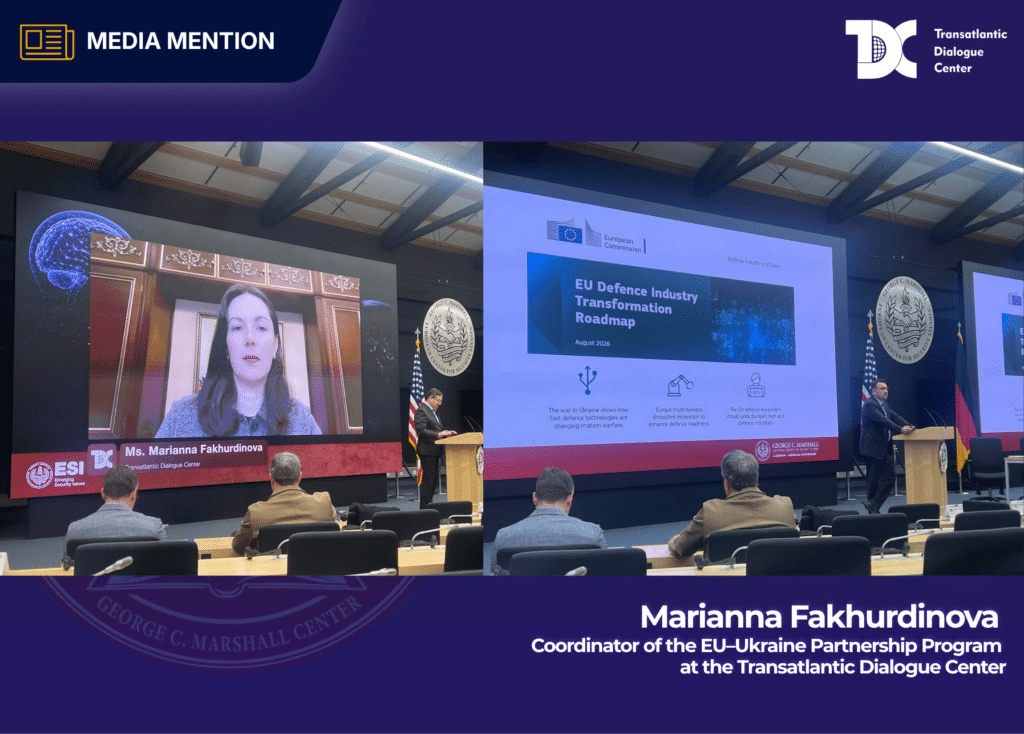
ماريانا فاخوردينوفا, Coordinator of the EU–Ukraine Partnership Program at the Transatlantic Dialogue Center, recently spoke at the George C. Marshall European Center for Security Studies as part of its “Emerging Security Issues” course, a seven-week resident program for junior- to mid-level security and defense professionals from Europe and the United States.
Fakhurdinova joined the panel “European Defense Initiatives” panel, where she discussed how EU-level security and defense instruments work for Ukraine, how they interact with bilateral engagement from individual European countries, and what Ukraine’s wartime experience reveals about the future of European defense.
A key takeaway from her remarks was that both EU-level and bilateral security assistance have delivered important results for Ukraine, but each format comes with trade-offs. EU initiatives, including the Ukraine Support Loan، و مرفق السلام الأوروبي, joint ammunition procurement, EDIP, EDF, SAFE, and EUMAM, provide financial and regulatory frameworks for long-term support. At the same time, consensus requirements, bureaucratic delays, and debates around “Buy European” approaches can slow down delivery.
Bilateral assistance, by contrast, often provides more flexible and tangible support, including direct weapons transfers, the Czech Ammunition Initiative، و النموذج الدنماركي, co-production, joint ventures, and localization with Ukrainian manufacturers. However, its effectiveness depends on the capacity, resources, and political will of individual member states.
Fakhurdinova also emphasized that, despite growing European support, Ukraine continues to face critical capability gaps. These include air and missile defense, aviation ammunition, air-to-air missiles, and maintenance for F-16 and Mirage 2000 aircraft. Shortages of Patriot and SAMP/T interceptors remain particularly pressing, as funding commitments do not automatically translate into immediate availability due to long production timelines and the reluctance of some states to release national stockpiles.
The discussion also addressed broader lessons for Europe’s defense industry. Ukraine’s wartime experience demonstrates that adaptability, rapid innovation, and production at scale are essential in high-intensity warfare. Europe’s credibility, Fakhurdinova noted, depends not only on current defense spending or existing arsenals but also on its ability to sustain production, replace losses, and support partners throughout a prolonged conflict.
She stressed that Europe’s fragmented defense-industrial landscape, with 27 national defense markets, incompatible systems, duplicated investments, and fragmented supply chains, undermines its overall readiness. Greater consolidation through joint procurement, co-production, and industrial partnerships is essential to reduce dependence on external suppliers and strengthen European deterrence.
Fakhurdinova also highlighted the risks of relying too heavily on partners. Shifts in U.S. strategic priorities, combined with Europe’s dependence on U.S. intelligence, software, advanced defense production, as well as on Chinese components and critical minerals, underline the need for stronger European industrial and technological autonomy.
At the same time, she argued that Ukraine should be treated not only as a recipient of assistance, but also as a contributor to Europe’s defense future. Integrating Ukrainian companies into European research, development, production, and maintenance chains, while preserving Ukraine’s own industrial capacity and innovation ecosystem, can strengthen both Ukraine’s defense and Europe’s long-term deterrence.