

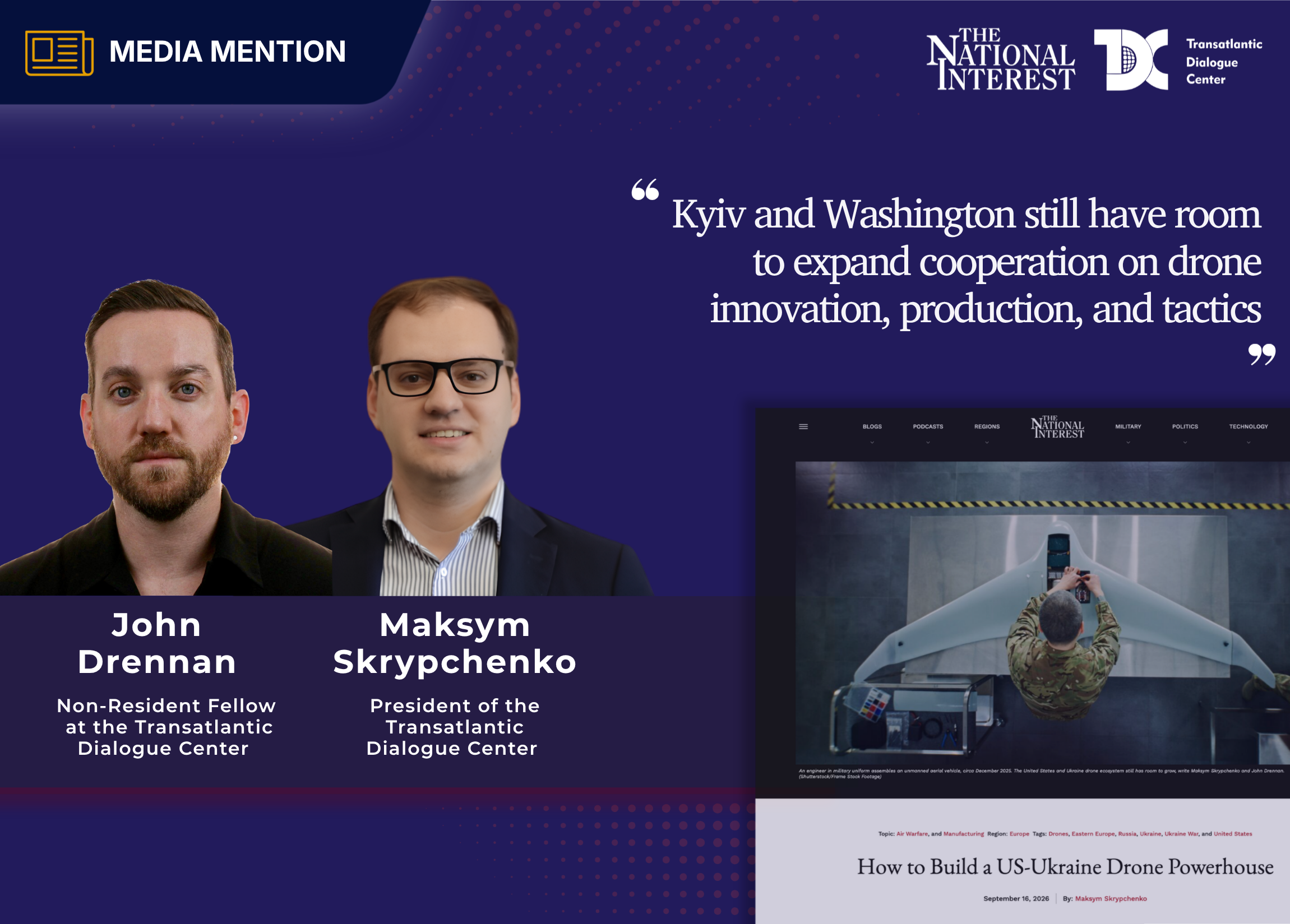
Maksym Skrypchenko, President of the Transatlantic Dialogue Center, and John Drennan, Visiting Fellow at Egmont–The Royal Institute for International Relations and Non-Resident Fellow at the Transatlantic Dialogue Center, published an article in The National Interest on how the United States and Ukraine can expand cooperation on drone innovation, production, and battlefield-tested technologies.
In the article, Drennan and Skrypchenko argue that buying drones is not enough: each system is only as effective as the experience, data, and ecosystem behind it. They call for a broader US–Ukraine defense-technology compact that would pair American industrial scale with Ukraine’s battlefield learning loop.
The authors emphasize that one of Ukraine’s key advantages is the speed of its innovation cycle. Frontline units identify battlefield needs, engineers adapt systems, manufacturers update production, and soldiers test the results under fire. This cycle allows Ukraine to develop and refine drone technologies at a pace that peacetime laboratories cannot replicate.
The article also notes that Ukraine is increasingly becoming a security provider, not only a recipient of assistance. Partners such as the United Kingdom, the European Union, and Japan are already seeking access to Ukrainian drone expertise through co-production, data-sharing, and joint technology initiatives.
At the same time, Skrypchenko and Drennan warn that Russia is learning quickly. Moscow has created a dedicated drone center, Rubicon, to copy Ukrainian innovations and integrate battlefield lessons into its own forces. For Washington, this means that access to Ukraine’s real-time battlefield validation is a strategic asset that cannot be recreated independently.
The authors propose the principle “Build in America, Validate in Ukraine” as the basis for future cooperation. This would connect US production lines with Ukrainian battlefield testing, data collection, software, and operational experience across domains. Such a compact would require a permanent joint coordination cell, multi-year procurement mechanisms, legal authorities, and faster procedures for licensing, contracting, technology transfer, and classification.
Finally, the article stresses that the compact should benefit both sides. Ukraine would gain access to US research, development capacity, and capital to scale production, while the United States would gain sustained access to the world’s fastest-moving defense innovation ecosystem. The central point is that Washington should not only buy drones from Ukraine, but learn from the system that makes them work.
पूरा लेख यहाँ पढ़ें: लिंक.
The event took place as part of a project supported by the International Renaissance Foundation.