

 13 min de lecture
On June 7, 2026, Armenia held parliamentary elections in which the country’s geopolitical vector was at stake: whether to remain under Moscow’s influence or to firmly consolidate a course toward rapprochement with the European Union. The party of incumbent Prime Minister Nikol Pashinyan, “Civil Contract,” won a convincing victory, receiving around 49.7–50% of the vote, while the pro-Russian alliance “Strong Armenia,” led by the family of oligarch Samvel Karapetyan, received approximately 23.3%.
For almost a year before the vote, Armenia became a testing ground where Russia, in real time, tried out nearly its entire arsenal of influence against a post-Soviet state attempting to break free from its control: a coordinated disinformation campaign, pressure through religious institutions, financing of the opposition through a Kremlin-affiliated oligarch, threats of force, and explicit territorial analogies with Ukraine. For Ukraine, Moldova, and Georgia — states exposed to Moscow’s declared zone of “historical interests” — Armenia’s experience in 2025–2026 is practically a ready-made manual: which levers the Kremlin uses when it loses control over an ally, and why even the failure of such an attempt does not mean the threat has disappeared.
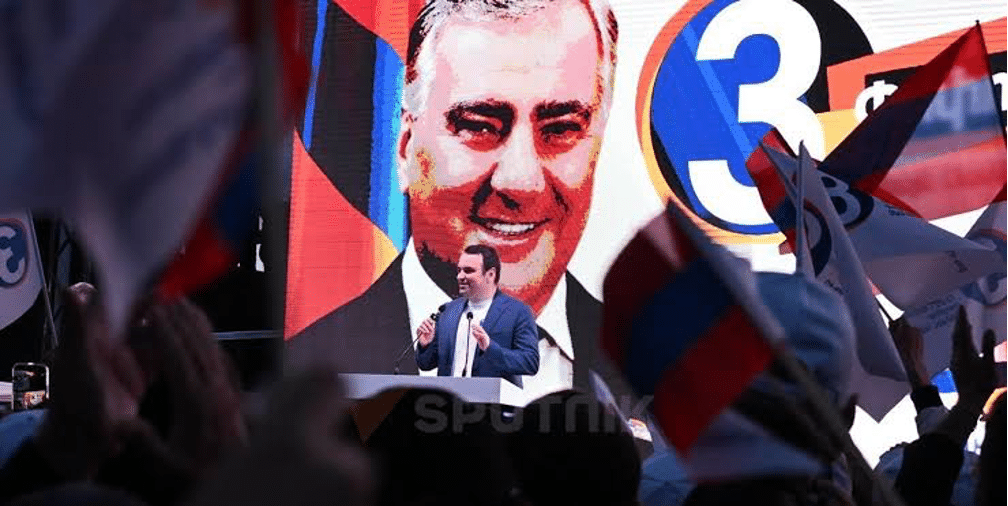
Samvel Karapetyan is a political figure with deep ties to Russia, whose political project was treated by pro-Kremlin networks as a key vehicle for challenging Pashinyan’s pro-Western course. The problem was not only political, but also legal: Karapetyan publicly admitted during a court hearing in Yerevan that, alongside Armenian citizenship, he also held Russian and Cypriot passports, and only after being nominated for prime minister did he begin renouncing them. This raised questions about his eligibility, since Armenia’s Constitution requires a prime ministerial candidate to have been solely an Armenian citizen and permanently resident in Armenia for the previous four years.
Karapetyan’s business empire, the Tashir Group, although named after his native Armenian town, was built and accumulated primarily in Russia. There, the company owns the Rio shopping mall chain and Fora-Bank, while Karapetyan himself went from being the director of an Armenian factory to one of the largest developers in both Russia and Armenia, with influence in the upper circles of both countries.
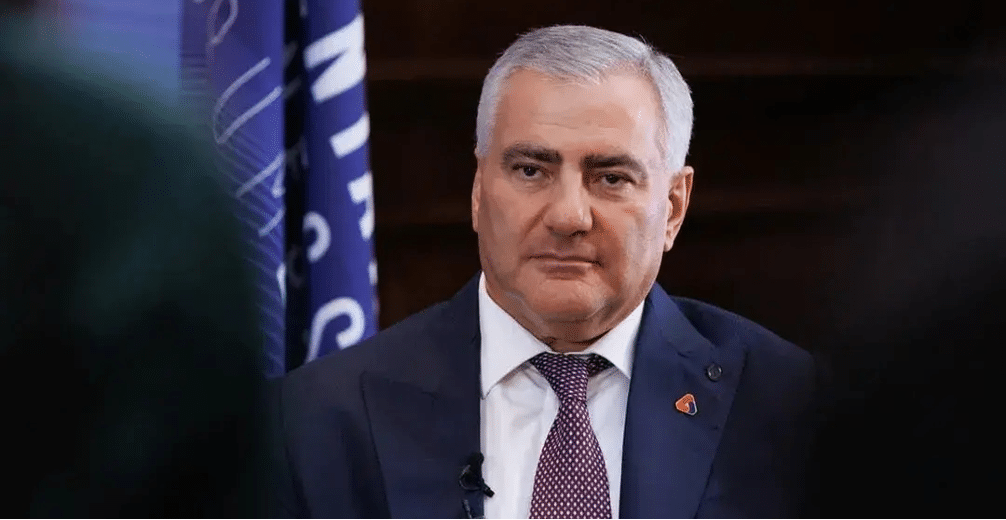
His institutional links are particularly telling. According to The Moscow Times, the billionaire is a member of Russian Senator Konstantin Zatulin’s Lazarevsky Club, which presents itself as an international public platform aimed at developing and strengthening Russian-Armenian relations. Its declared purpose is to discuss bilateral cooperation and reinforce cultural, humanitarian, and expert ties through meetings, roundtables, and expert discussions involving public figures, political analysts, diplomats, and journalists from both countries. In practice, however, platforms of this kind can serve as soft-power infrastructure for Moscow: they consolidate Russia-oriented elites and diaspora networks, provide a respectable “expert” façade for pro-Kremlin narratives, and help frame Armenia’s foreign policy choices in terms favorable to Russia. According to the same outlet, Zatulin and Senator Kosachev a entraîné the propaganda campaign against Pashinyan ahead of the 2026 election.
Furthermore, an investigation by the independent outlet The Insider a affirmé that the Strong Armenia bloc created by Karapetyan was regarded by the Kremlin as one of the main instruments for countering Pashinyan, who, after the war in Nagorno-Karabakh, had set a course toward rapprochement with the European Union and the United States. According to another article by the same outlet, after the failure of pro-Russian campaigns in Moldova and Hungary, the Kremlin concentrated significant attention and resources on the Armenian election, hoping to prevent the Civil Contract party from winning. Another telling fact: during Pashinyan’s visit to Moscow in spring 2026, according to the same source, he and Putin had a public dispute in which Putin insisted that pro-Russian forces should be allowed to take part in the election, without naming Karapetyan directly, but clearly referring to him.
Samvel’s nephew, Narek Karapetyan, headed Strong Armenia’s electoral list for the Yerevan Council of Elders, while Armenian investigators opened a case against him for concealing Russian citizenship during his candidate registration. He chairs the board of directors of Electric Networks of Armenia CJSC, 70% of which has been owned since 2017 by Tashir Capital, part of Samvel Karapetyan’s structures. In other words, the country’s key energy infrastructure is controlled by the same business clan that finances the pro-Russian political project.
Pro-Russian actors tried to make a political turn electorally acceptable through repackaging Russian interests into a language of national security, tradition, and revenge for past losses.
Karapetyan’s official campaign message was built around three pillars: a strong army, smart diplomacy, and economic independence. On the surface, these are conventional electoral themes for a country that has experienced war, territorial loss, and deep insecurity. Yet in the Armenian context of 2026, they carried a more specific political function: they challenged Pashinyan’s peace-oriented course and suggested that Armenia’s turn toward the West had produced weakness rather than security.
The slogan of “peace through strength” directly countered Pashinyan’s post-war narrative. Karapetyan argued that peace is not begged for, but preserved by force, because war comes where there is no strength, and a weak army provokes the enemy. This framing allowed the campaign to present the government not simply as unsuccessful, but as dangerous: a leadership whose pursuit of peace allegedly exposed Armenia to further humiliation by Azerbaijan and Turkey.
This message overlapped closely with Russia’s interest in discrediting Western-backed peace formats. If Armenia’s negotiations with Azerbaijan under Western or U.S. mediation could be portrayed as capitulation, then Moscow could reinsert itself as the indispensable security actor. In this logic, the problem was not Russia’s failure to protect Armenia in 2020–2023, but Pashinyan’s supposed abandonment of the Russian security framework.
Narek Karapetyan, the public face of the campaign, made this logic clearer when he a soutenu that a future peace agreement should be guaranteed by several regional powers rather than a single security guarantor. Formally, this sounded like a call for balance. Politically, however, it implied that Russia should remain inside the negotiation architecture alongside the United States or the EU, rather than being pushed out of the process. This directly matched Moscow’s interest in preventing the South Caucasus from becoming a space where Western actors can mediate security arrangements without Russia.
The campaign also used Syunik and the Meghri district as emotional and strategic trigger points. Concerns over transport routes, a prétendu resettlement of Azerbaijanis to the region, and Azerbaijan’s influence through Armenia’s southern corridor were framed not only as policy questions, but as existential threats to Armenian statehood.
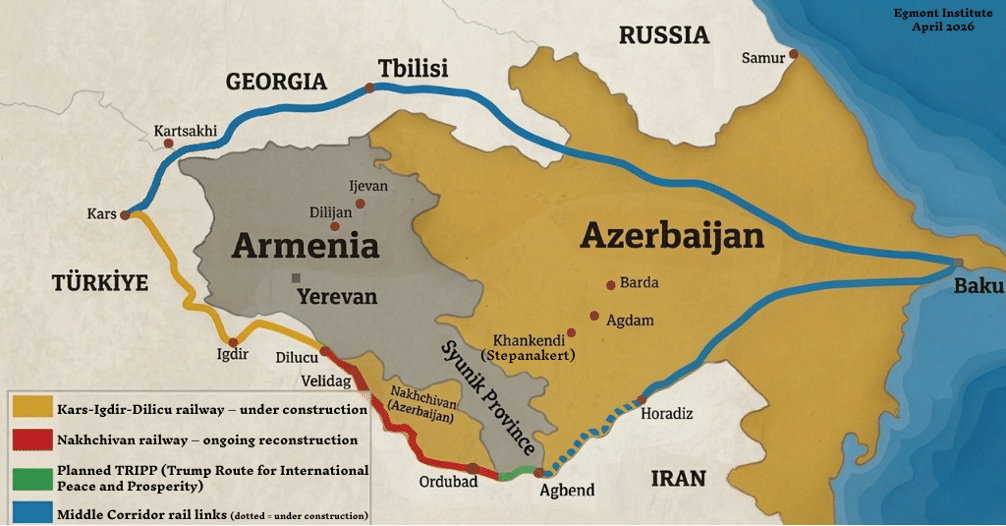
This mattered because Syunik is Armenia’s only land connection to Iran and the territory separating mainland Azerbaijan from the Nakhchivan region. Geographically, Syunik is the southernmost region of Armenia; it narrows to a tight strip in the vicinity of the town of Meghri and borders Iran along a stretch merely a few tens of kilometers long. This is the only section of Armenia’s border with Iran, and is therefore Armenia’s sole land access to a state that is neither a historical enemy nor a blocking party. At the same time, it physically separates the main part of Azerbaijan from its Nakhchivan Autonomous Republic exclave, which has been cut off from mainland Azerbaijan since the Soviet territorial demarcation of the 1920s. In other words, Syunik is a geographical stronghold that, for Armenia, is both its only window to the south towards Iran and the sole barrier preventing Azerbaijan and Turkey from maintaining uninterrupted land contact. For Russia, keeping this issue unstable is useful. It allows Moscow to present itself as a necessary arbiter while resisting transport arrangements that would reduce Russian control over regional connectivity.
Karabakh[1] was the deepest emotional resource for this strategy. Pro-Russian actors could no longer credibly promise to restore Artsakh through Russian protection, because Russia’s own passivity during Azerbaijan’s military operations had discredited that claim. Instead, the loss of Karabakh was repackaged as evidence of Pashinyan’s weakness and of the alleged danger of relying on the West. The message was not simply “Russia will return Artsakh,” but rather: “Armenia lost Artsakh because it moved away from Russia, trusted Western promises, and abandoned the logic of force.”
This narrative transformed Karabakh from a territorial and humanitarian issue into an electoral weapon. It allowed pro-Russian forces to accuse Pashinyan of national betrayal, mobilize resentment among displaced and traumatized communities, and present any compromise with Azerbaijan as another step toward national erasure. At the same time, it concealed the basic contradiction of Russia’s position: Moscow depends too heavily on Turkey and Azerbaijan to risk a serious confrontation on Armenia’s behalf.
The rhetoric of “Turkification” served a similar purpose. By amplifying claims that Armenia was being pushed toward concessions to Turkey and Azerbaijan, Karapetyan’s camp and allied voices turned geopolitical disagreement into a civilizational threat. The issue was no longer only where Armenia should seek security guarantees, but whether the country’s identity, memory, and historical continuity were being surrendered. This gave the campaign an emotional language that went far beyond ordinary opposition politics.
The Armenian Apostolic Church also became part of this wider ecosystem of influence. The conflict between Pashinyan’s government and parts of the Church hierarchy created an institutional channel through which questions of national identity, tradition, and loyalty could be politicized. For many Armenians, the Church remains a symbol of historical continuity, especially after the trauma of Karabakh. This made religious authority a powerful tool for framing the government as not only politically wrong, but spiritually or nationally illegitimate.
Moscow has long used conservative, religious, and “traditional values” narratives to weaken pro-Western governments across the post-Soviet space. In Armenia, this toolkit could be adapted to local conditions through the influence of the Church, the memory of genocide, fear of Turkey and Azerbaijan, and suspicion toward Western liberalism. The result was a political language in which loyalty to Russia could be presented not as foreign dependence, but as loyalty to Armenian tradition and survival.
Disinformation infrastructure reinforced these messages. Russian-linked networks and media ecosystems amplified narratives about the “Ukrainian scenario,” alleged betrayal by the West, threats to Syunik, the loss of Artsakh, and the supposed moral decline associated with European integration. Telegram channels, Russian-language media, diaspora networks, and influence operations such as Storm-1516 helped circulate these themes across different audiences. The goal was to make voters fearful, distrustful of the government, and skeptical of any Western-backed alternative to Russian influence.
In this sense, the Armenian election was not only a domestic contest between the government and the opposition. It was a test of how Russia could adapt its influence strategy as direct control weakened. Rather than relying solely on explicit pro-Moscow slogans, it works through local grievances, historical wounds, influence networks, and media ecosystems. The same template is relevant for Ukraine, Moldova, Georgia, Romania, and other states exposed to Russian pressure: Moscow rarely destabilizes societies by inventing divisions from nothing. It identifies unresolved conflicts, repackages them in its own geopolitical language, and uses domestic actors to turn them into instruments of political pressure.
The electoral geography shows that Russian influence in Armenia did not rely only on a traditionally conservative or provincial audience. On the contrary, Karapetyan’s campaign had visible resonance in the urban environment, especially in Yerevan. According to polling, Civil Contract was weakest precisely in Yerevan and strongest in rural areas, where before the election it exceeded 32% support.
Age distribution was the strongest predictor of voting: support for Civil Contract steadily increased with age, reaching more than one-third among respondents aged 60 and older in spring 2026, while it was significantly lower among younger voters. But this is where the trap for the opposition lay: younger respondents were also much more likely to remain undecided or to say they would not vote at all, meaning that the opposition’s relative popularity among young people did not translate into actual votes to the same extent as Civil Contract’s stable support among the older generation.
The education breakdown adds another layer: the ruling party performed best among voters with secondary or vocational education, while opposition parties overall attracted relatively more support among voters with higher education. At the same time, this educated group also had the highest rate of refusal to answer pollsters’ questions, suggesting political caution rather than consistent mobilization in favor of the opposition.
To reduce this to a profile: Karapetyan’s campaign worked best among urban, relatively young, and more educated voters in Yerevan who were disappointed with the authorities — the segment most visible at street protests and on social media, but also the least reliable in terms of actual turnout. It is worth noting that the share of Armenians naming security and border issues as the country’s main problem fell from 44% in June 2025 to 21% in February 2026. In other words, the very fear on which Karapetyan built the core of his “strong army” message was systematically losing its audience during the campaign, narrowing the natural base for mobilization around this theme.
The central contradiction in the pro-Russian narrative is that it asks Armenians to return to a security framework that has already failed them. The campaign around Karapetyan relied heavily on the language of strength, protection, and deterrence, but the recent history of the South Caucasus shows that Moscow no longer functions as a reliable guarantor of Armenian security.
The events of 2020–2023 demonstrated this more clearly than any theoretical debate. In September 2022, when Azerbaijan launched a direct attack on Armenia’s sovereign territory, neither Russia’s 102nd military base in Gyumri nor the Collective Security Treaty Organization (CSTO) forces intervened. The CSTO did not even issue a clear political condemnation of Azerbaijan’s actions. In September 2023, Russian peacekeepers in Karabakh similarly failed to prevent Baku’s military operation, effectively watching as Azerbaijan restored control over the region.
This failure was not simply the result of Pashinyan’s personal conflict with Moscow. Russia’s strategic calculus has changed. Azerbaijan and Turkey have become too important for Moscow as hubs for sanctions evasion, parallel imports, energy exports, and regional transport connectivity. Damaging relations with Baku or Ankara for the sake of defending Armenian interests would contradict Russia’s own wartime economic priorities.
There is also a military factor. Russia’s army and defense industry are absorbed by the war against Ukraine. Moscow lacks the spare capacity, modern equipment, and political appetite to sustain a serious confrontation in the South Caucasus. A pro-Russian government in Yerevan would therefore most likely receive not protection, but pressure to accept new concessions under the language of “stability,” “restraint,” and “preventing a larger war.”
The political function of the promise of Russian protection is clear: it transforms fear of another war into pressure against Armenia’s diversification of security partnerships and helps portray any move away from Moscow as a direct threat to national survival. It allows pro-Russian actors to argue that Armenia has no alternative but to return to Moscow’s orbit, while avoiding the central question: why did the Russian-led security system fail precisely when Armenia needed it most?
However, this does not mean Armenia can sever all ties with Russia overnight. Economically, it remains deeply dependent on Moscow: pipeline gas supplies, the Armenian Nuclear Power Plant, railway infrastructure, and access to the EAEU market all make an abrupt rupture dangerous. But economic pragmatism is not the same as strategic subordination. The lesson of recent years is that Russia can preserve Armenia’s dependence without guaranteeing its security — and then use that dependence to argue that no other path is possible.
For Ukraine, the Armenian case matters because it concerns the same principle at the heart of Russia’s war: whether post-Soviet states can choose their own geopolitical course without Moscow’s permission. If Armenia’s turn toward Europe is framed as reckless or illegitimate, the Kremlin strengthens the same logic it uses against Ukraine — that states in Russia’s former imperial space do not possess full strategic sovereignty.
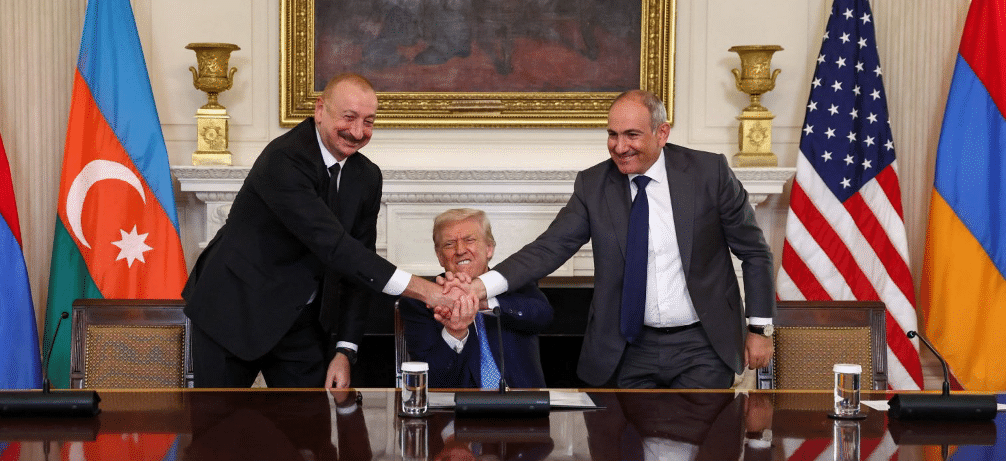
The case also has a practical dimension. Ukraine and Armenia had only recently begun rebuilding political dialogue, and Zelenskyy’s May meeting with Pashinyan est devenu the first visit by a Ukrainian president to Armenia in 24 years. At the same time, Western-backed connectivity projects such as the TRIPP corridor, a accepté under Trump’s mediation in August 2025, could help link the South Caucasus, the Black Sea, and Central Asia through routes less dependent on Russia.
This is why Syunik is not only an Armenian issue. As Armenia’s only land connection to Iran and the territory separating mainland Azerbaijan from Nakhchivan, it is central to any future regional transport architecture. If Moscow can influence how this corridor is governed, it preserves leverage over regional connectivity. If Armenia retains sovereign control while participating in Western-backed frameworks, the South Caucasus becomes less dependent on Russian mediation.
The Armenian case also echoes a broader regional pattern that analysts increasingly point to when discussing Georgia: even after war, occupation, and territorial loss, societies can still be politically pulled back into Russia’s sphere of influence. The fear of renewed conflict may produce not resistance, but exhaustion — a preference for caution, negotiations, and “pragmatism” toward Moscow. Yet Russia has repeatedly shown that it does not treat such pragmatism as a basis for compromise. It treats it as an opening for deeper leverage and eventual domination.
This is why Armenia and Georgia are warning cases for Ukraine and other states exposed to Russian pressure. Even after major losses, wars, and national trauma, the danger of political rollback does not disappear. Russian influence networks remain resilient: they survive through business ties, political intermediaries, media ecosystems, religious or conservative institutions, and the social fatigue that follows prolonged insecurity. Moscow does not need to erase the memory of conflict; it only needs to convince enough people that avoiding another confrontation requires accepting limits on sovereignty.
The lesson for Ukraine, Moldova, Georgia, Romania, and others is that Russian influence does not disappear when a pro-Russian party loses an election. It adapts and survives through unresolved territorial conflicts, fear of renewed violence, infrastructure disputes, economic dependence, religious authority, oligarchic networks, and information operations — the channels through which Moscow tries to make sovereignty look dangerous and dependence look like peace.
The 2026 election demonstrated the limits of Russian influence in Armenia, but not its disappearance. The Kremlin failed to bring a favorable political force to power, yet it retained many of the instruments that allow it to pressure Armenian politics from within: economic dependence, energy infrastructure, oligarchic networks, Church-related conservative narratives, the trauma of Karabakh, Russian-language media space, and the fear of renewed war.
This is what makes the Armenian case important beyond Armenia itself. For Ukraine, Georgia, Moldova, and other states trying to move beyond Russia’s sphere of influence, Armenia shows how the Kremlin adapts when direct control weakens. It does not rely on one instrument alone. It combines disinformation, security blackmail, identity politics, economic leverage, and local political actors capable of translating Moscow’s interests into domestic language.
Pashinyan’s victory, therefore, should not be read as the end of Russia’s struggle for Armenia. It is better understood as the failure of one campaign within a longer confrontation. Moscow lost the election, but it did not lose the networks, fears, and dependencies through which it can try again.
For Kyiv, the lesson is clear: the defense of sovereignty in the post-Soviet space is not fought only on battlefields or in diplomatic formats. It is also fought through information ecosystems, historical memory, religious institutions, infrastructure corridors, and the ability of societies to distinguish pragmatic relations with Russia from strategic dependence on it. Armenia has not resolved this struggle. It has only entered its next phase.
Les points de vue, pensées et opinions exprimés dans les études publiées sur ce site n’appartiennent qu’à leurs auteurs et ne reflètent pas nécessairement ceux du Transatlantic Dialogue Center, de ses comités ou de ses organisations affiliées. Ces études visent à stimuler le dialogue et la discussion et ne représentent pas les positions politiques officielles du Transatlantic Dialogue Center ni de toute autre organisation à laquelle les auteurs peuvent être associés.