

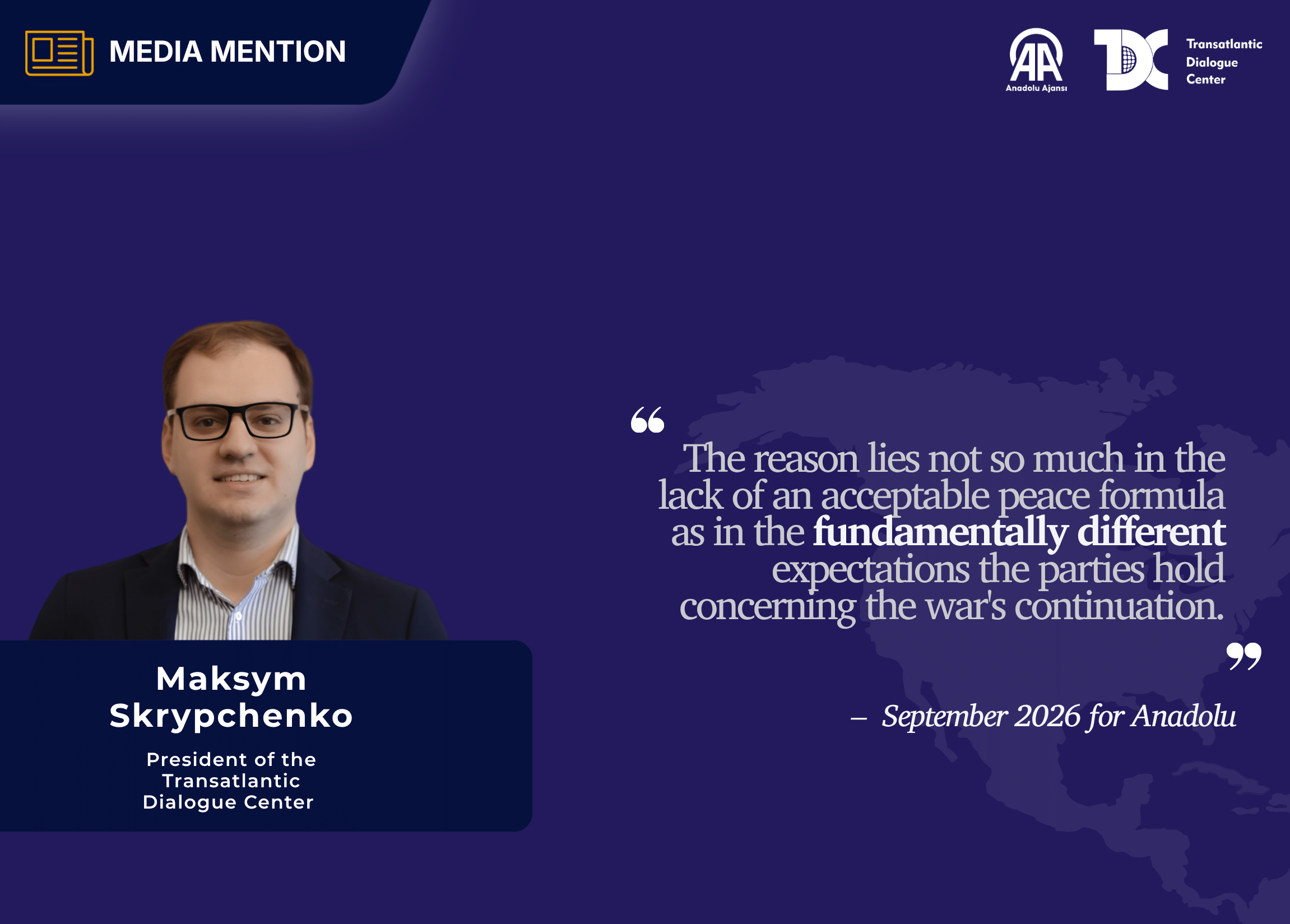
Maksym Skrypchenko, président du Transatlantic Dialogue Center, published an op-ed in Anadolu on why a broad peace agreement between Ukraine and Russia remains unlikely under current conditions, despite renewed diplomatic efforts by the United States.
In the article, Skrypchenko argues that the recent visits to Moscow and Kyiv by US envoys Steve Witkoff and Jared Kushner, preceded by a visit from CIA Director John Ratcliffe, have not produced a breakthrough. The problem, he explains, is not simply the absence of an acceptable peace formula, but the fundamentally different expectations of the parties: Ukraine is seeking ways to stop the destruction, while Russia believes that time and pressure may eventually weaken Kyiv’s ability to resist.
Skrypchenko notes that the war should not be understood only through the battlefield map, where neither side has achieved a decisive shift. Instead, the conflict is increasingly shaped by attempts to weaken the opponent’s economic foundation. Ukraine’s strikes on Russia’s oil industry are meant to raise the cost of the war for Moscow and create incentives for mutual limits on attacks, including possible arrangements to protect Black Sea shipping, grain infrastructure, energy facilities, or halt long-range strikes.
Cependant, Skrypchenko stresses that Moscow has so far been unwilling to discuss such limited arrangements. Instead, Russia links any meaningful move toward a truce to Ukraine’s withdrawal from the remaining parts of Donbas under Kyiv’s control — a demand Ukraine considers impossible.
The article also highlights Russia’s calculation that time is on its side. Moscow expects that Ukraine’s budgetary difficulties, uncertainty over future European funding, winter attacks on energy and gas infrastructure, and political changes in Europe could increase pressure on Kyiv. In this context, reliable air defense supplies and sustained financial support are not only necessary for Ukraine’s defense, but also help undermine the Kremlin’s belief that Ukrainian resistance will collapse.
Dans le même temps, Skrypchenko points out that a broad agreement remains unlikely in the near term. Russia may continue delaying negotiations, using the September parliamentary elections and other pretexts to extend the military campaign into spring. Economic incentives offered by Washington have not yet resolved the core contradiction: Moscow may be interested in benefits, but not enough to abandon its desire to continue the war.
In the absence of conditions for a comprehensive settlement, the upcoming meeting between President Volodymyr Zelenskyy and President Donald Trump during the UN General Assembly could provide an opportunity to test the prospects for a limited truce. One possible track is an agreement to stop strikes on grain infrastructure in the Black Sea, which would reduce risks to global food security and allow the UN to demonstrate practical relevance.
Skrypchenko concludes that Ukraine’s readiness for a mutual truce creates room for diplomacy. To use this opportunity, Washington and Europe must apply sanctions, incentives, or both to convince the Kremlin that another winter will not bring the victory it has failed to achieve on the battlefield.
Lisez l’article intégral via le lien.