

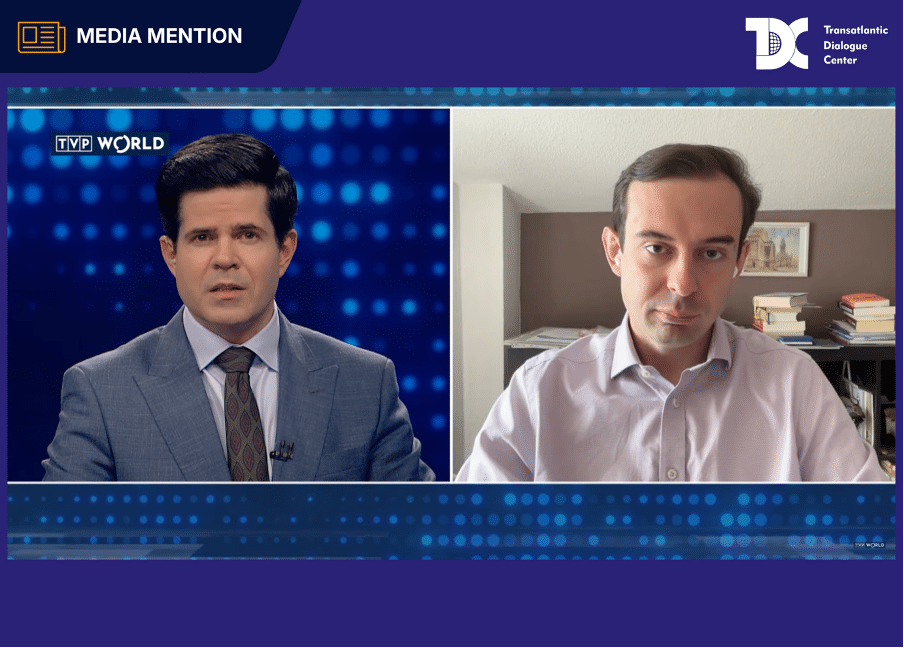
Stepan Rusyn, Coordinator of the Germany-Ukraine Partnership Program at the Transatlantic Dialogue Center (TDC), appeared on the October 3, 2026, edition of World Talks on TVP World to discuss Russia’s escalating attacks on Ukraine’s civilian and energy infrastructure, the risks of a humanitarian crisis ahead of winter, and the need for a more decisive European response.
During the interview, Rusyn explained how Russia’s strikes on Kyiv’s infrastructure are affecting civilian life and economic activity. Attacks on bridges and transportation networks disrupt movement between the two banks of the Dnipro River, complicating daily commutes and restricting access to workplaces. He noted that Moscow’s objective is to paralyse life in the Ukrainian capital and pressure the government into accepting Russian demands in potential peace negotiations.
Rusyn also addressed Russia’s increasing use of jet-powered drones, which present new challenges for Ukrainian air defences. While Moscow seeks to exploit this temporary technological advantage, Ukraine is developing new interception capabilities and expanding its domestic production of missiles and drones. According to Rusyn, these developments could strengthen Ukraine’s ability to respond to Russian attacks and increase the costs of continued aggression for Moscow.
A key part of the discussion focused on the threat to Ukraine’s energy infrastructure and nuclear safety. Rusyn warned that sustained strikes on power facilities could lead to widespread disruptions to electricity, heating, and essential public services. He also highlighted the risks posed by attacks on substations connected to nuclear power plants, citing ongoing security concerns surrounding the Russian-occupied Zaporizhzhia Nuclear Power Plant.
Turning to the international response, Rusyn argued that European governments should take a more active role in protecting Ukrainian civilians and critical infrastructure. He suggested that European air defense systems could help intercept Russian missiles and drones over parts of Ukraine, while acknowledging that political concerns about escalation continue to limit such measures. He expressed skepticism that even a severe humanitarian crisis would necessarily prompt European governments to move beyond humanitarian assistance and refugee support.
The interview also examined Russia’s hybrid warfare and disinformation campaigns in Europe. Rusyn called for more proactive measures to counter Russian influence operations and strengthen European resilience. At the same time, he emphasized the need to increase financial and military assistance to Ukraine, particularly by addressing shortages of air defense interceptors and providing funding that would allow Ukraine’s defense industry to operate closer to its full production capacity.
Rusyn stressed that a stronger European response to Russian aggression requires both greater political determination and sustained investment in Ukraine’s defense capabilities. Protecting Ukrainian infrastructure and strengthening the country’s ability to resist Russian attacks remain essential to Europe’s wider security.
Watch the full interview on TVP World: