

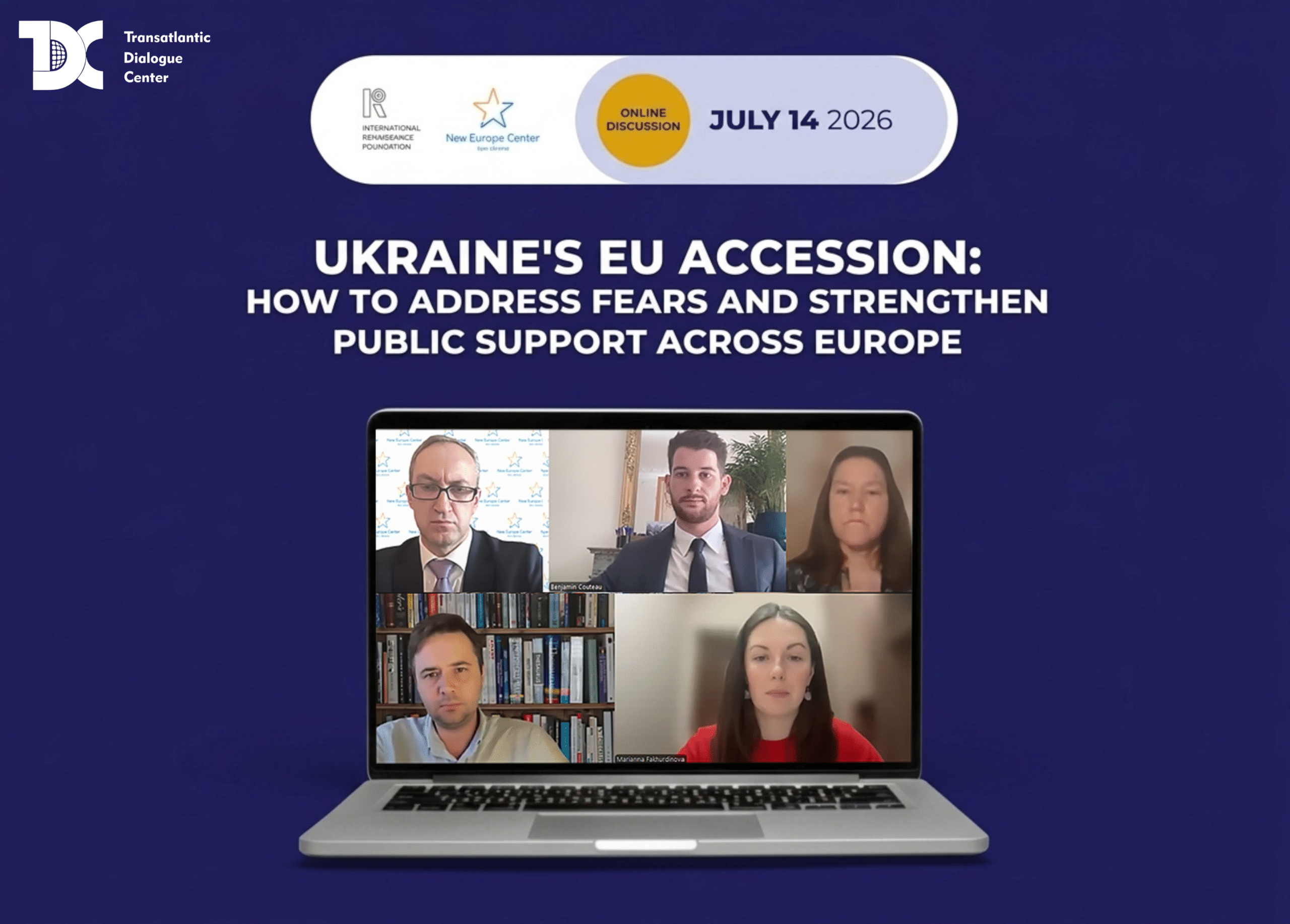
On July 14, the New Europe Center organized an online discussion, “Getting Ready for the ‘Ukrainian Plumber’ in the EU? Key Narratives of Resistance to EU Enlargement – and How to Counter Them.” The event brought together experts from Ukraine, France, and Germany to examine how Ukraine’s future EU membership is perceived across the European Union, what concerns shape public opinion, and how these narratives can be effectively addressed.
The discussion featured Leo Litra, Senior Fellow at the New Europe Center and Senior Policy Fellow at ECFR; Susan Stewart, Senior Fellow at the German Institute for International and Security Affairs (SWP); Benjamin Couteau, Research Fellow at the Jacques Delors Institute; et Marianna Fakhurdinova, Coordinator of the EU–Ukraine Partnership Program at the Transatlantic Dialogue Center. The event was moderated by Sergiy Solodkyy, Director of the New Europe Center.
Opening the discussion, Sergiy Solodkyy noted that public support for Ukraine’s EU membership remains uneven across member states. According to the latest Eurobarometer survey, 52% of citizens in EU countries support Ukraine’s accession, but in ten member states this figure remains below 50%. Germany and France also fall below that threshold, with support at 47% and 48% respectively.
Participants discussed the key concerns that influence attitudes toward enlargement, including economic competition, the rule of law, migration, security, agriculture, and Russian disinformation. They also emphasized that Ukraine’s accession should be framed not only as a Ukrainian objective, but as a strategic opportunity for the European Union itself.
Leo Litra argued that much of the resistance to enlargement stems from misconceptions about previous EU enlargements rather than from Ukraine specifically. He stressed that Ukraine brings a unique security argument to the accession process: Europe and the EU would be safer with Ukraine inside the Union.
Susan Stewart noted that concerns in Germany reflect broader debates about the future of enlargement. She emphasized the need to communicate more clearly that previous enlargements brought major benefits not only to candidate countries, but also to the EU as a whole.
Benjamin Couteau observed that while France’s political leadership has become more supportive of enlargement since 2022, this shift has not yet been fully reflected in public debate. He argued that communication in France should focus on Ukraine’s contribution to European sovereignty, including defence, technology, and food security.
Marianna Fakhurdinova suggested distinguishing between different types of concerns surrounding Ukraine’s accession, including what she described as “positive fears” related to Ukraine’s potential competitiveness in the EU market. She argued that Ukraine should communicate not only the benefits of accession, but also how it can help address the EU’s own structural challenges, including labour shortages, food security, critical raw materials, and defence capabilities.
Participants agreed that Ukraine’s successful accession will depend not only on reforms, but also on winning the public debate across EU member states. This requires countering misinformation, addressing legitimate concerns with facts, tailoring communication to national audiences, and demonstrating how Ukraine’s membership would strengthen the EU’s security, resilience, and long-term competitiveness.
Read the experts’ key messages and comments via the lien.
The event was organized by the New Europe Center with the support of the International Renaissance Foundation. The views and positions expressed during the event are those of the experts and do not necessarily reflect the position of the International Renaissance Foundation.