

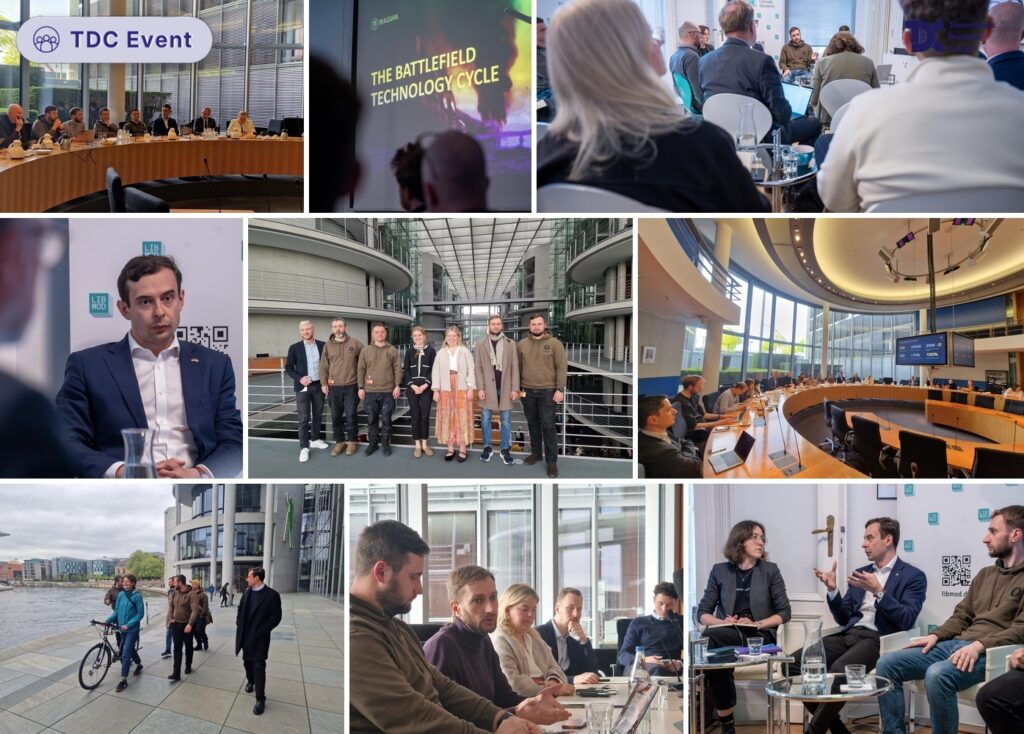
From 4 to 8 May 2026, the Transatlantic Dialogue Center (TDC) and Zentrum Liberale Moderne (LibMod) jointly organised a five-day working visit to Berlin for a delegation from the Ukrainian NGO Magura. The programme brought the delegation together with German government officials, Bundestag members and advisers, security experts, journalists, and representatives of the defence technology sector.
The visit focused on translating Ukraine’s frontline experience into practical cooperation with German partners, particularly in the areas of military digitalisation, unmanned systems, electronic warfare, training, and defence planning.
Magura was founded by members of Ukraine’s 47th Mechanised Brigade who combine combat experience with professional backgrounds in law, IT, and management. The organisation provides specialised military training, contributes to educational products for the Army+ platform, works on electronic warfare solutions, and is developing an analytical centre to preserve and institutionalise lessons from the war.
During the visit, the delegation met with representatives of the German Institute for International and Security Affairs (SWP), the Federal Ministry for Economic Affairs and Energy, the Bundeswehr Cyber Innovation Hub, as well as German defence and technology companies.
Discussions focused on drones, unmanned ground vehicles, sensors, situational awareness, and electronic warfare. One recurring lesson from Ukraine’s experience was the speed at which battlefield technologies become outdated. A system that works effectively today may lose its advantage within several months as the adversary adapts.
Keeping pace with this cycle requires more than faster procurement. It depends on continuous testing, direct feedback from military users, close cooperation with developers, and regulatory frameworks that allow technologies to evolve quickly.
A central event of the visit was the expert discussion “Ukraine Shaping the Future of Warfare: Lessons for European Security Policy” at the LibMod Salon. The discussion brought together representatives of Magura and Stepan Rusyn, Coordinator of the German-Ukrainian Partnership Program at TDC, and was moderated by Daria Malling of LibMod. Around 30 representatives of Germany’s policy, security, and defence communities attended.
The discussion highlighted two aspects of Ukraine’s experience particularly relevant for European defence: the ability to develop and rapidly scale interconnected digital tools based on soldiers’ needs, and the accelerating technological competition in unmanned systems and electronic warfare.
Participants stressed that technological advantage increasingly depends not simply on possessing a particular system, but on the ability to integrate, adapt, and replace technologies faster than the adversary. Individual solutions cannot operate in isolation: unmanned platforms require resilient communications, electronic warfare must be connected with intelligence capabilities, and technological innovation needs to be supported by doctrine and training.
The programme also included a closed exchange with advisers to members of the Bundestag and a parliamentary breakfast. These meetings opened discussions on how Ukrainian battlefield feedback could contribute more systematically to German defence decision-making, including assessments of how German equipment and training perform under combat conditions.
Such cooperation can benefit both sides: Ukrainian units can receive solutions better adapted to operational realities, while German institutions and manufacturers gain direct insights from one of the world’s most technologically dynamic battlefields.
Ukraine remains dependent on international support, but its wartime experience has also made it an important source of expertise for the future of European defense. Bringing Ukrainian practitioners into direct dialogue with German policymakers, military institutions, experts, and industry can help transform this experience into long-term cooperation.
TDC and LibMod thank the Magura delegation and all German partners who contributed to the programme.